Kazi Sadaf, Littlejohn Robin, Smith Kelly M, Busog Deanna-Nicole, Blumenthal Joseph, Mathur Shrey, McGill Zach, DeBold Doug, Hettinger Aaron Zachary, Miller Kristen E
National Center for Human Factors in Healthcare, MedStar Health Research Institute, Columbia, MD, United States.
School of Medicine, Georgetown University, Washington, DC, United States.
Front Health Serv. 2025 Apr 23;5:1474699. doi: 10.3389/frhs.2025.1474699. eCollection 2025.
Tapering prescription opioid pain medication through evidence-based guidelines can help in combating the opioid epidemic. Integrating clinical decision support (CDS) into the clinical workflow of tapering can help in translating guidelines to formulate and implement a tapering plan that manages pain symptoms while minimizing withdrawal, and optimally engages with the patient. The purpose of our project was to develop patient- and clinician-facing CDS in the area of chronic pain management in one integrated application (app) called Tapering And Patient Reporting outcomes for Chronic Pain Management (TAPR-CPM) App.
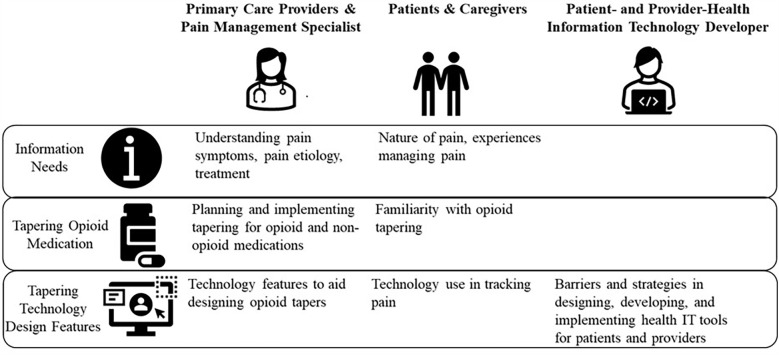
We leveraged human factors methodologies and a user-centered design (UCD) approach through guideline review, stakeholder interviews, ethnographic workflow analysis, process mapping, design workshops, and usability testing. Participants included patients with chronic noncancer pain, their family members, pain management physicians, primary care physicians, and health IT developers who focus on patient- and provider-facing technologies.
Based on interview findings and workflow analysis, the provider-facing app had five sections: Patient Context, Taper Settings, Create Taper Plan, Withdrawal and Non-opioid Pain Plan, and Summary Dashboard. The patient-facing app had three sections: Maintaining a Pain Journal, Sharing Pain Scores with Provider, and Connecting to Resources about Opioid Tapering.
This project leveraged a multi-method approach based in human factors and UCD to develop the TAPR-CPM app. Engaging with a diverse set of stakeholders including patients, caregivers, primary care providers, pain specialists, and health information technology developers was critical to develop a user-friendly experience with accessible technology to support patient engagement and provider decision-making.
通过基于证据的指南逐渐减少处方阿片类止痛药的使用,有助于应对阿片类药物流行问题。将临床决策支持(CDS)整合到逐渐减量的临床工作流程中,有助于将指南转化为制定和实施逐渐减量计划,该计划既能管理疼痛症状,又能将戒断反应降至最低,并能最佳地与患者互动。我们项目的目的是在一个名为“慢性疼痛管理逐渐减量与患者报告结果”(TAPR-CPM)应用程序的综合应用中,开发面向患者和临床医生的慢性疼痛管理领域的CDS。
我们通过指南审查、利益相关者访谈、人种学工作流程分析、流程映射、设计研讨会和可用性测试,利用人因方法和以用户为中心的设计(UCD)方法。参与者包括慢性非癌性疼痛患者、他们的家庭成员、疼痛管理医生、初级保健医生以及专注于面向患者和提供者技术的健康信息技术开发人员。
根据访谈结果和工作流程分析,面向提供者的应用程序有五个部分:患者背景、逐渐减量设置、创建逐渐减量计划、戒断和非阿片类疼痛计划以及汇总仪表板。面向患者的应用程序有三个部分:记录疼痛日记、与提供者分享疼痛评分以及连接阿片类药物逐渐减量相关资源。
该项目利用基于人因和UCD的多方法方法开发了TAPR-CPM应用程序。与包括患者、护理人员、初级保健提供者、疼痛专家和健康信息技术开发人员在内的各种利益相关者合作,对于开发一种用户友好的体验以及使用易于获取的技术来支持患者参与和提供者决策至关重要。