Zou Yongling, Zhang Yang
Department of Traditional Chinese Medicine, Dalian Economic and Technological Development Zone Hospital, Dalian, China.
Department of Traditional Chinese Medicine, The Second Hospital of Dalian Medical University, Dalian, China.
Discov Oncol. 2025 May 8;16(1):703. doi: 10.1007/s12672-025-02501-7.
Primary liver cancer is one of the most common malignant tumors with a rising incidence in recent years. In China, it ranks as the fourth most prevalent malignancy. Although surgery is the primary treatment, many advanced-stage patients are ineligible due to late diagnosis, rapid progression, or other contraindications. Targeted therapy, chemotherapy, and transarterial chemoembolization (TACE) are common non-surgical approaches, but these often result in significant side effects such as gastrointestinal reactions, bone marrow suppression, and high recurrence rates. In this context, integrative treatment with traditional Chinese medicine (TCM) has shown promise. Cinobufacin, a TCM drug developed in China, has demonstrated superior efficacy and safety when combined with Western treatments in patients with advanced hepatocellular carcinoma (HCC).
We conducted a systematic review and meta-analysis by searching PubMed, Embase, Cochrane Library, CNKI, WanFang Data, VIP, and the Chinese Biomedical Literature Database (CBM) for randomized controlled trials (RCTs) comparing cinobufacin combined with conventional Western treatments to Western treatments alone in advanced HCC patients. The search covered all databases up to December 30, 2024. Statistical analyses were performed using Stata 15.0, and Review Manager.
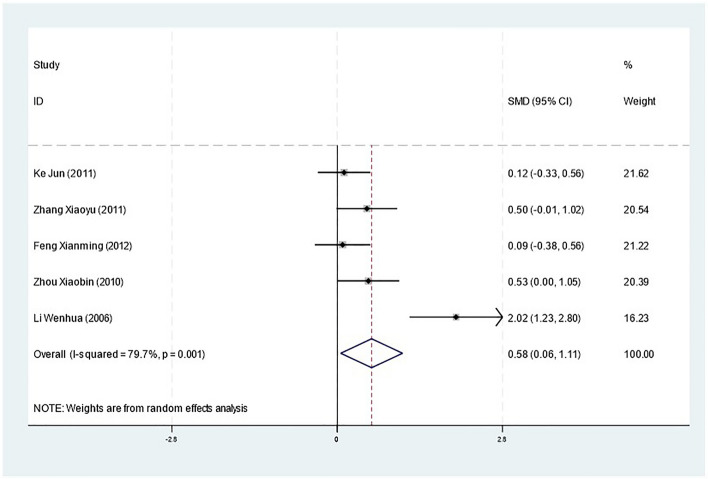
A total of 30 studies were included in the meta-analysis. Cinobufacin combination therapy significantly improved the disease control rate (DCR, OR = 2.49, 95% CI 2.01 to 3.07), reduced alpha-fetoprotein (AFP) levels (SMD = - 1.86, 95% CI - 2.58 to - 1.13), alanine aminotransferase (ALT) levels (SMD = - 1.66, 95% CI - 2.48 to - 0.83), and total bilirubin (TBIL) levels (SMD = - 1.82, 95% CI - 2.36 to - 1.28). It also increased white blood cell (WBC) counts (SMD = 0.58, 95% CI 0.06 to 1.11) and improved Karnofsky Performance Status (KPS) scores (SMD = 1.24, 95% CI 0.93 to 1.56). Funnel plots and sensitivity analyses confirmed the robustness of the results.
Cinobufacin combined with Western treatments significantly improves clinical efficacy, reduces adverse drug reactions, and enhances the quality of life for patients with advanced HCC.
原发性肝癌是最常见的恶性肿瘤之一,近年来发病率呈上升趋势。在中国,它是第四大常见恶性肿瘤。尽管手术是主要治疗方法,但许多晚期患者因诊断较晚、进展迅速或其他禁忌症而不符合手术条件。靶向治疗、化疗和经动脉化疗栓塞术(TACE)是常见的非手术治疗方法,但这些方法常常导致明显的副作用,如胃肠道反应、骨髓抑制和高复发率。在此背景下,中西医结合治疗已显示出前景。华蟾素是中国研发的一种中药,在晚期肝细胞癌(HCC)患者中,与西医治疗联合使用时已显示出卓越的疗效和安全性。
我们通过检索PubMed、Embase、Cochrane图书馆、中国知网、万方数据、维普资讯和中国生物医学文献数据库(CBM)以查找比较华蟾素联合传统西医治疗与单纯西医治疗晚期HCC患者的随机对照试验(RCT),从而进行系统评价和荟萃分析。检索涵盖截至2024年12月30日的所有数据库。使用Stata 15.0和Review Manager进行统计分析。
荟萃分析共纳入30项研究。华蟾素联合治疗显著提高了疾病控制率(DCR,OR = 2.49,95%CI 2.01至3.07),降低了甲胎蛋白(AFP)水平(SMD = -1.86,95%CI -2.58至-1.13)、丙氨酸转氨酶(ALT)水平(SMD = -1.66,95%CI -2.48至-0.83)和总胆红素(TBIL)水平(SMD = -1.82,95%CI -2.36至-1.28)。它还增加了白细胞(WBC)计数(SMD = 0.58,95%CI 0.06至1.11)并改善了卡氏功能状态(KPS)评分(SMD = 1.24,95%CI 0.93至1.56)。漏斗图和敏感性分析证实了结果的稳健性。
华蟾素联合西医治疗可显著提高临床疗效,减少药物不良反应,并提高晚期HCC患者的生活质量。