Garcia Eduardo, Claudi Lene, La Chica Lhoëst Maria Teresa, Polishchuk Anna, Samouillan Valerie, Benitez Amaro Aleyda, Pinero Janet, Escolà-Gil Joan Carles, Sabidó Eduard, Leta Ruben, Vilades David, Llorente Cortes Vicenta
Institute of Biomedical Research of Barcelona (IIBB), Spanish National Research Council (CSIC), Barcelona, Spain.
Institut de Recerca Sant Pau (IR SANT PAU), Sant Quintí 77-79, 08041, Barcelona, Spain.
J Transl Med. 2025 May 9;23(1):523. doi: 10.1186/s12967-025-06513-3.
Vascular smooth muscle cells loaded with cholesterol (foam-VSMCs) play a crucial role in the progression of human atherosclerosis. Exchange Protein Directly Activated by cAMP 1 (EPAC1) is a critical protein in the regulation of vascular tone, endothelial function, and inflammation. Our objectives were to identify proteins specifically secreted by foam human coronary VSMCs (foam-hcVSMC) to evaluate their potential as circulating biomarkers for diagnosing coronary artery disease (CAD), and to ascertain the mechanisms underlying their levels in the blood of patients with CAD.
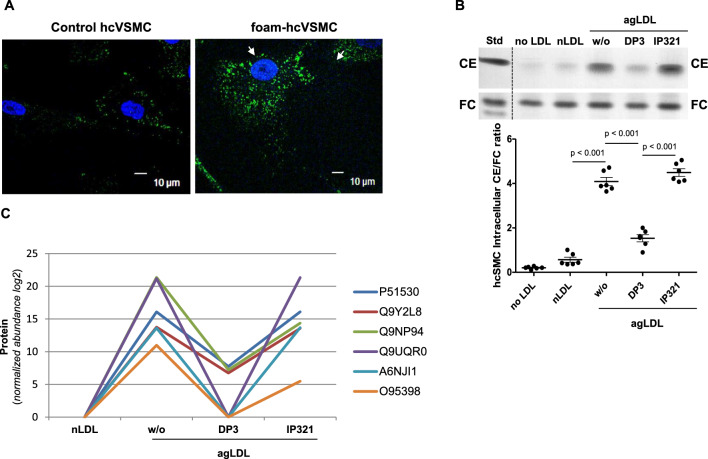
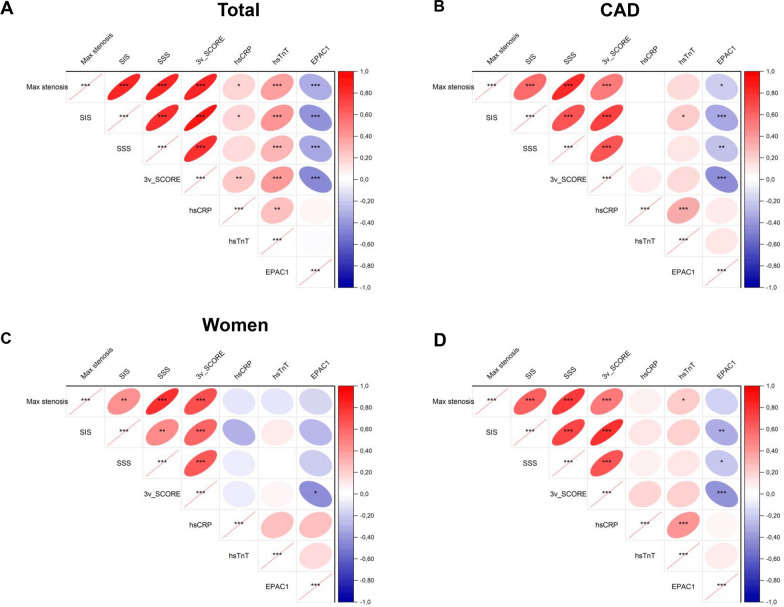
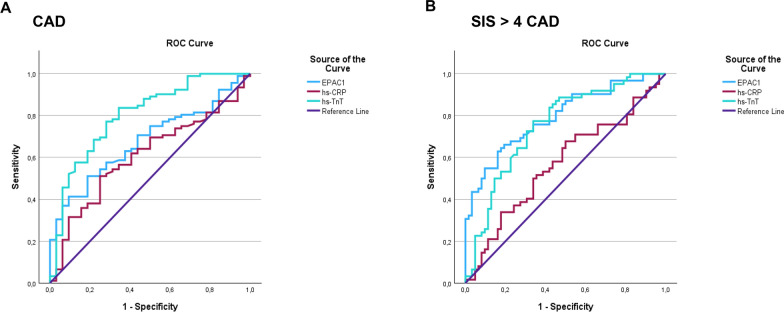
Differential proteomics identified EPAC1 as a differential foam-hcVSMC-secreted protein. Circulating EPAC1 levels were measured by ELISA in blood from 202 patients with suspected CAD who underwent coronary computed tomography angiography (CCTA). Blood EPAC1 levels were significantly lower in CAD patients compared to controls (p < 0.001). EPAC1 levels were reduced in both men and women with severe CAD (SIS > 4) compared to those with moderate CAD (SIS 1-4). ROC analysis identified 9.16 ng/ml as the optimal EPAC1 cut-off for severe CAD. At this threshold, EPAC1 predicted severe CAD (SIS > 4) with 69.6% sensitivity and 79.4% specificity, outperforming hs-CRP and hs-TnT in predicting CAD severity. Real-time PCR and Western blot analysis revealed that human foam-SMCs under hypoxic conditions exhibited a significant reduction in EPAC1 mRNA (p = 0.013) and protein (p < 0.001) levels.
These findings suggest that circulating EPAC1 protein levels lower than 9.16 ng/mL are predictive of severe CAD in humans. Hypoxic foam-SMCs, characteristic of advanced atherosclerotic lesions, exhibit diminished production of EPAC1, potentially contributing to the decreased circulating EPAC1 levels in patients with severe CAD.
负载胆固醇的血管平滑肌细胞(泡沫血管平滑肌细胞)在人类动脉粥样硬化进展中起关键作用。环磷酸腺苷直接激活的交换蛋白1(EPAC1)是调节血管张力、内皮功能和炎症的关键蛋白。我们的目标是鉴定泡沫人冠状动脉血管平滑肌细胞(泡沫-hcVSMC)特异性分泌的蛋白质,以评估其作为诊断冠状动脉疾病(CAD)循环生物标志物的潜力,并确定CAD患者血液中其水平背后的机制。
差异蛋白质组学鉴定出EPAC1是一种差异泡沫-hcVSMC分泌蛋白。通过酶联免疫吸附测定(ELISA)测量了202例接受冠状动脉计算机断层扫描血管造影(CCTA)的疑似CAD患者血液中的循环EPAC1水平。与对照组相比,CAD患者的血液EPAC1水平显著降低(p < 0.001)。与中度CAD(狭窄指数1-4)患者相比,重度CAD(狭窄指数>4)的男性和女性的EPAC1水平均降低。ROC分析确定9.16 ng/ml为重度CAD的最佳EPAC1临界值。在此阈值下,EPAC1预测重度CAD(狭窄指数>4)的敏感性为69.6%,特异性为79.4%,在预测CAD严重程度方面优于超敏C反应蛋白(hs-CRP)和超敏肌钙蛋白T(hs-TnT)。实时聚合酶链反应(PCR)和蛋白质印迹分析显示,缺氧条件下的人泡沫平滑肌细胞中EPAC1信使核糖核酸(mRNA)水平(p = 0.013)和蛋白质水平(p < 0.001)显著降低。
这些发现表明,循环EPAC1蛋白水平低于9.16 ng/mL可预测人类重度CAD。晚期动脉粥样硬化病变特征性的缺氧泡沫平滑肌细胞表现出EPAC1产生减少,这可能导致重度CAD患者循环EPAC1水平降低。