Vanoli Alessandro, Piva Nestor, Inzani Frediano Socrate, Grillo Federica, Klersy Catherine, Uccella Silvia, Spaggiari Paola, Albarello Luca, Schiavo Lena Marco, Milione Massimo, Antoniacomi Caterina, Milanetto Anna Caterina, Zerbi Alessandro, Di Sabatino Antonio, Falconi Massimo, Anderloni Andrea, Mattiolo Paola, Luchini Claudio, Scarpa Aldo, Fassan Matteo, Parente Paola, Luinetti Ombretta, Rindi Guido, Paulli Marco, La Rosa Stefano
Anatomic Pathology Unit, Department of Molecular Medicine, University of Pavia, Via Carlo Forlanini 16, 27100, Pavia, Italy.
Anatomic Pathology, Fondazione IRCCS San Matteo Hospital, Pavia, Italy.
Endocr Pathol. 2025 May 10;36(1):18. doi: 10.1007/s12022-025-09861-4.
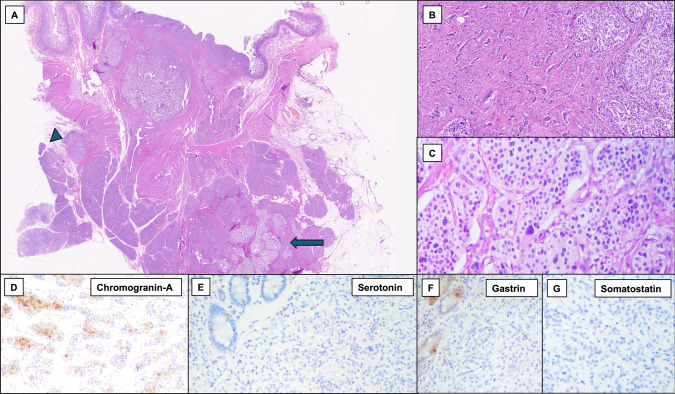
Duodenal neuroendocrine tumors (Duo-NETs) may arise in the ampullary and non-ampullary duodenum. Non-functioning Duo-NETs (NF-Duo-NETs), which account for most cases, may express various hormones. Previous studies have suggested that hormone production might be associated with biological aggressiveness. Current treatment protocols are based on functionality, tumor size, and location, but small NF-Duo-NETs may also have metastatic potential. We aimed to investigate whether tumor cell subtyping, based on hormone expression, could provide further insights into NF-Duo-NET biological behavior. We analyzed the clinico-pathological correlates of hormone expression in a multicenter series of 151 NF-Duo-NETs, subdividing tumors into five subtypes: gastrin-producing G-cell NETs (Gas-NETs), somatostatin-producing D-cell NETs (Som-NETs), serotonin-producing enterochromaffin-cell NETs (Ser-NETs), plurihormonal NETs, and gastrin-, somatostatin-, and serotonin-negative NETs (GSSN-NETs). Som-NETs were the most frequent (31%), followed by plurihormonal NETs (26%), Gas-NETs (24%), GSSN-NETs (13%), and Ser-NETs (4%). Som-NETs and GSSN-NETs were more commonly located in the ampullary region and showed significantly larger size, more frequent lymphatic and/or vascular invasion, and higher pT, pN, and American Joint Committee on Cancer (AJCC-9th edition) stages compared to Gas-NETs, which were often (77%) diagnosed at AJCC stage I. Ampullary Som-NETs showed a more invasive and metastatic potential compared to non-ampullary Som-NETs, while, among plurihormonal NETs, the predominantly expressed hormone influenced tumor biological features, with gastrin-predominant NETs showing less invasive potential. At logistic regression, both tumor cell subtype and tumor size were independently associated with aggressiveness (pT3, pN1, or pM1 stage at diagnosis). Hormonal expression profiling may be clinically relevant in NF-Duo-NETs, independently of tumor size.
十二指肠神经内分泌肿瘤(Duo-NETs)可发生于壶腹和非壶腹十二指肠。无功能性Duo-NETs(NF-Duo-NETs)占大多数病例,可能表达多种激素。既往研究提示激素产生可能与生物学侵袭性有关。目前的治疗方案基于功能、肿瘤大小和位置,但小的NF-Duo-NETs也可能具有转移潜能。我们旨在研究基于激素表达的肿瘤细胞亚型分类是否能为NF-Duo-NETs的生物学行为提供进一步的见解。我们分析了151例NF-Duo-NETs多中心系列中激素表达的临床病理相关性,将肿瘤分为五种亚型:产生胃泌素的G细胞NETs(Gas-NETs)、产生生长抑素的D细胞NETs(Som-NETs)、产生血清素的肠嗜铬细胞NETs(Ser-NETs)、多激素NETs以及胃泌素、生长抑素和血清素阴性的NETs(GSSN-NETs)。Som-NETs最为常见(31%),其次是多激素NETs(26%)、Gas-NETs(24%)、GSSN-NETs(13%)和Ser-NETs(4%)。与Gas-NETs相比,Som-NETs和GSSN-NETs更常位于壶腹区域,且显示出明显更大的尺寸、更频繁的淋巴和/或血管侵犯以及更高的pT、pN和美国癌症联合委员会(AJCC第9版)分期,Gas-NETs常(77%)在AJCC I期被诊断。壶腹Som-NETs比非壶腹Som-NETs表现出更强的侵袭和转移潜能,而在多激素NETs中,主要表达的激素影响肿瘤生物学特征,以胃泌素为主的NETs显示出较低的侵袭潜能。在逻辑回归分析中,肿瘤细胞亚型和肿瘤大小均与侵袭性独立相关(诊断时为pT3、pN1或pM1期)。激素表达谱分析在NF-Duo-NETs中可能具有临床相关性,与肿瘤大小无关。