
帕金森病前驱期至晚期的胃肠功能障碍概况
The profile of gastrointestinal dysfunction in prodromal to late-stage Parkinson's disease.
作者信息
Camacho Marta, Greenland Julia C, Daruwalla Cyrus, Scott Kirsten M, Patel Bina, Apostolopoulos Dimitrius, Ribeiro Joana, O'Reilly Molly, Hu Michele T, Williams-Gray Caroline H
机构信息
Department of Clinical Neurosciences, University of Cambridge, Cambridge, UK.
Cambridge University Hospitals NHS Foundation Trust, Cambridge, UK.
出版信息
NPJ Parkinsons Dis. 2025 May 11;11(1):123. doi: 10.1038/s41531-025-00900-9.
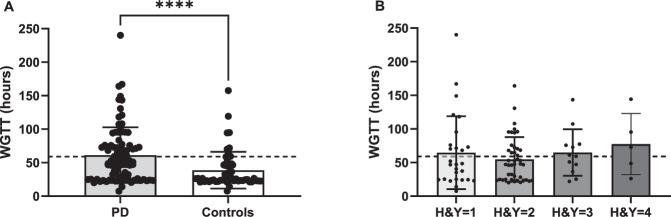
Gastrointestinal dysfunction (GID) may play a key role in Parkinson's disease (PD) but its relationship with disease progression remains unclear. We recruited 404 PD cases, 37 iRBD (isolated REM Sleep Behaviour Disorder) and 105 controls. Participants completed the Gastrointestinal Dysfunction Scale for PD (GIDS-PD) and standardised disease severity assessments. Whole gut transit time (WGTT) was measured by ingestion of blue dye and recorded time to blue stools appearance ('Blue Poop Challenge') in a subset of PD cases. Gastrointestinal symptoms were more common and prevalent in iRBD and PD versus controls, and WGTT was significantly higher in PD versus controls. After adjustment for confounding factors, disease stage was not a significant predictor of GIDS-PD Constipation or Bowel Irritability scores. Longitudinal assessment of GIDS-PD scores and WGTT confirmed stability over a 4 year period. Bowel dysfunction may be a phenotypic feature in a subset of Parkinson's with implications for patient stratification and management.
胃肠功能障碍(GID)可能在帕金森病(PD)中起关键作用,但其与疾病进展的关系仍不明确。我们招募了404例PD患者、37例快速眼动睡眠行为障碍(iRBD)患者和105名对照者。参与者完成了帕金森病胃肠功能障碍量表(GIDS-PD)和标准化疾病严重程度评估。在一部分PD患者中,通过摄入蓝色染料并记录出现蓝色粪便的时间(“蓝色大便挑战”)来测量全胃肠通过时间(WGTT)。与对照组相比,iRBD和PD患者的胃肠道症状更常见且普遍,PD患者的WGTT显著高于对照组。在调整混杂因素后,疾病阶段不是GIDS-PD便秘或肠道易激惹评分的显著预测因素。对GIDS-PD评分和WGTT的纵向评估证实了其在4年期间的稳定性。肠道功能障碍可能是一部分帕金森病患者的表型特征,对患者分层和管理具有重要意义。


 Zotero 插件