Mao Bochun, Tian Yajing, Zhou Hanzhang, Gu Yan
Department of Orthodontics, Peking University School and Hospital of Stomatology, National Center for Stomatology, National Clinical Research Center for Oral Diseases, National Engineering Research Center of Oral Biomaterials and Digital Medical Devices, Beijing Key Laboratory of Digital Stomatology, Research Center of Engineering and Technology for Computerized Dentistry Ministry of Health, Beijing, 10081, China.
Center of Stomatology, China-Japan Friendship Hospital, Beijing, 100029, China.
BMC Oral Health. 2025 May 10;25(1):707. doi: 10.1186/s12903-025-06109-9.
During the maxillary premolar distalization process in clear aligner (CA) therapy, anterior aligner misfit and mesial displacement of the molars are two common challenges. This study aims to propose a novel attachment design to address these issues and to investigate the biomechanical effects of varying canine tipping angles during treatment.
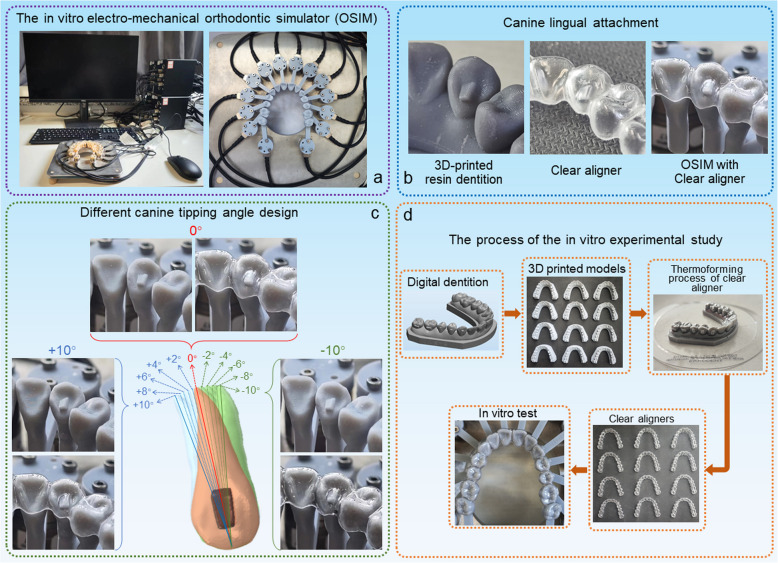
A dual-methodological approach was employed: 1) A four-dimensional finite element model (4D FEM) incorporating automated staging simulation was developed, utilizing iterative computations for long-term tooth movement prediction and thermal expansion algorithms for CA morphology adaptation; 2) An electromechanical orthodontic simulator (OSIM) was implemented for in vitro validation. The study analyzed three canine inclination groups in FEM simulations versus eleven groups in OSIM experiments, with particular focus on lingual attachment biomechanics. The A t-test was used to compare the forces and moments of each tooth between the groups with the same canine tipping angle.
The findings from the 4D FEM analysis demonstrated that distally inclined canines provided greater anchorage during premolar distalization (0.27 mm mesial movement for the first molar in -10° group), while mesially inclined canines contributed to more pronounced anchorage loss (0.34 mm mesial movement for the first molar in 10° group). The use of lingual attachments on canines improved the average distalization efficacy of premolars by 1%, 6%, and 7% in the -10°, 0°, and 10° canine tipping groups, respectively. Similarly, the in vitro orthodontic simulator (OSIM) experiment showed a comparable trend in force and moment variations.
Both the 4D FEM and OSIM analyses indicted that during the distalization process of premolars, canine lingual attachment significantly reduces the mesial displacement of molars by alleviating the unfitness of CA at anterior teeth area to enhance anterior anchorage. The efficiency of the attachment increased with the greater mesial tipping of canine. Based on the results of this study, it is clinically recommended to place lingual attachments during premolar distalization when the canine mesially tipped more than 4°.
在透明矫治器(CA)治疗上颌前磨牙远中移动过程中,前牙矫治器贴合不佳和磨牙近中移位是两个常见挑战。本研究旨在提出一种新颖的附件设计来解决这些问题,并研究治疗过程中不同尖牙倾斜角度的生物力学效应。
采用双方法学途径:1)开发了一个包含自动分期模拟的四维有限元模型(4D FEM),利用迭代计算进行长期牙齿移动预测,并使用热膨胀算法进行CA形态适配;2)实施了一个机电正畸模拟器(OSIM)进行体外验证。该研究在FEM模拟中分析了三个尖牙倾斜组,在OSIM实验中分析了十一个组,特别关注舌侧附件生物力学。采用t检验比较相同尖牙倾斜角度组之间各牙齿的力和力矩。
4D FEM分析结果表明,远中倾斜的尖牙在磨牙远中移动过程中提供了更大的支抗(-10°组中第一磨牙近中移动0.27 mm),而近中倾斜的尖牙导致更明显的支抗丧失(10°组中第一磨牙近中移动0.34 mm)。在-10°、0°和10°尖牙倾斜组中,在尖牙上使用舌侧附件分别使前磨牙的平均远中移动效率提高了1%、6%和7%。同样,体外正畸模拟器(OSIM)实验在力和力矩变化方面显示出类似趋势。
4D FEM和OSIM分析均表明,在前磨牙远中移动过程中,尖牙舌侧附件通过减轻前牙区CA的贴合不佳来显著减少磨牙的近中移位,从而增强前牙支抗。附件的效率随着尖牙近中倾斜度的增加而提高。基于本研究结果,临床建议在尖牙近中倾斜超过4°时,在前磨牙远中移动过程中放置舌侧附件。