
与职业相关的含锌和含铜金属烟雾会抑制人类THP-1巨噬细胞对细菌刺激的TNF和IL-6反应。
Occupationally Relevant Zinc- and Copper-Containing Metal Fumes Inhibit Human THP-1 Macrophage TNF and IL-6 Responses to Bacterial Stimuli.
作者信息
Steffens Jan, Michael Sabrina, Kuth Katharina, Hollert Henner, Du Marchie Sarvaas Miriam, Nesic Andrijana, Kraus Thomas, Baumann Ralf
机构信息
Institute for Translational Medicine (ITM) Medical School Hamburg (MSH) 20457 Hamburg Germany.
Institute for Occupational, Social and Environmental Medicine Medical Faculty University Hospital RWTH Aachen University 52074 Aachen Germany.
出版信息
Glob Chall. 2024 Dec 31;9(5):2400302. doi: 10.1002/gch2.202400302. eCollection 2025 May.
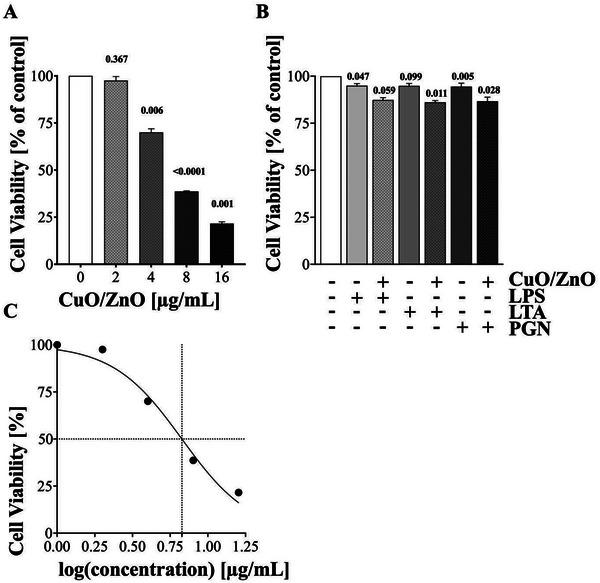
Metal workers have an increased risk of severe lobar pneumonia due to exposure to metal fume particles, which lead to recent pneumococcal vaccination recommendations. To investigate the effects of metal fume-derived zinc oxide (ZnO) and copper oxide (CuO) particles on airway immune responses, human THP-1-derived macrophages are exposed in vitro to the bacterial pathogen-associated molecular patterns (PAMPs) lipopolysaccharide (LPS), lipoteichoic Acid (LTA), or peptidoglycan (PGN), together with particle suspensions. Particles are generated through metal inert gas (MIG) soldering. Spectrometric and microscopic analysis confirms CuO and ZnO as main components. Macrophage and mRNAs are quantified by qPCR and secreted protein levels by electrochemiluminescent multi-spot assay. A dose-dependent increase in macrophage TNF and IL-6 mRNA (4 h) and protein (24 h) levels following exposure to PAMPs is significantly inhibited by 2 µg mL CuO/ZnO particles ( = 5). Additionally, CuO/ZnO particles significantly inhibit TNF protein expression in unstimulated macrophages, while IL-6 protein levels are unaffected ( = 5). The presented in vitro immunotoxicity approach may extend existing new approach methodology (NAM) elements for chemical risk assessment and possibly exposure limit evaluation refinements. These findings implicate that CuO/ZnO particles suppress macrophage proinflammatory responses to PAMPs, potentially compromising lung immunity, underlining current vaccine recommendations and efforts for preventive occupational health guidelines.
金属工人因接触金属烟雾颗粒而患重症大叶性肺炎的风险增加,这导致了近期的肺炎球菌疫苗接种建议。为了研究金属烟雾衍生的氧化锌(ZnO)和氧化铜(CuO)颗粒对气道免疫反应的影响,将人THP-1衍生的巨噬细胞在体外暴露于细菌病原体相关分子模式(PAMPs)脂多糖(LPS)、脂磷壁酸(LTA)或肽聚糖(PGN)以及颗粒悬浮液中。颗粒通过金属惰性气体(MIG)焊接产生。光谱和显微镜分析证实CuO和ZnO为主要成分。通过qPCR对巨噬细胞和mRNA进行定量,通过电化学发光多点测定法对分泌蛋白水平进行定量。暴露于PAMPs后,巨噬细胞TNF和IL-6 mRNA(4小时)和蛋白(24小时)水平的剂量依赖性增加被2μg/mL CuO/ZnO颗粒显著抑制(n = 5)。此外,CuO/ZnO颗粒显著抑制未刺激巨噬细胞中TNF蛋白的表达,而IL-6蛋白水平不受影响(n = 5)。所提出的体外免疫毒性方法可能会扩展现有的新方法学(NAM)元素,用于化学风险评估以及可能的暴露限值评估改进。这些发现表明,CuO/ZnO颗粒抑制巨噬细胞对PAMPs的促炎反应,可能损害肺部免疫力,强调了当前的疫苗接种建议以及制定预防性职业健康指南的努力。




 Zotero 插件