Yan X, Chen H Y, Wang L, Tian Y L, Gu Y, Liu N, Ge Z
Department of Hematology, Zhongda Hospital, School of Medicine, Southeast University, Institute of Hematology Southeast University, Nanjing 210009, China.
Xuyi People's Hospital, Xuyi 211700, China.
Zhonghua Xue Ye Xue Za Zhi. 2025 Mar 14;46(3):252-260. doi: 10.3760/cma.j.cn121090-20240708-00254.
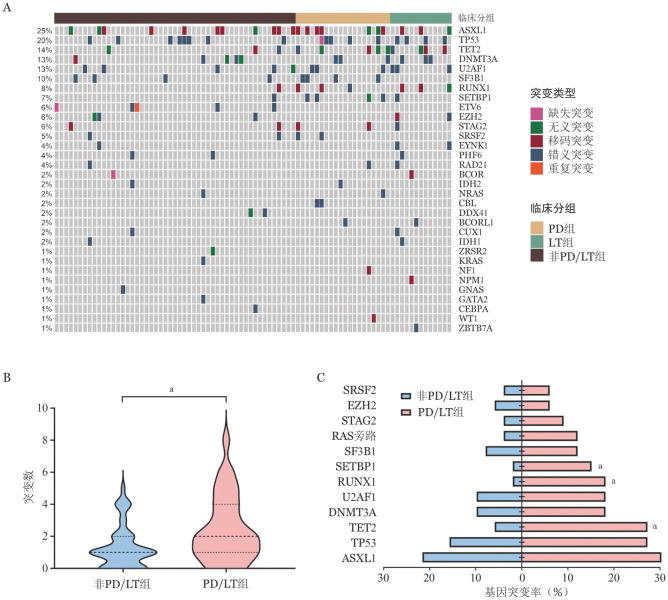
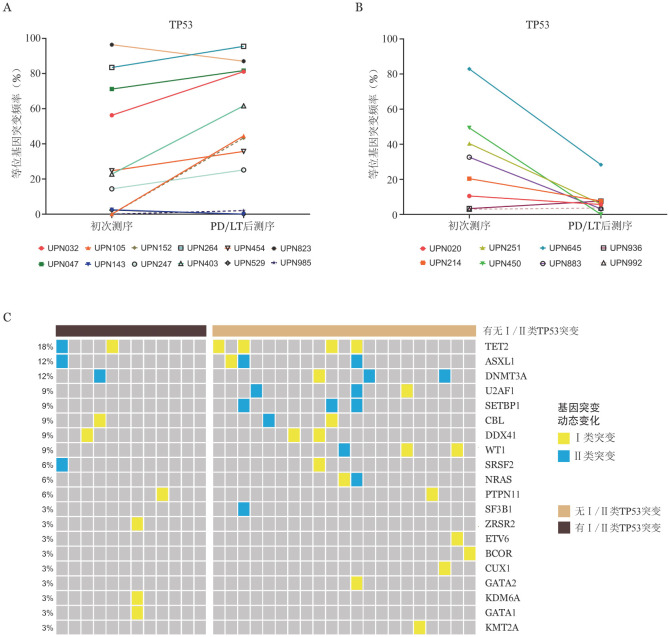
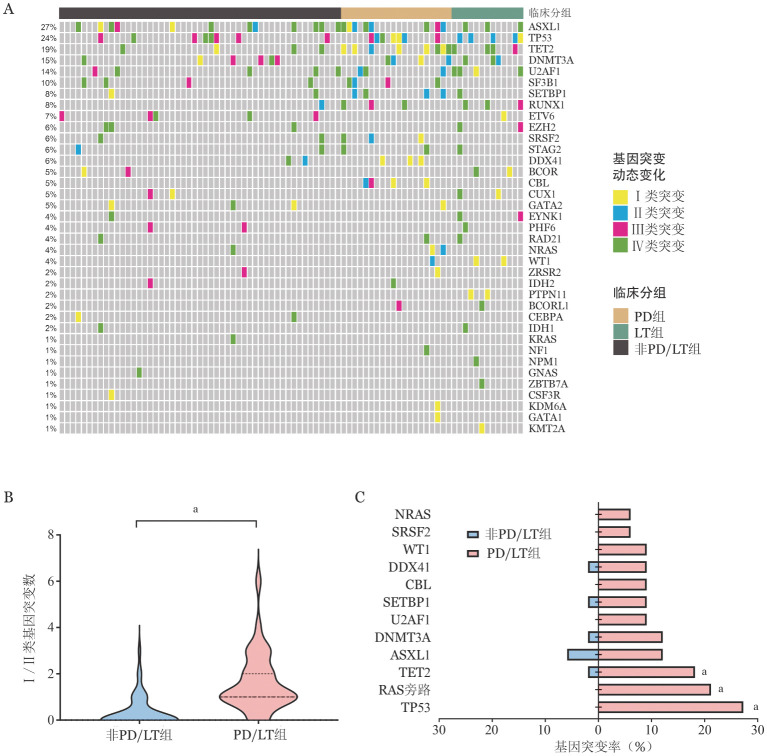
To investigate the key genetic mutations during the progressive disease (PD) /leukemic transformation (LT) course in MDS by analyzing the dynamic changes of genetic mutations in patients with myelodysplastic neoplasms (MDS) with or without PD/LT. This study enrolled 84 patients with sequential MDS from May 2019 to August 2023 at ZhongDa Hospital Southeast University and used the next generation sequencing to detect gene mutations. The dynamic changes of genetic mutations in patients with MDS with or without PD/LT were retrospectively analyzed. ①This study analyzed data from 84 patients diagnosed with MDS with a median age of 63 (range: 31-95) years and consisting of 51 males and 33 females. Participants were distributed to the PD cohort (=20), LT cohort (=13), and non-PD/LT cohort (=51). Patients from the PD/LT cohorts demonstrated a higher proportion of bone marrow blasts than the non-PD/LT cohort at the first sequencing (1.6% . 0.4%, =0.013). ②The most frequently mutated genes that were detected at first sequencing were ASXL1 (=21, 25.0%), TP53 (=17, 20.2%), TET2 (=12, 14.3%), DNMT3A (=11, 13.1%), and U2AF1 (=11, 13.1%). Further, patients from the PD/LT cohorts exhibited a higher median number of mutated genes than the non-PD/LT cohort (2 .1, =0.014) at first sequencing. TET2 (27.3% . 5.9%, =0.010), SETBP1 (15.2% .2.0%, =0.033), and RUNX1 (18.2% . 2.0%, =0.013) mutations were enriched in the PD/LT cohorts than in the non-PD/LT cohort. ③The most frequently detected acquired mutations (Ⅰ mutations) and clonally expanded mutations (Ⅱ mutations) were TP53 (=9, 10.7%), TET2 (=7, 8.3%), ASXL1 (=7, 8.3%), and RAS pathway (=7, 8.3%). Furthermore, patients from the PD/LT cohorts showed a higher median number of Ⅰ/Ⅱ genes than the non-PD/LT cohort (2 . 0, <0.001), and Ⅰ/Ⅱ RAS pathway (21.2% . 0, =0.001), TP53 (27.3% . 0, <0.001), and TET2 (18.2% . 2.0%, =0.013) mutations were enriched in PD/LT cohorts than in the non-PD/LT cohorts. ④Most of the TP53 mutations (9/12, 75.0%) in PD/LT cohorts were Ⅰ/Ⅱ mutations, whereas all of the TP53 mutations in non-PD/LT cohort were clone-decrease mutations (Ⅲ mutations) (5/8, 62.5%) or clone-stable mutations (Ⅳ mutations) (3/8, 37.5%). Most of the RAS pathway mutations (7/8,87.5%) in the PD/LT cohorts were Ⅰ/Ⅱ mutations, whereas only one patient in the non-PD/LT cohort demonstrated RAS pathway mutations, which belonged to Ⅳ mutations. Patients from the PD/LT cohorts demonstrated a higher proportion of bone marrow blasts and a higher median number of mutations than the non-PD/LT cohort at first sequencing; TET2, SETBP1, and RUNX1 mutations were enriched in the PD/LT cohorts than in the non-PD/LT cohort at first sequencing. Patients from the PD/LT cohorts exhibited a higher number of Ⅰ/Ⅱ mutations than the non-PD/LT cohort. Further, Ⅰ/Ⅱ TP53, RAS pathway, and TET2 mutations were enriched in the PD/LT cohorts, and Ⅰ/Ⅱ TP53 and RAS pathway mutations may contribute to the PD/LT.
通过分析伴或不伴疾病进展(PD)/白血病转化(LT)的骨髓增生异常综合征(MDS)患者基因突变的动态变化,研究MDS疾病进展(PD)/白血病转化(LT)过程中的关键基因突变。本研究纳入了2019年5月至2023年8月在东南大学附属中大医院连续就诊的84例MDS患者,并采用二代测序检测基因突变。对伴或不伴PD/LT的MDS患者基因突变的动态变化进行回顾性分析。①本研究分析了84例诊断为MDS患者的数据,患者中位年龄为63岁(范围:31 - 95岁),其中男性51例,女性33例。参与者被分为PD队列(=20例)、LT队列(=13例)和非PD/LT队列(=51例)。在首次测序时,PD/LT队列患者的骨髓原始细胞比例高于非PD/LT队列(1.6%对0.4%,P = 0.013)。②首次测序时检测到的最常见突变基因是ASXL1(=21例,25.0%)、TP53(=17例,20.2%)、TET2(=12例,14.3%)、DNMT3A(=11例,13.1%)和U2AF1(=11例,13.1%)。此外,在首次测序时,PD/LT队列患者的中位突变基因数量高于非PD/LT队列(2对1,P = 0.0!4)。与非PD/LT队列相比,TET2(27.3%对5.9%,P = 0.010)、SETBP1(15.2%对2.0%,P = 0.033)和RUNX1(18.2%对2.0%,P = 0.013)突变在PD/LT队列中更为富集。③最常检测到的获得性突变(Ⅰ类突变)和克隆性扩增突变(Ⅱ类突变)是TP53(=9例,10.7%)、TET2(=7例,8.3%)、ASXL1(=7例,8.3%)和RAS通路(=7例,8.3%)。此外,PD/LT队列患者的Ⅰ/Ⅱ类基因中位数量高于非PD/LT队列(2对0,P<0.001),并且Ⅰ/Ⅱ类RAS通路(21.2%对0,P = 0.001)、TP53(27.3%对0,P<0.001)和TET2(18.2%对2.0%,P = 0.013)突变在PD/LT队列中比非PD/LT队列更富集。④PD/LT队列中大多数TP53突变(9/12,75.0%)为Ⅰ/Ⅱ类突变,而非PD/LT队列中所有TP53突变均为克隆减少突变(Ⅲ类突变)(5/8,62.5%)或克隆稳定突变(Ⅳ类突变)(3/8,37.5%)。PD/LT队列中大多数RAS通路突变(7/8,87.5%)为Ⅰ/Ⅱ类突变,而非PD/LT队列中只有1例患者有RAS通路突变,属于Ⅳ类突变。在首次测序时,PD/LT队列患者的骨髓原始细胞比例和中位突变数量高于非PD/LT队列;在首次测序时,TET2、SETBP1和RUNX1突变在PD/LT队列中比非PD/LT队列更富集。PD/LT队列患者的Ⅰ/Ⅱ类突变数量高于非PD/LT队列。此外,Ⅰ/Ⅱ类TP53、RAS通路和TET2突变在PD/LT队列中更富集,且Ⅰ/Ⅱ类TP53和RAS通路突变可能与PD/LT有关。