Ahel Juraj, Balci Arda, Faas Victoria, Grabarczyk Daniel B, Harmo Roosa, Squair Daniel R, Zhang Jiazhen, Roitinger Elisabeth, Lamoliatte Frederic, Mathur Sunil, Deszcz Luiza, Bell Lillie E, Lehner Anita, Williams Thomas L, Sowar Hanna, Meinhart Anton, Wood Nicola T, Clausen Tim, Virdee Satpal, Fletcher Adam J
Research Institute of Molecular Pathology (IMP), Vienna BioCenter, Vienna, Austria.
MRC University of Glasgow Centre for Virus Research, University of Glasgow, Glasgow, United Kingdom.
Nat Commun. 2025 May 13;16(1):4414. doi: 10.1038/s41467-025-59444-4.
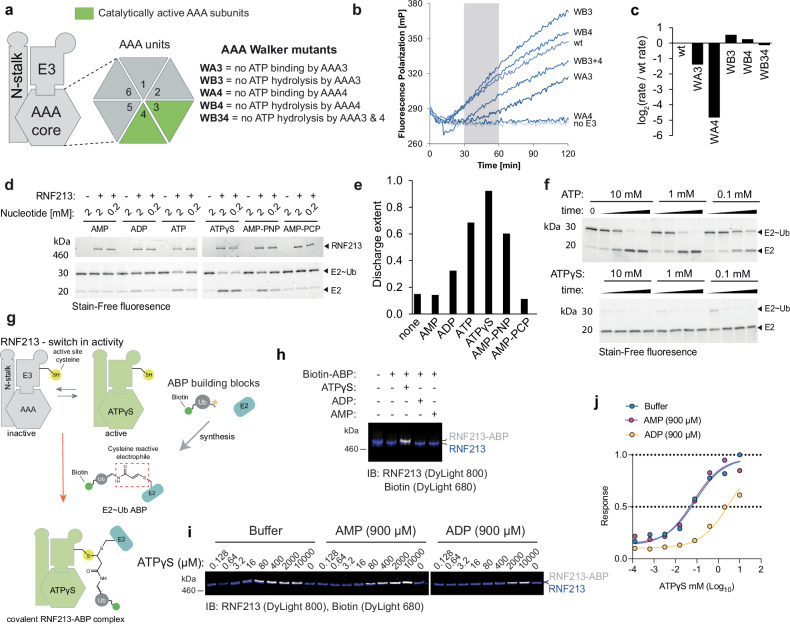
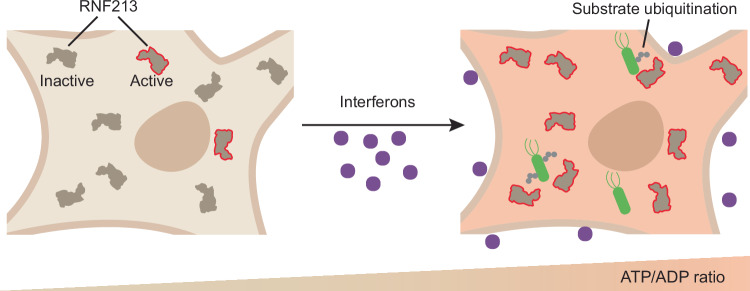
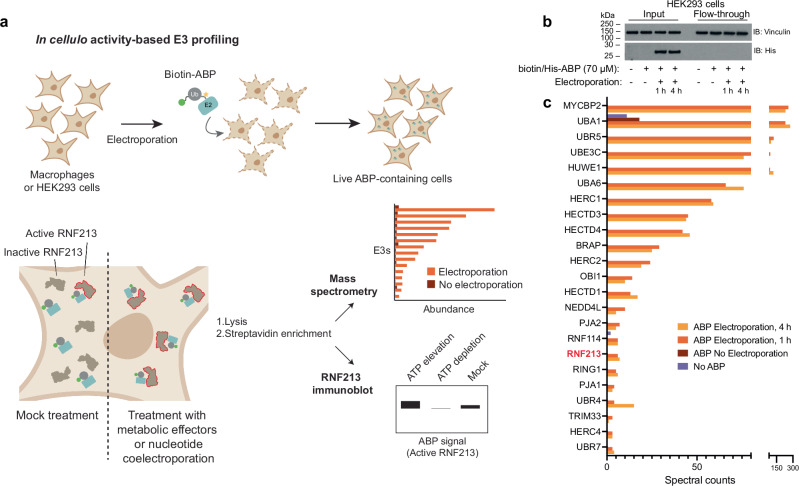
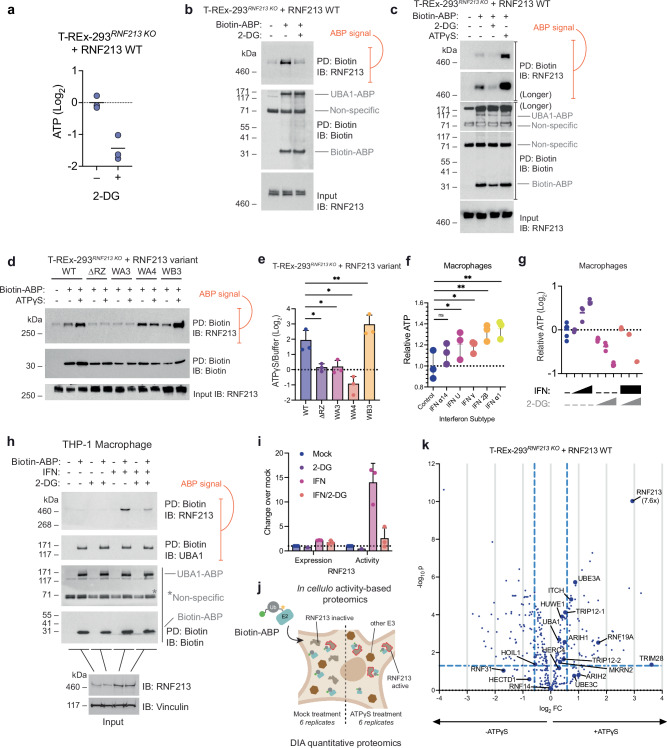
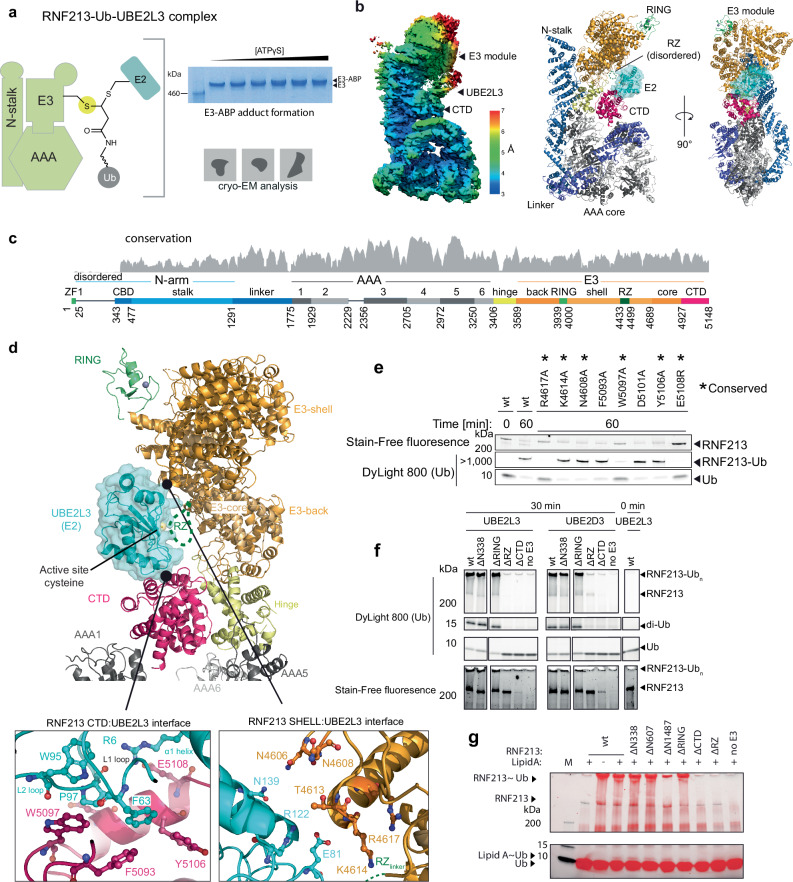
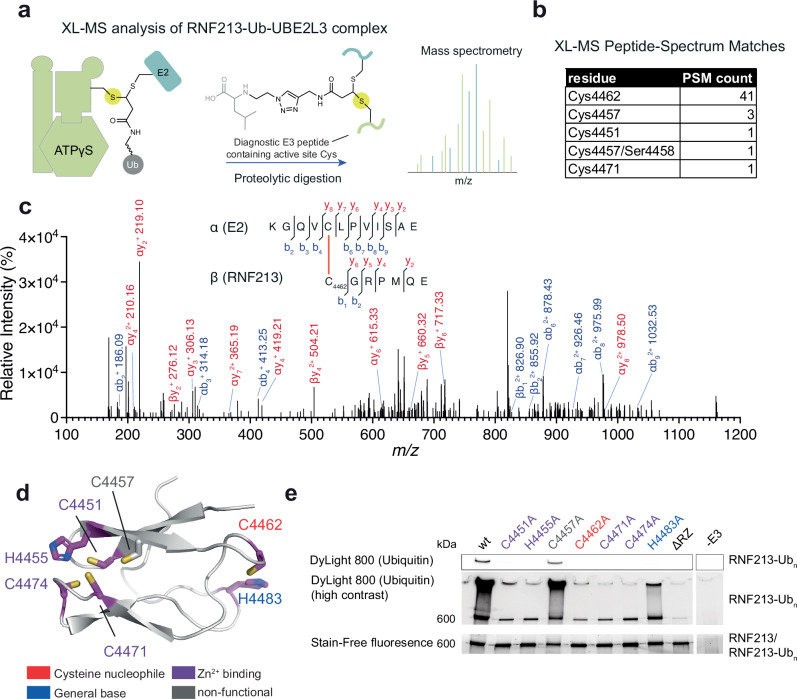
The giant E3 ubiquitin ligase RNF213 is a conserved component of mammalian cell-autonomous immunity, limiting the replication of bacteria, viruses and parasites. To understand how RNF213 reacts to these unrelated pathogens, we employ chemical and structural biology to find that ATP binding to its ATPases Associated with diverse cellular Activities (AAA) core activates its E3 function. We develop methodology for proteome-wide E3 activity profiling inside living cells, revealing that RNF213 undergoes a reversible switch in E3 activity in response to cellular ATP abundance. Interferon stimulation of macrophages raises intracellular ATP levels and primes RNF213 E3 activity, while glycolysis inhibition depletes ATP and downregulates E3 activity. These data imply that ATP bears hallmarks of a danger/pathogen associated molecular pattern, coordinating cell-autonomous defence. Furthermore, quantitative labelling of RNF213 with E3-activity probes enabled us to identify the catalytic cysteine required for substrate ubiquitination and obtain a cryo-EM structure of the RNF213-E2-ubiquitin conjugation enzyme transfer intermediate, illuminating an unannotated E2 docking site. Together, our data demonstrate that RNF213 represents a new class of ATP-dependent E3 enzyme, employing distinct catalytic and regulatory mechanisms adapted to its specialised role in the broad defence against intracellular pathogens.
巨型E3泛素连接酶RNF213是哺乳动物细胞自主免疫的一个保守组成部分,可限制细菌、病毒和寄生虫的复制。为了了解RNF213如何对这些不相关的病原体作出反应,我们运用化学和结构生物学方法,发现ATP与其具有多种细胞活性的ATP酶(AAA)核心结合会激活其E3功能。我们开发了在活细胞内进行全蛋白质组E3活性分析的方法,揭示了RNF213会根据细胞内ATP的丰度经历E3活性的可逆转换。巨噬细胞受到干扰素刺激会提高细胞内ATP水平并启动RNF213的E3活性,而糖酵解抑制会消耗ATP并下调E3活性。这些数据表明,ATP具有危险/病原体相关分子模式的特征,可协调细胞自主防御。此外,用E3活性探针定量标记RNF213使我们能够鉴定底物泛素化所需的催化半胱氨酸,并获得RNF213-E2-泛素结合酶转移中间体的冷冻电镜结构,揭示了一个未注释的E2对接位点。总之,我们的数据表明,RNF213代表了一类新的ATP依赖性E3酶,采用了独特的催化和调节机制,以适应其在广泛防御细胞内病原体中的特殊作用。