Mandour Howida S, Khorshed Lobna A, Abdou Amr M, Ghazal Basma
Physical Chemistry Department, National Research Centre, 33 El Bohoth St., Dokki, P.O. 12622, Giza, Egypt.
Microbiology and Immunology Department, National Research Centre, 33 El Bohoth St., Dokki, P.O. 12622, Giza, Egypt.
Sci Rep. 2025 May 13;15(1):16577. doi: 10.1038/s41598-025-98580-1.
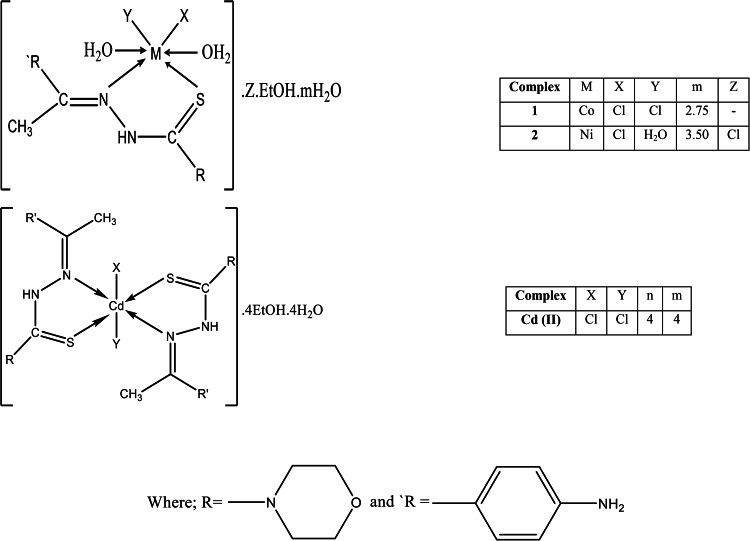
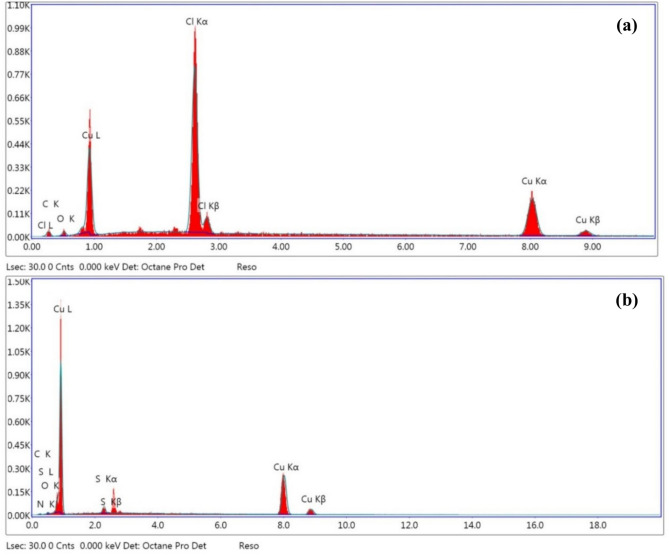
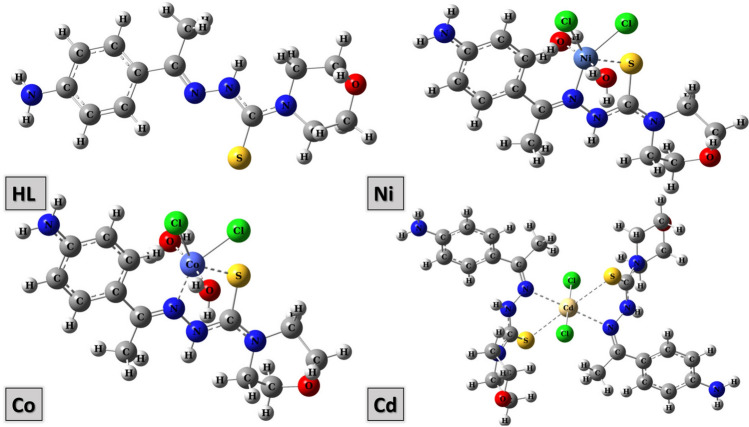
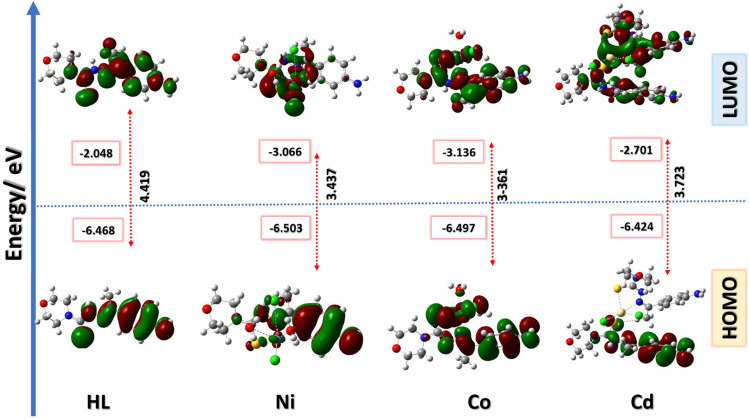
In the current study, the execution of thiosemicarbazone ligand (HL) as a novel corrosion inhibitor for copper metal in 1 M HCl solution was evaluated through the electrochemical measurements which includes (open circuit potential (OCP) potentiodynamic polarization (PDP) and electrochemical impedance spectroscopy (EIS). The results confirmed that the ligand (HL) acted as a good corrosion inhibitor for copper metal in 1 M HCl solution; as it displayed high percentage of inhibition efficiency about 94.66% and 92.93% after PDP and EIS methods respectively; at its optimum concentration (1 × 10 M). The morphology and surface constituents of the sample were examined before and after addition of the ligand (HL) by using the analysis (scanning electron microscope and an energy dispersive X-ray spectroscopy) which clarified the passivation effect of the ligand (HL) after formation of a protective layer of its adsorbed molecules on the surface of the copper sample. In addition, the metal complexes Ni (II), Co (II) and Cd (II) derived from thiosemicarbazone ligand (HL) were used in this study to shed light on some of their electrochemical properties. But based on their nature as they are insoluble in aqueous media the cyclic voltammetry method was used in this section. The results deducted from cyclic voltammetry technique showed that, the oxidation-reduction process of the ligand (HL) and its metal complexes Ni (II), Co (II) and Cd (II) under quasi-reversible system and the reaction occurred on the metal surface under diffusion control. In vitro, the antibacterial activity testing against S. aureus, S. pneumonia, E. coli and S. Typhimurium were performed for the ligand (HL) and its metal complexes Ni (II), Co (II) and Cd (II). The result showed that Co (II) and Cd (II), complexes exhibited the best antibacterial activity against S. pneumonia, S. Typhimurium and E. coli while, all the compounds did not show any antibacterial activity against S. aureus. To obtain a good relation that supports and explains the interactions between the molecules of the studied compounds and the metal surface and with the antibacterial activity; the theoretical study in detail was applied using density functional theory (DFT) and molecular docking. The parameters such as, energy level (ΔE), the highest HOMO (E), and the lowest occupied LUMO (E), molecular orbital and the binding energy are deducted and discussed. The main target investigated of this study is that the thiosemicarbazone ligand (HL) can be used as a new corrosion inhibitor for the metals and their alloys against the aggressive media. Also, from cyclic voltammetry technique which had been used for testing the metal complexes Ni (II), Co (II) and Cd (II) derived from the ligand (HL); all the details about the redox reactions of these compounds had been obtained. The importance of knowing oxidation and reduction reactions is due to their consideration as the main source of energy for the most biological process, energy productions, photosynthesis to immune responses and the synthesis and breakdown of biomolecules. Therefore, redox reactions are very important in our life.
在当前研究中,通过电化学测量评估了硫代卡巴腙配体(HL)作为铜金属在1 M HCl溶液中的新型缓蚀剂的性能,这些测量包括(开路电位(OCP)、动电位极化(PDP)和电化学阻抗谱(EIS))。结果证实,该配体(HL)在1 M HCl溶液中对铜金属起到了良好的缓蚀作用;在其最佳浓度(1×10⁻³ M)下,通过PDP和EIS方法分别显示出约94.66%和92.93%的高抑制效率。通过(扫描电子显微镜和能量色散X射线光谱)分析,在添加配体(HL)前后对样品的形态和表面成分进行了检查,这阐明了配体(HL)在铜样品表面形成吸附分子保护层后产生的钝化作用。此外,本研究中使用了源自硫代卡巴腙配体(HL)的金属配合物Ni(II)、Co(II)和Cd(II),以揭示它们的一些电化学性质。但基于它们不溶于水介质的性质,在本节中使用了循环伏安法。从循环伏安技术得出的结果表明,配体(HL)及其金属配合物Ni(II)、Co(II)和Cd(II)在准可逆体系下的氧化还原过程以及在扩散控制下金属表面发生的反应。在体外,对配体(HL)及其金属配合物Ni(II)、Co(II)和Cd(II)进行了针对金黄色葡萄球菌、肺炎链球菌、大肠杆菌和鼠伤寒沙门氏菌的抗菌活性测试。结果表明,Co(II)和Cd(II)配合物对肺炎链球菌、鼠伤寒沙门氏菌和大肠杆菌表现出最佳抗菌活性,而所有化合物对金黄色葡萄球菌均未显示出任何抗菌活性。为了获得支持和解释所研究化合物分子与金属表面之间以及与抗菌活性之间相互作用的良好关系;使用密度泛函理论(DFT)和分子对接进行了详细的理论研究。推导并讨论了诸如能级(ΔE)、最高占据分子轨道(E HOMO)和最低未占据分子轨道(E LUMO)、分子轨道和结合能等参数。本研究调查的主要目标是硫代卡巴腙配体(HL)可作为金属及其合金在侵蚀性介质中的新型缓蚀剂。此外,通过用于测试源自配体(HL)的金属配合物Ni(II)、Co(II)和Cd(II)的循环伏安技术;已经获得了这些化合物氧化还原反应的所有详细信息。了解氧化和还原反应的重要性在于它们被视为大多数生物过程、能量产生、光合作用到免疫反应以及生物分子合成和分解的主要能量来源。因此,氧化还原反应在我们的生活中非常重要。