Rosania Rosa, Nord Maximilian, Scurt Florian G, Lux Anke, Keitel Verena, von Arnim Ulrike, Venerito Marino
Department of Gastroenterology, Hepatology and Infectious Diseases, Otto-von-Guericke University Hospital, 39120 Magdeburg, Germany.
University Clinic for Nephrology and Hypertension, Diabetology and Endocrinology, Otto-von-Guericke University, 39120 Magdeburg, Germany.
Cancers (Basel). 2025 Apr 22;17(9):1396. doi: 10.3390/cancers17091396.
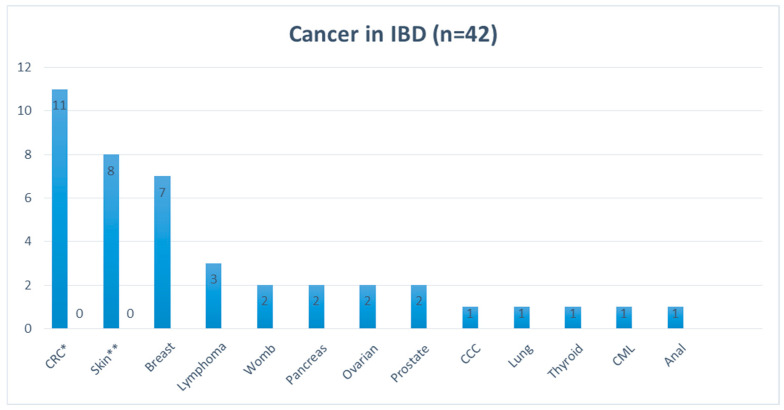
: Patients with inflammatory bowel disease (IBD) face an increased risk of developing intestinal and extraintestinal cancers. This retrospective single-center study aimed to quantify cancer risk and identify potential risk factors associated with cancer in IBD patients. : The epidemiological data, disease characteristics, treatment regimens, and occurrences of cancer following IBD diagnosis were collected between January 2021 and February 2022. Hazard ratios (HRs) and standardized incidence ratios (SIRs) were estimated. : 560 IBD patients were included; 37 patients developed cancer, with 5 patients developing two distinct cancers, resulting in 42 cancers overall. This translated into a twofold increased risk of developing any cancer compared to the general population (SIR 1.94, 95% CI 1.4-2.6). Colorectal (CRC, 29%), skin (19%), and breast cancer (17%) were the most common malignancies. Female patients showed an increased risk for all cancers (SIR 3.1, 95% CI 2.06-4.3), melanoma (SIR 5.6, 95% CI 1.14-16.2), and CRC (SIR 7.5, 95% CI 3-15.4). Conversely, male patients exhibited a significantly increased risk of lymphoma (SIR 26.2, 95% CI 3.2-95.7). Young age at IBD diagnosis and the use of immunomodulators, whether as monotherapy or in combination with biologics, were associated with an increased risk of cancer. : The risk of CRC and lymphoma in IBD patients may be higher than previously reported, potentially due to the increasing use of combination therapy. Cancer risk in IBD should be regularly assessed and personalized throughout the disease course.
炎症性肠病(IBD)患者患肠道和肠外癌症的风险增加。这项回顾性单中心研究旨在量化IBD患者的癌症风险,并确定与癌症相关的潜在风险因素。在2021年1月至2022年2月期间收集了IBD诊断后的流行病学数据、疾病特征、治疗方案和癌症发生情况。估计了风险比(HRs)和标准化发病率比(SIRs)。纳入了560例IBD患者;37例患者发生癌症,其中5例患者患两种不同癌症,共发生42例癌症。这意味着与普通人群相比,患任何癌症的风险增加了两倍(SIR 1.94,95%CI 1.4 - 2.6)。结直肠癌(CRC,29%)、皮肤癌(19%)和乳腺癌(17%)是最常见的恶性肿瘤。女性患者患所有癌症(SIR 3.1,95%CI 2.06 - 4.3)、黑色素瘤(SIR 5.6,95%CI 1.14 - 16.2)和结直肠癌(SIR 7.5,95%CI 3 - 15.4)的风险增加。相反,男性患者患淋巴瘤的风险显著增加(SIR 26.2,95%CI 3.2 - 95.7)。IBD诊断时年龄较小以及使用免疫调节剂,无论是单药治疗还是与生物制剂联合使用,都与癌症风险增加有关。IBD患者患结直肠癌和淋巴瘤的风险可能高于先前报道,这可能是由于联合治疗的使用增加。IBD患者的癌症风险应在整个病程中定期评估并进行个体化评估。