Rabiej-Kozioł Dobrochna, Szydłowska-Czerniak Aleksandra
Department of Analytical Chemistry and Applied Spectroscopy, Faculty of Chemistry, Nicolaus Copernicus University in Toruń, Gagarina 7, 87-100 Toruń, Poland.
Foods. 2025 Apr 22;14(9):1444. doi: 10.3390/foods14091444.
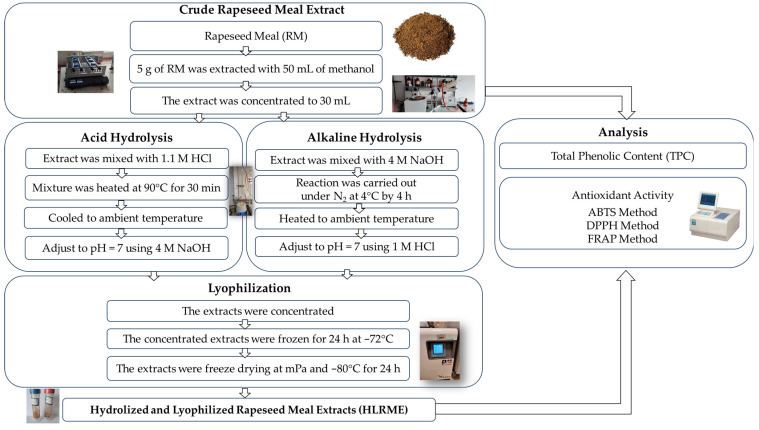
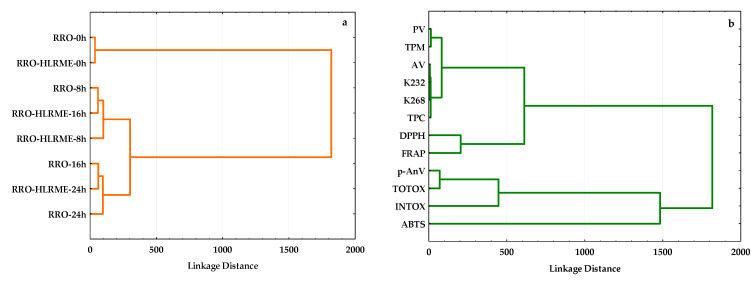
In the present study, methanolic extracts from rapeseed meal, an oil industry by-product, were treated with alkaline hydrolysis, acid hydrolysis, and lyophilization to enhance their antioxidant features. Antioxidant activity (AA) of the prepared rapeseed meal extracts was determined using three modified spectrophotometric methods: 2,2'-azino-bis(3-ethylbenzothiazoline-6-sulfonic acid) (ABTS), 2,2-diphenyl-1-picrylhydrazyl (DPPH), and ferric reducing antioxidant power (FRAP) methods. The effect of acid-hydrolyzed and lyophilized rapeseed meal extract (HLRME) at 200 ppm on the antioxidant properties of refined rapeseed oil heating at 180 °C for 24 h and French fries fried in it was estimated. Moreover, the total phenolic content (TPC) in rapeseed meal extracts, enriched rapeseed oils before and after the thermo-degradation processes, and fried French fries was analyzed. The addition of HLRME affected the oxidation stability of refined rapeseed oil heated for 8 h daily for 3 days at 180 °C by preventing an increase in the peroxide values (PV), anisidine values (-AnV), TOTOX and INTOX indexes, conjugated dienes (K), and total polar material (TPM). However, thermal degradation generated similar amounts of conjugated trienes (K) in non-supplemented and supplemented rapeseed oils. Fortified rapeseed oils after each heating cycle and French fries fried in them revealed higher antioxidant properties than those prepared in refined rapeseed oils without HLRME. Results from the present study suggest that HLRME, as a potential source of natural antioxidants from oil industry by-products, can prevent the degradation of refined rapeseed oil and help improve the quality of French fries.
在本研究中,对油菜籽粕(一种油脂工业副产品)的甲醇提取物进行了碱水解、酸水解和冻干处理,以增强其抗氧化特性。使用三种改良的分光光度法测定制备的油菜籽粕提取物的抗氧化活性(AA):2,2'-联氮-双-(3-乙基苯并噻唑啉-6-磺酸)(ABTS)法、2,2-二苯基-1-苦基肼(DPPH)法和铁还原抗氧化能力(FRAP)法。评估了200 ppm的酸水解冻干油菜籽粕提取物(HLRME)对在180℃加热24小时的精炼菜籽油及其炸制的薯条抗氧化性能的影响。此外,还分析了油菜籽粕提取物、热降解前后的强化菜籽油以及炸制薯条中的总酚含量(TPC)。添加HLRME通过防止过氧化值(PV)、茴香胺值(-AnV)、TOTOX和INTOX指数、共轭二烯(K)以及总极性物质(TPM)的增加,影响了在180℃每天加热8小时、持续3天的精炼菜籽油的氧化稳定性。然而,热降解在未添加和添加HLRME的菜籽油中产生了相似量的共轭三烯(K)。每次加热循环后的强化菜籽油及其炸制的薯条显示出比未添加HLRME的精炼菜籽油制备的更高的抗氧化性能。本研究结果表明,HLRME作为油脂工业副产品中天然抗氧化剂的潜在来源,可以防止精炼菜籽油的降解,并有助于提高薯条的品质。