
音猬因子激动剂可增强同型Lgr5阳性内耳类器官的成熟。
Shh agonist enhances maturation in homotypic Lgr5-positive inner ear organoids.
作者信息
Carpena Nathaniel T, Chang So-Young, Mun Seyoung, Kim Kyung Wook, Yoon Hyun C, Chung Phil-Sang, Mo Ji-Hun, Ahn Jin-Chul, Park Ji On, Han Kyudong, Choi Ji Eun, Jung Jae Yun, Lee Min Young
机构信息
Department of Medical Laser, Graduate School of Medicine, Dankook University, Cheonan 31116, Republic of Korea.
Beckman Laser Institute Korea, Dankook University, Cheonan 31116, Republic of Korea.
出版信息
Theranostics. 2025 Apr 13;15(12):5543-5565. doi: 10.7150/thno.107345. eCollection 2025.
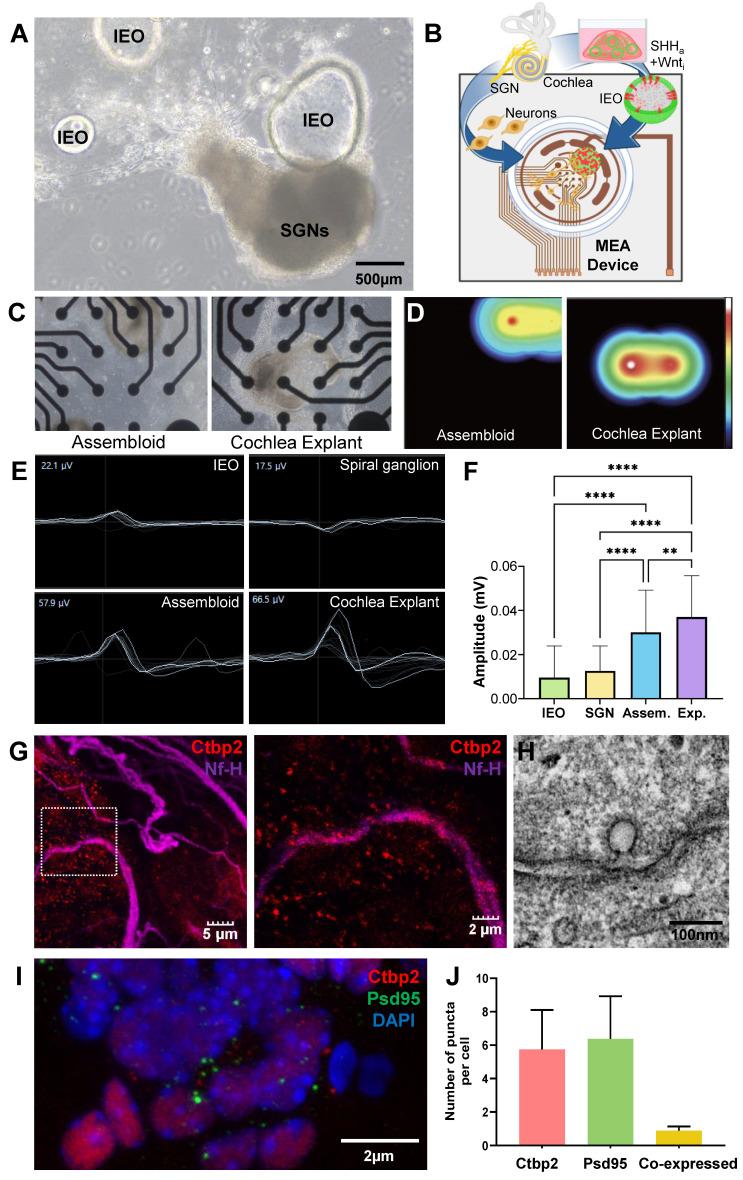
The regeneration of functional hair cells (HCs) remains a critical challenge in addressing sensorineural hearing loss. This study aimed to investigate the molecular and functional mechanisms driving stereocilia maturation within inner ear organoids (IEO) derived from homogenic Lgr5-positive progenitor cells (LPCs) and to compare outcomes with traditional heterotypic cultures. Mouse cochlear LPCs were isolated via magnetic-activated cell sorting (MACS) to establish homotypic cultures, ensuring purity and eliminating the heterotypic influences present in traditional manual isolation (MI) methods. Differentiation into HCs was induced through Wnt and Notch signaling modulation. Transcriptomic profiling using bulk and single-cell RNA sequencing (scRNA-seq) identified gene expression changes linked to stereocilia development. A Sonic Hedgehog (Shh) agonist was applied to enhance structural maturation of HCs. Functional assessment included electron microscopy, FM1-43 uptake assays, and microelectrode array recordings in assembloids of IEO with primary spiral ganglion neurons (SGN) co-cultures. While homotypic LPC-derived IEOs successfully differentiated into HC-like cells, initial morphological assessment revealed immature stereocilia structures. Bulk RNA-seq analysis highlighted a downregulation of morphogenesis-related genes in these organoids. The application of a Shh agonist, acting as a key morphogen, promoted stereocilia development, as evidenced by enhanced ultrastructural features and increased expression of cuticular plate-associated genes ( and . Single-cell RNA sequencing (scRNA-seq) further identified distinct cell clusters, which exhibited robust expression of stereocilia-related genes ( and , indicative of advanced HC maturation. Electrophysiological assessments of IEO-SGN assembloids using microelectrode arrays confirmed functional mechanoelectrical transduction between cells. This integrated approach elucidates critical pathways and cellular dynamics underpinning stereocilia maturation and functional HC development in EIOs. These findings provide new insights into the molecular regulation of HC maturation and support the utility of Shh-modulated IEOs as a promising platform for inner ear regeneration and therapeutic development for inner ear regenerative therapies.
功能性毛细胞(HCs)的再生仍然是解决感音神经性听力损失的一项关键挑战。本研究旨在探讨驱动源自同源Lgr5阳性祖细胞(LPCs)的内耳类器官(IEO)内静纤毛成熟的分子和功能机制,并将结果与传统的异型培养进行比较。通过磁激活细胞分选(MACS)分离小鼠耳蜗LPCs以建立同型培养,确保纯度并消除传统手工分离(MI)方法中存在的异型影响。通过Wnt和Notch信号调节诱导分化为HCs。使用批量和单细胞RNA测序(scRNA-seq)进行转录组分析,确定了与静纤毛发育相关的基因表达变化。应用音猬因子(Shh)激动剂来增强HCs的结构成熟。功能评估包括电子显微镜、FM1-43摄取测定以及在IEO与初级螺旋神经节神经元(SGN)共培养的组装体中的微电极阵列记录。虽然同源LPC衍生的IEO成功分化为类HC细胞,但初步形态学评估显示静纤毛结构不成熟。批量RNA-seq分析突出了这些类器官中形态发生相关基因的下调。作为关键形态发生素的Shh激动剂的应用促进了静纤毛的发育,超微结构特征的增强和角质板相关基因(和)表达的增加证明了这一点。单细胞RNA测序(scRNA-seq)进一步确定了不同的细胞簇,这些细胞簇表现出静纤毛相关基因(和)的强烈表达,表明HC成熟程度较高。使用微电极阵列对IEO-SGN组装体进行的电生理评估证实了细胞之间的功能性机械电转导。这种综合方法阐明了支撑EIOs中静纤毛成熟和功能性HC发育的关键途径和细胞动态。这些发现为HC成熟的分子调节提供了新见解,并支持Shh调节的IEO作为内耳再生和内耳再生治疗治疗开发的有前景平台的实用性。


 Zotero 插件