Shah Hassan, Liu Zhengkun, Guo Weisheng, Ren Wenjie, Xiao Yafang
Department of Minimally Invasive Interventional Radiology, The Second Affiliated Hospital, School of Biomedical Engineering, Guangzhou Medical University, Guangzhou 510260, China.
Institutes of Health Central Plain, Clinical Medical Center of Tissue Engineering and Regeneration, Xinxiang Medical University, Xinxiang 453003, China.
Essays Biochem. 2025 May 13. doi: 10.1042/EBC20253016.
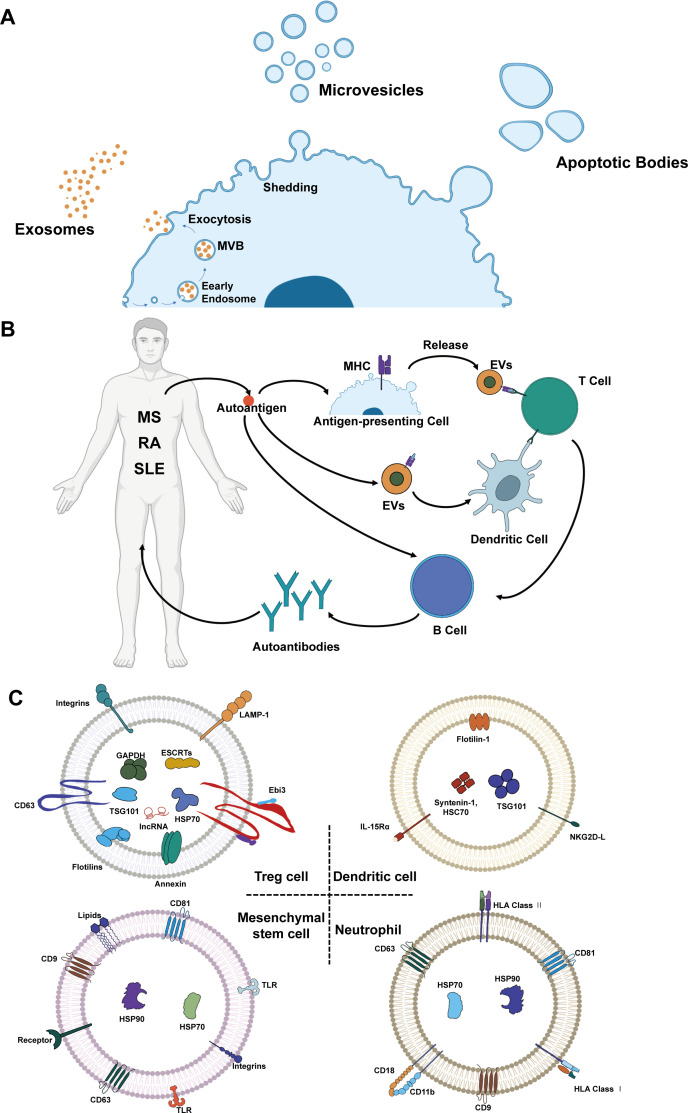
Immune regulation is recognized as a cornerstone therapeutic strategy for the treatment of various autoimmune diseases. These disorders, driven by dysregulated immune responses, contribute significantly to morbidity and mortality. Although conventional immunosuppressive therapies provide symptomatic relief, their prolonged use is often associated with severe adverse effects, underscoring the need for safer and more effective treatment approaches. Extracellular vesicles (EVs), derived from immunoregulatory cells such as regulatory T cells, dendritic cells, mesenchymal stem cells, and neutrophils, have emerged as promising candidates for targeted immunomodulation. These nanoscale vesicles inherit the immunosuppressive properties of their parental cells, thereby facilitating immune homeostasis while mitigating the risks associated with other cell-based therapies. This review provides a comprehensive overview of recent advances in the application of immunoregulatory cell-derived EVs for autoimmune disease treatment, with a particular focus on their mechanisms of action within the immune microenvironment. Finally, we discuss the challenges and potential future directions in the development of EV-based therapies for autoimmune diseases.
免疫调节被认为是治疗各种自身免疫性疾病的基石性治疗策略。这些由失调的免疫反应驱动的疾病,对发病率和死亡率有重大影响。尽管传统的免疫抑制疗法能提供症状缓解,但其长期使用往往与严重的不良反应相关,这凸显了对更安全、更有效治疗方法的需求。源自免疫调节细胞(如调节性T细胞、树突状细胞、间充质干细胞和中性粒细胞)的细胞外囊泡(EVs),已成为靶向免疫调节的有前景的候选物。这些纳米级囊泡继承了其亲本细胞的免疫抑制特性,从而促进免疫稳态,同时降低与其他基于细胞的疗法相关的风险。本综述全面概述了免疫调节细胞衍生的EVs在自身免疫性疾病治疗应用中的最新进展,特别关注它们在免疫微环境中的作用机制。最后,我们讨论了基于EVs的自身免疫性疾病治疗开发中的挑战和潜在的未来方向。