Freiberg Cynthia, Dotan Arad, Arnheim Dana, Aviel Yonatan Butbul
Maccabi Healthcare Services, Tel Aviv, Israel.
Faculty of Medicine, Tel Aviv University, Ramat Aviv, Israel.
Pediatr Rheumatol Online J. 2025 May 14;23(1):52. doi: 10.1186/s12969-025-01093-4.
During the COVID-19 pandemic there were reports of an increased association between COVID 19 and various autoimmune diseases (AID) in adults. This study aims to investigate the incidence of AIDs in children before and during the pandemic and explores potential links to SARS-CoV-2 vaccination.
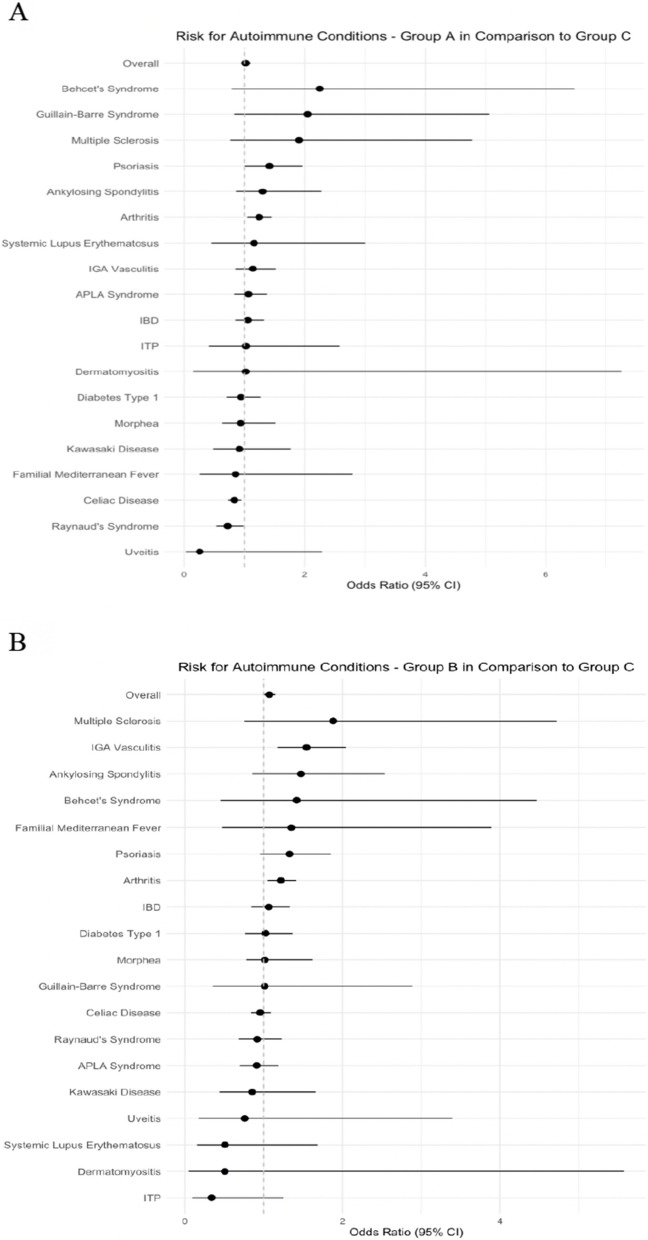
We analyzed 493,705 anonymized medical records from Maccabi Healthcare Services, Israel's second-largest healthcare provider, to study AID incidence during 2014-2022. The study period was divided into three phases: two pre-pandemic phases of equal duration (A and B) and a pandemic phase (C).
Of 4,596 (0.9%) patients diagnosed with an AID in the cohort, incidence rates were 0.9% for Group A (2014-2016), 1.0% for Group B (2017-2019), and 0.9% for Group C (2020-2022) (p = 0.13). Logistic regression showed no significant differences in overall autoimmune disease incidence between the pre-COVID and COVID periods. Notably, specific conditions like celiac disease showed reduced incidence in Group A (OR 0.8309, p = 0.0071) while arthritis was significantly more common in Groups A and B. Additionally, COVID-19 diagnosis was not significantly associated with increased autoimmune disease risk (HR 1.092, p = 0.491); however, receiving at least one COVID vaccine was linked to higher risk (HR 1.2323, p = 0.0033).
Our findings suggest that the overall incidence of new-onset autoimmune diseases in children remained relatively stable during the COVID-19 pandemic. The study indicates a potential association between COVID-19 vaccination and an increased risk of developing autoimmune diseases, necessitating further research to elucidate long-term effects in the pediatric population.
在新冠疫情期间,有报告称成人中新冠病毒与各种自身免疫性疾病(AID)之间的关联有所增加。本研究旨在调查疫情前和疫情期间儿童自身免疫性疾病的发病率,并探索与新冠病毒疫苗接种的潜在联系。
我们分析了以色列第二大医疗服务提供商马卡比医疗服务公司的493,705份匿名医疗记录,以研究2014年至2022年期间的自身免疫性疾病发病率。研究期分为三个阶段:两个持续时间相等的疫情前阶段(A和B)以及一个疫情阶段(C)。
在该队列中,4596名(0.9%)患者被诊断患有自身免疫性疾病,A组(2014 - 2016年)发病率为0.9%,B组(2017 - 2019年)为1.0%,C组(2020 - 2022年)为0.9%(p = 0.13)。逻辑回归显示,新冠疫情前和疫情期间自身免疫性疾病的总体发病率无显著差异。值得注意的是,乳糜泻等特定疾病在A组发病率降低(OR 0.8309,p = 0.0071),而关节炎在A组和B组中明显更常见。此外,新冠病毒诊断与自身免疫性疾病风险增加无显著关联(HR 1.092,p = 0.491);然而,接种至少一剂新冠疫苗与更高风险相关(HR 1.2323,p = 0.0033)。
我们的研究结果表明,在新冠疫情期间,儿童新发自身免疫性疾病的总体发病率保持相对稳定。该研究表明新冠病毒疫苗接种与自身免疫性疾病发生风险增加之间存在潜在关联,有必要进一步研究以阐明对儿童群体的长期影响。