Wang Kaifeng, Lan Zhixian, Zhou Heqi, Fan Rong, Chen Huiyi, Liang Hongyan, You Qiuhong, Liang Xieer, Zeng Ge, Deng Rui, Lan Yu, Shen Sheng, Chen Peng, Hou Jinlin, Bu Pengcheng, Sun Jian
State Key Laboratory of Organ Failure Research; Key Laboratory of Infectious Diseases Research in South China, Ministry of Education; Guangdong Provincial Clinical Research Center for Viral Hepatitis; Guangdong Provincial Key Laboratory of Viral Hepatitis Research; Department of Infectious Diseases, Nanfang Hospital, Southern Medical University, Guangzhou 510515, China.
Department of Pathophysiology, Guangdong Provincial Key Laboratory of Proteomics, School of Basic Medical Sciences, Southern Medical University, Guangzhou 510515, China.
Acta Pharm Sin B. 2025 Mar;15(3):1383-1396. doi: 10.1016/j.apsb.2025.01.017. Epub 2025 Jan 28.
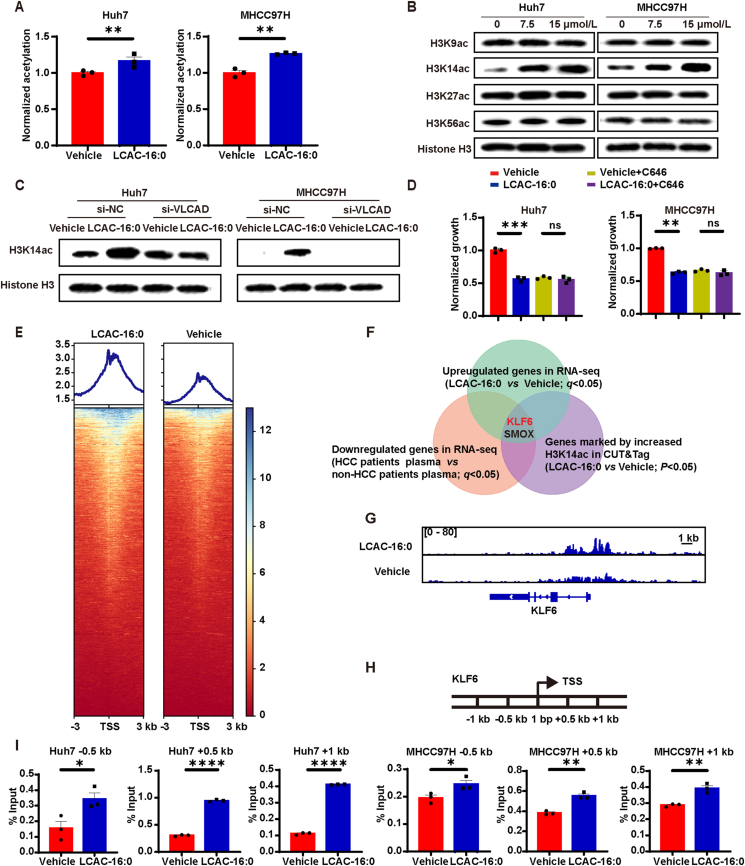
Despite therapy with potent antiviral agents, chronic hepatitis B (CHB) patients remain at high risk of hepatocellular carcinoma (HCC). While metabolites have been rediscovered as active drivers of biological processes including carcinogenesis, the specific metabolites modulating HCC risk in CHB patients are largely unknown. Here, we demonstrate that baseline plasma from CHB patients who later developed HCC during follow-up exhibits growth-promoting properties in a case-control design nested within a large-scale, prospective cohort. Metabolomics analysis reveals a reduction in long-chain acylcarnitines (LCACs) in the baseline plasma of patients with HCC development. LCACs preferentially inhibit the proliferation of HCC cells at a physiological concentration and prevent the occurrence of HCC without hepatorenal toxicity. Uptake and metabolism of circulating LCACs increase the intracellular level of acetyl coenzyme A, which upregulates histone H3 Lys14 acetylation at the promoter region of gene and thereby activates KLF6/p21 pathway. Indeed, blocking LCAC metabolism attenuates the difference in expression induced by baseline plasma of HCC/non-HCC patients. The deficiency of circulating LCACs represents a driver of HCC in CHB patients with viral control. These insights provide a promising direction for developing therapeutic strategies to reduce HCC risk further in the antiviral era.
尽管使用了强效抗病毒药物进行治疗,但慢性乙型肝炎(CHB)患者仍面临肝细胞癌(HCC)的高风险。虽然代谢物已被重新发现是包括致癌作用在内的生物过程的活跃驱动因素,但调节CHB患者HCC风险的特定代谢物在很大程度上仍不清楚。在此,我们证明,在一项嵌套于大规模前瞻性队列中的病例对照设计中,随访期间后来发生HCC的CHB患者的基线血浆具有促生长特性。代谢组学分析显示,发生HCC的患者基线血浆中长链酰基肉碱(LCACs)减少。LCACs在生理浓度下优先抑制HCC细胞的增殖,并预防HCC的发生,且无肝肾毒性。循环LCACs的摄取和代谢增加了细胞内乙酰辅酶A的水平,从而上调基因启动子区域组蛋白H3赖氨酸14的乙酰化,进而激活KLF6/p21途径。事实上,阻断LCAC代谢可减弱HCC/非HCC患者基线血浆诱导的基因表达差异。循环LCACs的缺乏是病毒得到控制的CHB患者发生HCC的一个驱动因素。这些见解为在抗病毒时代进一步降低HCC风险的治疗策略开发提供了一个有前景的方向。