Bai Xian-Jie, Mei Yu-Chen, Zhao Jia-Tong, Chen Zhi-Ren, Yang Chen-Xi, Dong Xiao-Juan, Yu Jia-Wei, Xiang Lin-Biao, Zhou Er-Zheng, Chen Yong, Hao Jia-Yi, Zhang Zhi-Jie, Liuyang Yu-Xuan, Ren Lu, Yao Ying-Min, Zhang Lei, Lv Yi, Lu Qiang
Department of Geriatric Surgery, The First Affiliated Hospital of Xi'an Jiaotong University, Xi'an, Shaanxi Province, China.
National Local Joint Engineering Research Center for Precision Surgery and Regenerative Medicine, The First Affiliated Hospital of Xi'an Jiaotong University, Xi'an, Shaanxi Province, China.
BMC Microbiol. 2025 May 15;25(1):295. doi: 10.1186/s12866-025-04026-z.
Fecal microbiota transplantation (FMT) transfers fecal matter from a donor into the gastrointestinal tract of a recipient to induce changes to the gut microbiota for therapeutic benefit; however, differences in the composition of gut microbiota after FMT via different donor material delivery routes are poorly understood. In this study, we first developed a novel technique for FMT, magnetic navigation technology(MAT)-assisted proximal colon enemas, in healthy Sprague-Dawley rats. Besides, the difference in fecal microbiota composition after FMT via oral gavage and proximal colon/cecum enemas was determined in antibiotic knock-down rats, in addition to the impact on intestinal barrier function.
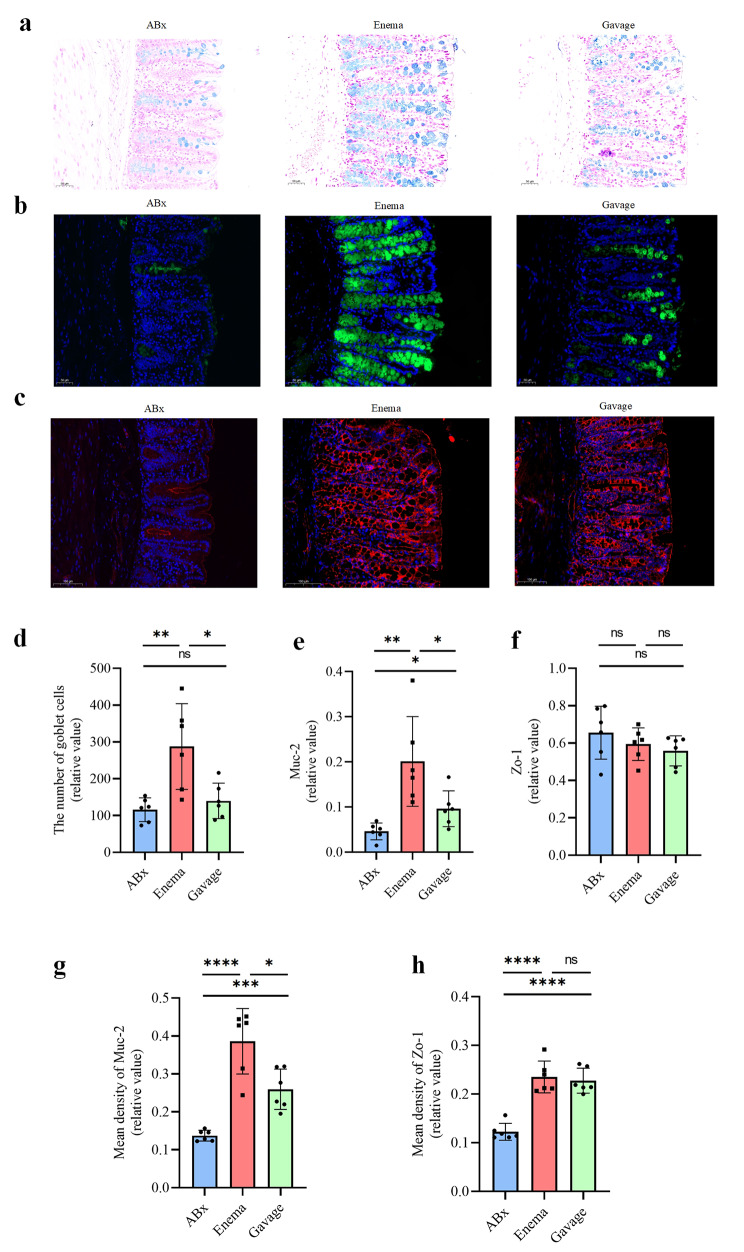
A device consisting of an external magnet and a magnet-tipped 6 Fr tube was used in the MAT group (n = 6), and the control group (n = 6) where fecal matter was delivered without magnetic navigation. The feasibility and safety of this method were assessed by angiography and histology. Next, the fecal microbiota of donor rats was transplanted into antibiotic knock-down rats via oral gavage (n = 6) and MAT-assisted proximal colon/cecum enema (n = 6) for a week. Analysis of fecal 16 S rRNA was conducted to determine differences in the composition of gut microbiota between different groups. The rat intestinal barrier integrity were evaulated by H&E and ZO-1/MUC2 immunofluorescence staining.
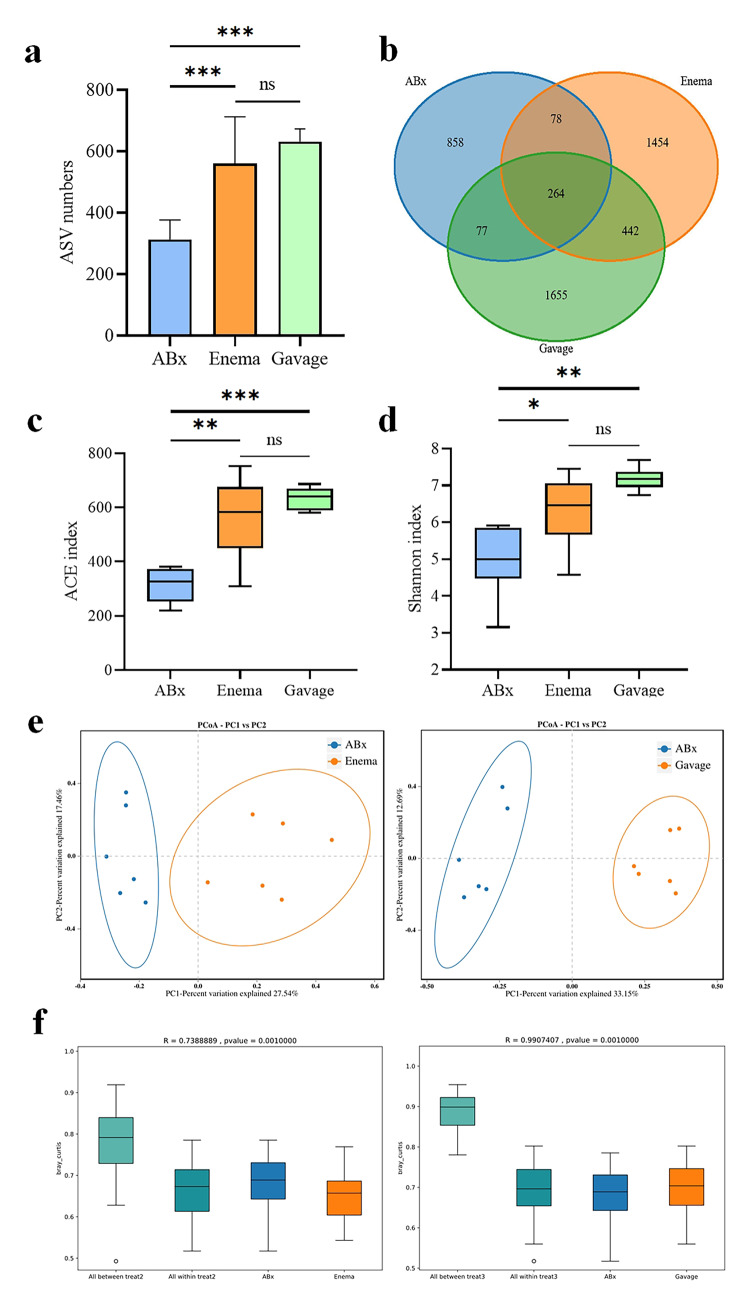
The end of the fecal tube could be placed in the cecum or proximal colon of rats in MAT group; however, this was rarely achieved in the control group. No colon perforation or bleeding was detected in either group. After fecal microbiota transplantation, the microbiota α-diversity and β-diversity were comparable among the different delivery routes.At the family level, the relative abundances of Muribaculaceae, Oscillospiraceae, and Erysipelotrichaceae were higher in the gavage treatment group, whereas Lactobacillaceae and Saccharimonadaceae were higher in the enema treatment group (all p < 0.05). FMT by enema was superior to gavage in maintaining the integrity of the rat intestinal barrier, as assessed by an elevation in the density of goblet cells and increased expression of mucin-2.
Fecal microbiota tube placement using magnetic navigation was safe and feasible in rats.Different delivery route for FMT affects the gut microbiota composition and the integrity of the rat intestinal barrier. Future experimental designs should consider the colonization outcomes of critical microbial taxa to determine the optimal FMT delivery routes in scientific research as well as clinical practise.
粪便微生物群移植(FMT)是将供体的粪便物质转移到受体的胃肠道中,以诱导肠道微生物群发生变化从而获得治疗益处;然而,对于通过不同供体材料递送途径进行FMT后肠道微生物群组成的差异,人们了解甚少。在本研究中,我们首先在健康的斯普拉格-道利大鼠中开发了一种用于FMT的新技术,即磁导航技术(MAT)辅助的近端结肠灌肠。此外,除了对肠道屏障功能的影响外,我们还在抗生素清除大鼠中确定了通过口服灌胃和近端结肠/盲肠灌肠进行FMT后粪便微生物群组成的差异。
MAT组(n = 6)使用由外部磁体和带磁头的6 Fr管组成的装置,对照组(n = 6)在无磁导航的情况下递送粪便物质。通过血管造影和组织学评估该方法的可行性和安全性。接下来,将供体大鼠的粪便微生物群通过口服灌胃(n = 6)和MAT辅助的近端结肠/盲肠灌肠(n = 6)移植到抗生素清除大鼠中,持续一周。进行粪便16S rRNA分析以确定不同组之间肠道微生物群组成的差异。通过苏木精-伊红(H&E)染色和紧密连接蛋白-1(ZO-1)/黏蛋白-2(MUC2)免疫荧光染色评估大鼠肠道屏障的完整性。
MAT组能够将粪管末端放置在大鼠的盲肠或近端结肠;然而,对照组很少能做到这一点。两组均未检测到结肠穿孔或出血。粪便微生物群移植后,不同递送途径之间的微生物群α多样性和β多样性相当。在科水平上,灌胃治疗组中毛螺菌科、颤螺菌科和丹毒丝菌科的相对丰度较高,而灌肠治疗组中乳酸杆菌科和糖单胞菌科的相对丰度较高(所有p < 0.05)。通过杯状细胞密度升高和黏蛋白-2表达增加评估,灌肠法进行FMT在维持大鼠肠道屏障完整性方面优于灌胃法。
在大鼠中使用磁导航放置粪便微生物群管是安全可行的。FMT的不同递送途径会影响肠道微生物群组成和大鼠肠道屏障的完整性。未来的实验设计应考虑关键微生物类群的定殖结果,以确定科学研究和临床实践中最佳的FMT递送途径。