
确定反应控制燃烧发动机中实现最佳输出特性的运行条件。
Establish operating conditions for optimal output characteristics in reactivity controlled combustion engine.
作者信息
Muniyappan Sinnappadass, Krishnaiah Ravi
机构信息
School of Mechanical Engineering, VIT University, Vellore, 632014, Tamilnadu, India.
出版信息
Sci Rep. 2025 May 16;15(1):17101. doi: 10.1038/s41598-025-00497-2.
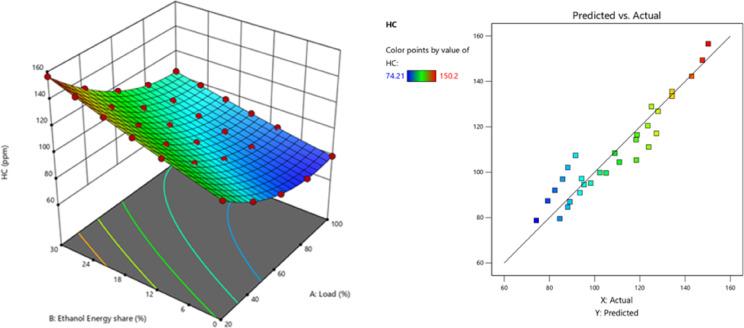
This work aims to determine the optimal engine operating conditions for balanced combustion, performance and emissions characteristics with considerable reduction in smoke and nitrogen oxides (NOx). This work examined direct injected (DI) 30% mahua biodiesel-diesel as high reactive fuel (HRF) and port fuel injected (PFI) ethanol as low reactive fuel (LRF) in reactivity controlled compression ignition (RCCI) combustion at different engine loads and ethanol energy shares (EES) (0, 10, 15, 20, 25, and 30%). The RCCI engine was able to access low temperature combustion (LTC) with improved brake thermal efficiency (BTE), lower smoke and NOx with a trade-off in carbon monoxide (CO) and hydrocarbon (HC). The duty conditions of modern engines require single optimal operating condition to suit applications such as hybrid powertrain, generators and irrigation pumps. Using response surface methodology (RSM) it was established that 28.43% EES at 83.4% engine load resulted in optimal output responses for their due weightages assigned. This was validated by experimental results. In RCCI mode BTE of 32.54%, brake specific energy consumption (BSEC) of 10.79 MJ/kWh were realized. Also, smoke and NOx were reduced by 34.8% and 29.3%, with a compromise in CO and HC increase by 36.4% and 34.9% compared to DI mode. All the engine output parameters reported were within acceptable range. HC and CO can be mitigated with conventional catalytic convertors.
这项工作旨在确定最佳发动机运行条件,以实现平衡燃烧、性能和排放特性,同时大幅减少烟雾和氮氧化物(NOx)。这项工作研究了在不同发动机负荷和乙醇能量份额(EES)(0、10、15、20、25和30%)下,将直喷(DI)30%的麻疯树生物柴油-柴油作为高反应性燃料(HRF)和将进气道燃油喷射(PFI)乙醇作为低反应性燃料(LRF)用于反应控制压缩点火(RCCI)燃烧。RCCI发动机能够实现低温燃烧(LTC),提高制动热效率(BTE),降低烟雾和NOx,但以一氧化碳(CO)和碳氢化合物(HC)的增加为代价。现代发动机的工况要求单一的最佳运行条件以适用于混合动力系统、发电机和灌溉泵等应用。使用响应面方法(RSM)确定,在83.4%的发动机负荷下,28.43%的EES可产生针对其分配的相应权重的最佳输出响应。实验结果验证了这一点。在RCCI模式下,实现了32.54%的BTE和10.79 MJ/kWh的制动比能量消耗(BSEC)。此外,与DI模式相比,烟雾和NOx分别减少了34.8%和29.3%,而CO和HC分别增加了36.4%和34.9%。所有报告的发动机输出参数均在可接受范围内。HC和CO可以通过传统的催化转化器来减轻。




 Zotero 插件