Naveenkumar Selvam, Kamaraj Chinnaperumal, Kumarasamy Vinoth, Jayaseelan Chidambaram, Prem Pradisha, Boomija Rajagopalan Vijayalakshmi, Suseem S R, Subramaniyan Vetriselvan, Barasarathi Jayanthi, Wong Ling Shing
Department of Biotechnology, Faculty of Science and Humanities, SRM Institute of Science and Technology (SRMIST), Kattankulatur, Chennai, Tamil Nadu, 603203, India.
Interdisciplinary Institute of Indian System of Medicine, Directorate of Research, SRM Institute of Science and Technology, Kattankulathur, Tamil Nadu, 603203, India.
Sci Rep. 2025 May 20;15(1):17452. doi: 10.1038/s41598-025-99998-3.
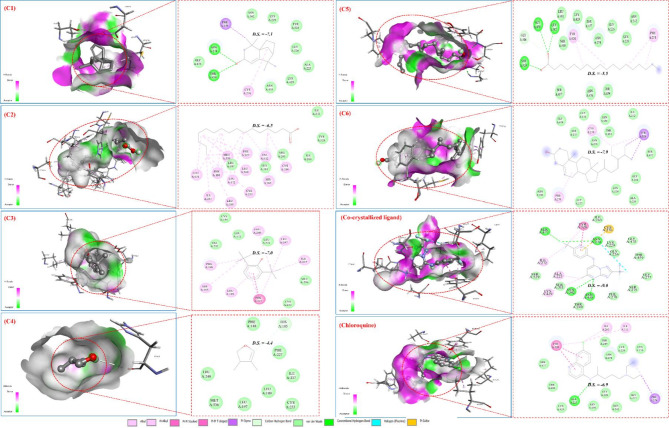
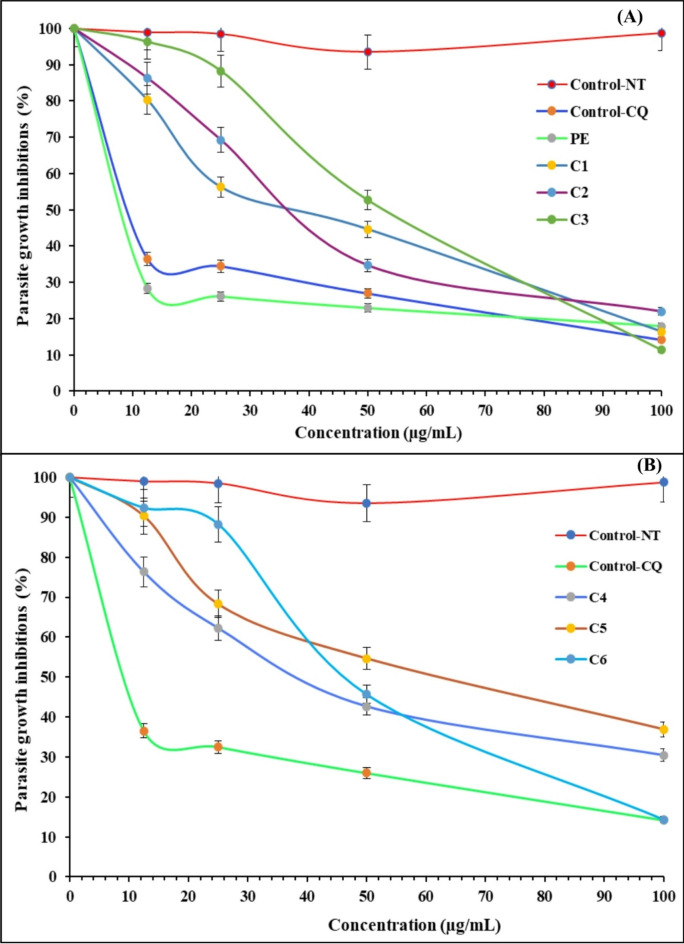
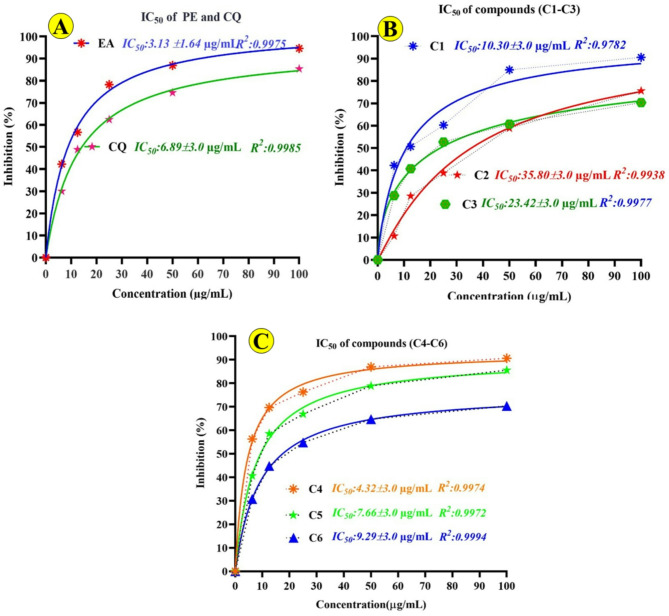
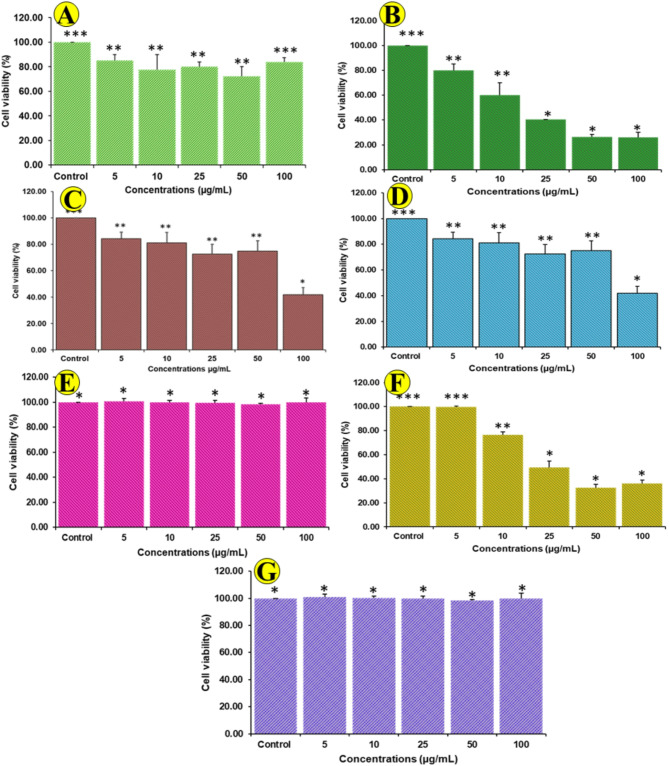
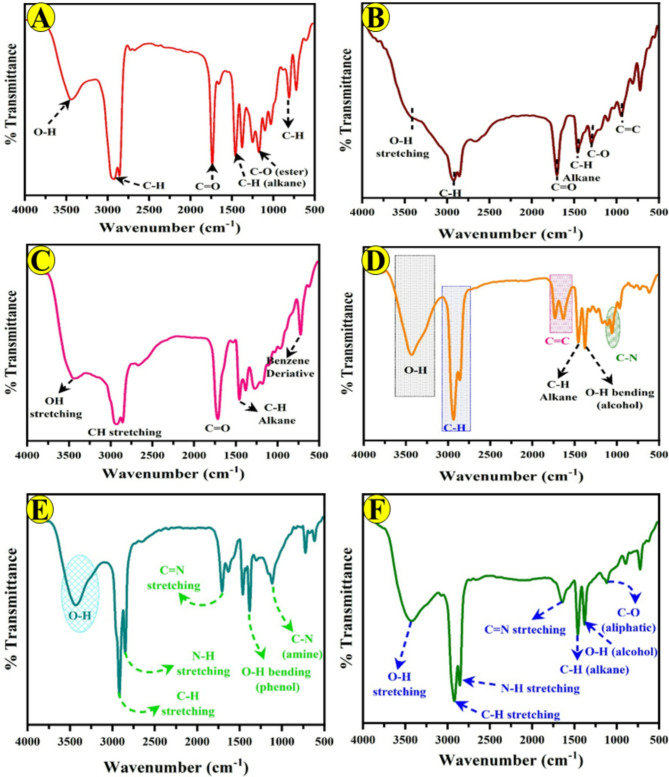
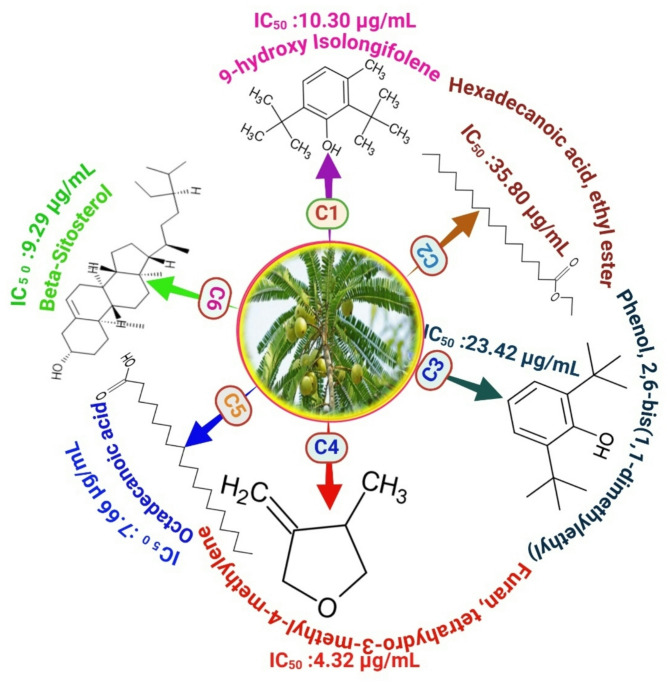
Natural products can serve as an alternative source of novel therapies that are required to address the problem of malarial infection resistance. Indian gooseberry (Phyllanthus emblica L.) leaves are often used in traditional medicine to treat fevers, but there isn't enough scientific proof that they contain antimalarial and effective phytochemicals. This study's primary goal was to investigate the antimalarial efficacy of P. emblica leaf ethyl acetate extract against Plasmodium falciparum (3D7) and its cytotoxicity against the HeLa cell line. The active compounds from P. emblica were isolated using a bioassay-guided fractionation of column chromatography technique, and NMR spectroscopy was employed to identify their structures. The drug's anti-malarial efficacy was assessed by estimating its growth-inhibitory activities employing the SYBR Green I asexual parasite drug assay. The cytotoxic effect was evaluated using the MTT assay. P. falciparum dihydroorotate dehydrogenase protein (Pf-DDP) was used as a drug target to investigate molecular docking. P. emblica crude extract and two fractions exhibited > 90% inhibition of 3D7 parasite proliferation, indicating good antimalarial activity at 100 and 10 µg/mL, respectively. Subsequently, the column chromatography study of each fraction, a targeted purification, contributed to the separation of six active compounds designated as 9-hydroxy isolongifolene (C1), Hexadecanoic acid (C2), Phenol, 2,6-Bis(1,1-Dimethylethyl) (C3), Furan, tetrahydro-3-methyl-4-methylene (C4), Octadecanoic acid (C5), and Beta-Sitosterol (C6). Compound C4 showed stronger bioactivity against P. falciparum (3D7) (IC 4.32 µg/mL) parasites than other constituents, equivalent to the drug-sensitive strains (100 µg/mL). Considering the IC levels of the two compounds, 90.56 and > 100 µg/mL, respectively, both demonstrated low cytotoxicity against HeLa cell lines. This research offers scientific support for the historical application of P. emblica in combating malaria. Building on existing knowledge, this study represents a groundbreaking effort to isolate and identify antimalarial compounds from P. emblica leaves for the first time. Moreover, our research underscores the potential of P. emblica in the development of antimalarial agents, encouraging further investigation of different species to suppress the growth of P. falciparum. This plant species could be a valuable source for developing new anti-malarial drugs.
天然产物可作为新型疗法的替代来源,以应对疟疾感染耐药性问题。印度醋栗(余甘子)叶常用于传统医学治疗发热,但尚无足够科学证据表明其含有抗疟且有效的植物化学物质。本研究的主要目的是调查余甘子叶乙酸乙酯提取物对恶性疟原虫(3D7)的抗疟效果及其对HeLa细胞系的细胞毒性。采用柱色谱生物测定导向分馏技术从余甘子中分离出活性化合物,并利用核磁共振光谱鉴定其结构。通过使用SYBR Green I无性寄生虫药物测定法评估药物的生长抑制活性来评估其抗疟效果。使用MTT测定法评估细胞毒性。以恶性疟原虫二氢乳清酸脱氢酶蛋白(Pf-DDP)作为药物靶点进行分子对接研究。余甘子粗提物和两个馏分分别在100和10 μg/mL时对3D7疟原虫增殖表现出>90%的抑制作用,表明具有良好的抗疟活性。随后,对每个馏分进行柱色谱研究,即靶向纯化,有助于分离出六种活性化合物,分别命名为9-羟基异长叶烯(C1)、十六烷酸(C2)、2,6-双(1,1-二甲基乙基)苯酚(C3)、3-甲基-4-亚甲基四氢呋喃(C4)、十八烷酸(C5)和β-谷甾醇(C6)。化合物C4对恶性疟原虫(3D7)寄生虫的生物活性比其他成分更强(IC50为4.32 μg/mL),与药物敏感株(100 μg/mL)相当。考虑到这两种化合物的IC50水平分别为90.56和>100 μg/mL,两者对HeLa细胞系均表现出低细胞毒性。本研究为余甘子在对抗疟疾方面的历史应用提供了科学支持。基于现有知识,本研究首次从余甘子叶中分离和鉴定抗疟化合物,是一项开创性的工作。此外,我们的研究强调了余甘子在抗疟药物开发中的潜力,鼓励对不同物种进行进一步研究以抑制恶性疟原虫的生长。这种植物物种可能是开发新型抗疟药物的宝贵来源。