An Jie, Wu Kaiqi, Wu Teng, Xu Pengyang, Yang Chuanli, Fan Yunhe, Li Qing, Dong Xiushan
Department of General Surgery, Shanxi Bethune Hospital, Taiyuan, Shanxi, China.
Third Hospital of Shanxi Medical University, Taiyuan, Shanxi, China.
BMJ Open. 2025 May 21;15(5):e088512. doi: 10.1136/bmjopen-2024-088512.
Drug-induced ischaemic colitis is a significant adverse event (AE) in clinical practice. This study aimed to recognise the top drugs associated with the risk of ischaemic colitis based on the FDA Adverse Event Reporting System (FAERS) database.
A cross-sectional design.
All data retrieved from the FAERS database from the first quarter of 2004 to the fourth quarter of 2023.
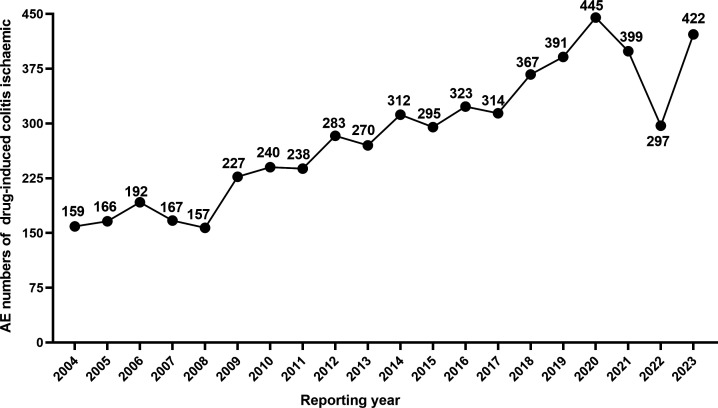
A total of 5664 drug-induced ischaemic colitis AEs eligible for screening.
The Medical Dictionary for Regulatory Activities was used to identify ischaemic colitis (code: 10009895) cases. Disproportionality analysis for drug-associated ischaemic colitis signals.
Drug-induced ischaemic colitis AEs were more prevalent in females (60.12%) and individuals aged ≥65 years (34.25%). The common outcomes were hospitalisation (46.85%) and death (9.73%). Disproportionality analysis identified 91 ischaemic colitis signals and the top 30 drugs mainly involved in the gastrointestinal and nervous systems. The top five drugs with the highest reported OR, proportional reporting ratio, information component and the empirical Bayesian geometric mean, were alosetron, tegaserod, osmoprep, naratriptan and kayexalate. Additionally, 20 of the top 30 drugs did not have ischaemic colitis risk indicated in the package insert.
This study identified key drugs associated with ischaemic colitis, particularly alosetron, tegaserod, osmoprep, naratriptan and kayexalate. Notably, two-thirds of these drugs lacked ischaemic colitis warnings in their package inserts. These findings underscore the need for greater clinical vigilance, improved regulatory oversight and further research to clarify underlying mechanisms and support safer medication use.
药物性缺血性结肠炎是临床实践中的一种重要不良事件(AE)。本研究旨在基于美国食品药品监督管理局不良事件报告系统(FAERS)数据库,识别与缺血性结肠炎风险相关的主要药物。
横断面设计。
检索2004年第一季度至2023年第四季度FAERS数据库中的所有数据。
共有5664例符合筛查条件的药物性缺血性结肠炎不良事件。
使用《监管活动医学词典》识别缺血性结肠炎(代码:10009895)病例。对药物相关缺血性结肠炎信号进行不成比例分析。
药物性缺血性结肠炎不良事件在女性(60.12%)和年龄≥65岁的个体(34.25%)中更为普遍。常见结局为住院(46.85%)和死亡(9.73%)。不成比例分析识别出91个缺血性结肠炎信号,前30种药物主要涉及胃肠道和神经系统。报告的比值比、比例报告率、信息成分和经验贝叶斯几何均值最高的前五种药物为阿洛司琼、替加色罗、聚乙二醇电解质散、那拉曲普坦和聚苯乙烯磺酸钠。此外,前30种药物中有20种在药品说明书中未标明有缺血性结肠炎风险。
本研究识别出了与缺血性结肠炎相关的关键药物,特别是阿洛司琼、替加色罗、聚乙二醇电解质散、那拉曲普坦和聚苯乙烯磺酸钠。值得注意的是,这些药物中有三分之二在药品说明书中缺乏缺血性结肠炎警告。这些发现强调需要提高临床警惕性、加强监管监督并进行进一步研究,以阐明潜在机制并支持更安全的药物使用。