Egoávil-Espejo Rocío, Ymaña Barbara, Oporto-Llerena Rosario, Navarro Dafne, Huerto-Huánuco Rosario, Salvador-Luján Gina, Ortiz-Gómez Tamin, Pinedo-Bardales Maria, Palomino-Kobayashi Luciano A, Gómez Andrea C, Castillo Angie K, Gonzales Patricia, Valera-Krumdieck Carmen, Soza Gabriela, Zapata-Cachay Cristhian, Riveros Maribel, Pons Maria J, Ruiz Joaquim
Grupo de Investigación en Dinámicas y Epidemiología de la Resistencia a Antimicrobianos-"One Health", Universidad Científica del Sur, Antigua Panamericana Sur Km 19, Villa El Salvador, 15067 Lima, Peru.
Laboratorio de Microbiología, Hospital Militar Central, Lima, Peru.
JAC Antimicrob Resist. 2025 May 21;7(3):dlaf082. doi: 10.1093/jacamr/dlaf082. eCollection 2025 Jun.
To determine the activity of cefiderocol against 101 Peruvian isolates.
Carbapenem- and/or third- and fourth-generation cephalosporin-resistant clinical isolates were isolated in nine Peruvian health centres. Antibiotic susceptibility was established by automated methods and/or disc diffusion (10 antimicrobial agents), colistin agar test (colistin) and microdilution (cefiderocol). The presence of , , , , , , , , , , , and was established by PCR; and were sequenced. The levels of antimicrobial resistance ranged from 20.8% (colistin) to 97.0% (meropenem).
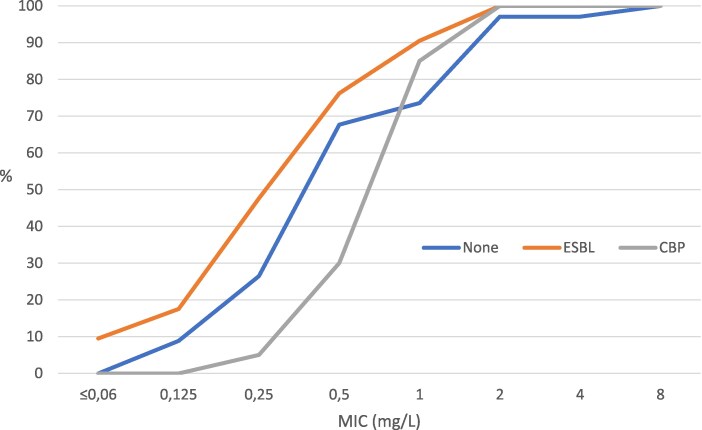
The MIC of cefiderocol ranged from ≤ 0.06 to 8 mg/L (one isolate). Cefiderocol resistance rates were 1.0% (according to the FDA and EUCAST) and 0% according to CLSI, whereas 14.9% and 1.0% of isolates were classified as cefiderocol-intermediate according to FDA and CLSI, respectively. CTX-M-131 and GES, and IMP and VIM were the most frequent ESBLs and carbapenemases, respectively. The presence of mutations was tested in 47 carbapenem-resistant isolates, 23 with -inactivating mutations as the sole underlying mechanism. Although no specific association was found between the presence of ESBLs and carbapenemases with cefiderocol resistance, carbapenemase-producing isolates tended to present slightly higher cefiderocol MIC values. The cefiderocol-resistant isolate did not present ESBLs or carbapenemases, showing only an -inactivating mutation.
Cefiderocol showed excellent activity against , irrespective of the presence of ESBLs and/or carbapenemases. The high number of isolates bordering cefiderocol-resistant levels suggests the need for cautious use and continuous surveillance of this antibiotic.
测定头孢地尔对101株秘鲁分离株的活性。
在秘鲁的9个医疗中心分离出对碳青霉烯类和/或第三代及第四代头孢菌素耐药的临床分离株。通过自动化方法和/或纸片扩散法(10种抗菌药物)、多粘菌素琼脂试验(多粘菌素)和微量稀释法(头孢地尔)确定抗生素敏感性。通过PCR检测 、 、 、 、 、 、 、 、 、 、 、 和 的存在情况;对 和 进行测序。抗菌药物耐药水平从20.8%(多粘菌素)到97.0%(美罗培南)不等。
头孢地尔的MIC范围为≤0.06至8mg/L(1株分离株)。根据FDA和EUCAST标准,头孢地尔耐药率为1.0%,而根据CLSI标准为0%;根据FDA和CLSI标准,分别有14.9%和1.0%的分离株被分类为头孢地尔中介株。CTX-M-131和GES分别是最常见的超广谱β-内酰胺酶(ESBLs),IMP和VIM分别是最常见的碳青霉烯酶。在47株碳青霉烯耐药分离株中检测了 突变,其中23株以 -失活突变作为唯一潜在机制。虽然未发现ESBLs和碳青霉烯酶的存在与头孢地尔耐药之间存在特定关联,但产碳青霉烯酶的分离株往往呈现略高的头孢地尔MIC值。头孢地尔耐药分离株未产生ESBLs或碳青霉烯酶,仅显示 -失活突变。
无论是否存在ESBLs和/或碳青霉烯酶,头孢地尔对 均显示出优异的活性。接近头孢地尔耐药水平的分离株数量众多,表明需要谨慎使用并持续监测这种抗生素。