Yamazaki Reiji, Ohno Nobuhiko
Department of Anatomy, Division of Histology and Cell Biology, School of Medicine, Jichi Medical University, Shimotsuke, Japan.
Division of Ultrastructural Research, National Institute for Physiological Sciences, Okazaki, Japan.
Front Cell Neurosci. 2025 May 7;19:1582902. doi: 10.3389/fncel.2025.1582902. eCollection 2025.
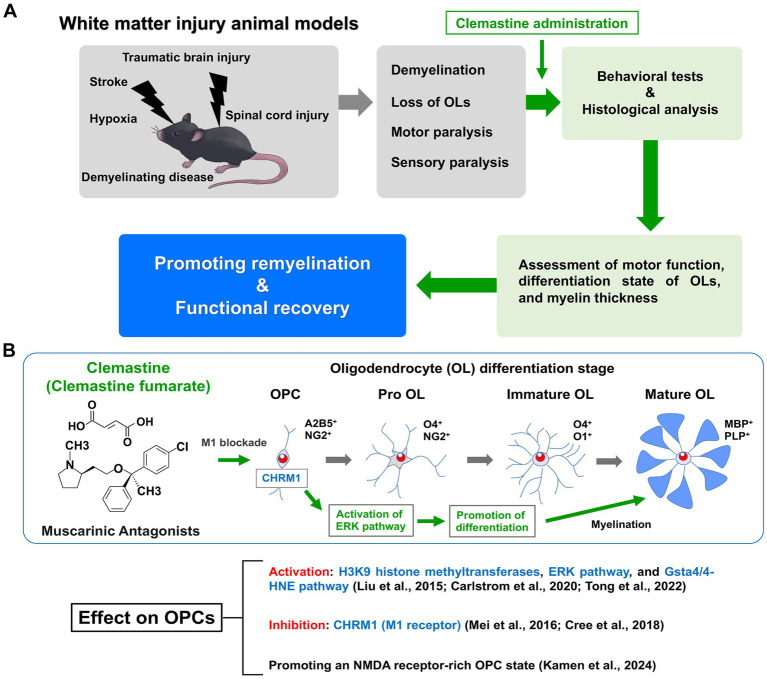
White matter in the central nervous system comprises bundled nerve fibers myelinated by oligodendrocytes. White matter injury, characterized by the loss of oligodendrocytes and myelin, is common after ischemic brain injury, inflammatory demyelinating diseases including multiple sclerosis, and traumatic damage such as spinal cord injury. Currently, no therapies have been confirmed to promote remyelination in these diseases. Over the past decade, various reports have suggested that the anti-muscarinic drug clemastine can stimulate remyelination by oligodendrocytes. Consequently, the repurposing of clemastine as a potential treatment for a variety of neurological disorders has gained significant attention. The therapeutic effects of clemastine have been demonstrated in various animal models, and its mechanisms of action in various neurological disorders are currently being investigated. In this review, we summarize reports relating to clemastine administration for white matter injury and neurological disease and discuss the therapeutic potential of remyelination promotion.
中枢神经系统中的白质由少突胶质细胞髓鞘化的成束神经纤维组成。以少突胶质细胞和髓鞘丢失为特征的白质损伤,在缺血性脑损伤、包括多发性硬化症在内的炎症性脱髓鞘疾病以及诸如脊髓损伤等创伤性损伤后很常见。目前,尚无已证实能促进这些疾病中髓鞘再生的疗法。在过去十年中,各种报告表明抗毒蕈碱药物氯马斯汀可以刺激少突胶质细胞进行髓鞘再生。因此,将氯马斯汀重新用作治疗多种神经疾病的潜在药物已引起了广泛关注。氯马斯汀的治疗效果已在各种动物模型中得到证实,目前正在研究其在各种神经疾病中的作用机制。在这篇综述中,我们总结了有关氯马斯汀用于治疗白质损伤和神经疾病的报告,并讨论了促进髓鞘再生的治疗潜力。