Zhan Yangqing, Fang Zhonghao, Hu Yinhong, Luo Jincan, Hou Lili, Li Yilin, Li Qiexinhao, Liu Yuyue, Yang Chuoqi, Liang Shiwei, Zhao Kun, Zhong Nanshan, Yang Zifeng
National Clinical Research Center for Respiratory Disease, State Key Laboratory of Respiratory Disease, Guangzhou Institute of Respiratory Health, the First affiliated Hospital of Guangzhou Medical University, Guangzhou, China.
Guangzhou Laboratory, Bio-Island, Guangzhou, China.
J Thorac Dis. 2025 Apr 30;17(4):2623-2633. doi: 10.21037/jtd-24-1542. Epub 2025 Apr 28.
Seasonal influenza poses a high risk of death worldwide. Lianhua Qingwen (LHQW) is effective in shortening the time to symptom alleviation in patients with influenza, but there is a lack of convincing clinical trials targeting influenza prevention. This study aims to evaluate both efficacy and safety of LHQW in the preventing spread of seasonal influenza among close contacts under a cluster setting.
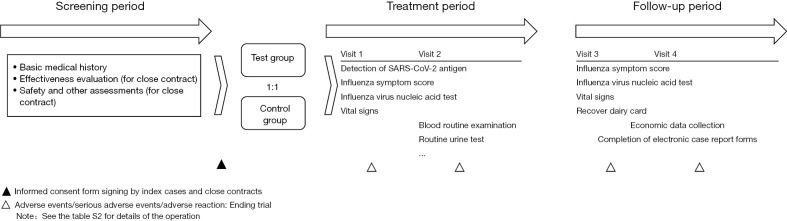
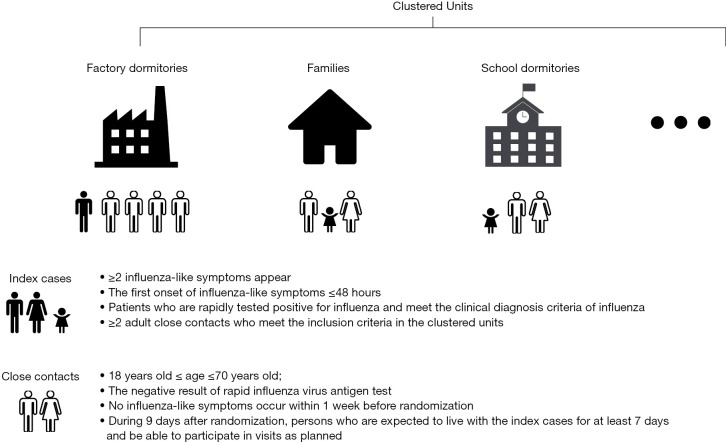
This study is a randomized, double-blind, multicenter clinical trial to evaluate the preventive efficacy and safety of LHQW in close contacts in a residential environments; 1,884 close contacts will be enrolled in this trial at 72 centers in China, with a five-day duration of LHQW or placebo. All participants were randomized into the LHQW and placebo groups in a 1:1 ratio via the interactive web response system (IWRS), balanced by the stochastic minimization method. Participants are required to undergo three visits (on days 3, 5, and 9 after initiation of medication). At each visit, a throat swab is collected from the participant, and RT-PCR is used to detect influenza virus nucleic acid. Symptom scoring will be performed nightly for the duration of the trial. The primary efficacy outcome was the secondary infection risk in close contacts on day 9 (±1) after medication. Safety outcomes are the incidence and severity of adverse events. This study used a randomized, double-blind, multicenter design method to evaluate the efficacy and safety of LHQW for close contacts in a congregate setting with risks of seasonal influenza transmission, to provide a valuable reference for clinical application. The treatment period of this study was five days and 1,884 close contacts were enrolled. All cases were randomized into experimental and placebo groups as index cases, and each subject returned three times during the treatment period on days 3, 5 and 9 after drug or placebo treatment, respectively, and the corresponding examinations were performed to evaluate the effect of the drug. Symptom scoring will be performed nightly for the duration of the trial.
This trial is the first seasonal influenza prevention study of traditional Chinese medicines concerning prophylactic effects globally. Positive findings could demonstrate the efficacy of LHQW against seasonal influenza, which provides a new therapeutic option for infection prevention, symptom alleviation, cost reduction, and renewal of treatment guideline.
The trial has been registered at Chinese Clinical Trial Registry (ChiCTR2300074385).
季节性流感在全球范围内构成了很高的死亡风险。连花清瘟(LHQW)能有效缩短流感患者症状缓解时间,但缺乏针对流感预防的有说服力的临床试验。本研究旨在评估连花清瘟在聚集性环境下预防密切接触者中季节性流感传播的有效性和安全性。
本研究是一项随机、双盲、多中心临床试验,旨在评估连花清瘟在居住环境中对密切接触者的预防效果和安全性;1884名密切接触者将在中国72个中心参与本试验,服用连花清瘟或安慰剂,为期5天。所有参与者通过交互式网络响应系统(IWRS)以1:1的比例随机分为连花清瘟组和安慰剂组,并通过随机最小化方法进行平衡。参与者需要接受三次访视(在用药后第3天、第5天和第9天)。每次访视时,从参与者身上采集咽拭子,并使用逆转录聚合酶链反应(RT-PCR)检测流感病毒核酸。在试验期间每晚进行症状评分。主要疗效指标是用药后第9天(±1天)密切接触者的继发感染风险。安全性指标是不良事件的发生率和严重程度。本研究采用随机、双盲、多中心设计方法,评估连花清瘟在存在季节性流感传播风险的聚集性环境中对密切接触者的有效性和安全性,为临床应用提供有价值的参考。本研究的治疗期为5天,共纳入1884名密切接触者。所有病例作为索引病例随机分为试验组和安慰剂组,每个受试者在接受药物或安慰剂治疗后的第3天、第5天和第9天分别在治疗期间返回三次,并进行相应检查以评估药物效果。在试验期间每晚进行症状评分。
本试验是全球首个关于中药预防季节性流感效果的研究。阳性结果可能证明连花清瘟对季节性流感的疗效,这为预防感染、缓解症状、降低成本和更新治疗指南提供了新的治疗选择。
该试验已在中国临床试验注册中心(ChiCTR2300074385)注册。