Zhang Qi-Feng, Zhang Shuang-Long, Li Gang, Guo Miao, Qi Xiao-Xia, Xing Xiao-Hui, Wang Zheng
Department of Critical Care Medicine, Peking University International Hospital, Beijing, China.
Department of Neurosurgery, Tianjin Medical University General Hospital, Tianjin, China.
Front Cardiovasc Med. 2025 May 7;12:1557909. doi: 10.3389/fcvm.2025.1557909. eCollection 2025.
The objective of this study is to examine the prognostic value of lactate clearance, fluid balance, and the Acute Physiology and Chronic Health Evaluation II (APACHE II) score in patients with cardiogenic shock undergoing treatment with extracorporeal membrane oxygenation (ECMO).
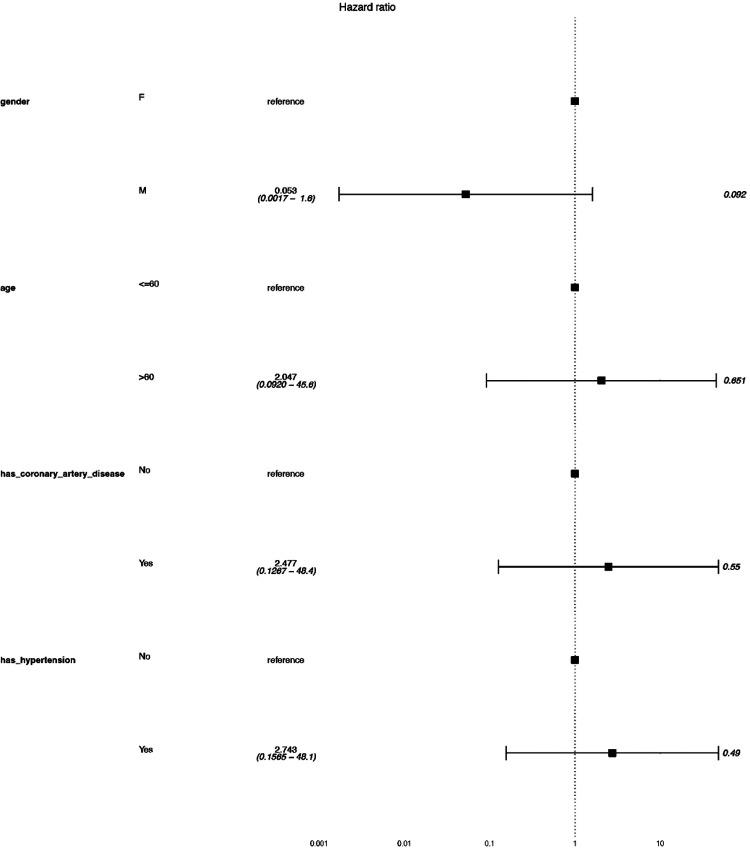
A retrospective analysis was conducted on 32 patients with cardiogenic shock who underwent ECMO in the Intensive Care Unit of Peking University International Hospital between January 2021 and June 2024. The patients were categorized into a survival group ( = 14) and a non-survival group ( = 18) based on their clinical outcomes. Baseline characteristics, including age, sex, and body weight and so on were collected for both groups. Multivariate logistic regression analysis was used to identify risk factors influencing patient prognosis. The prognostic value of relevant indicators was assessed using receiver operating characteristic curve analysis, while Pearson's correlation analysis was conducted to assess the relationships between specific indicators.
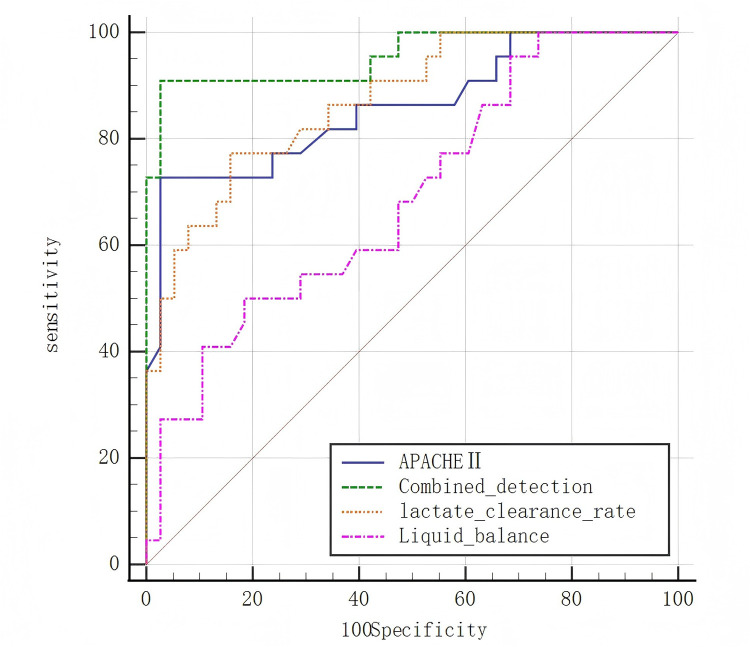
Lactate clearance was significantly lower in the non-survival group compared to the survival group, while fluid balance and APACHE II scores were notably higher in the non-survival group ( < 0.05). Based on the predictive model, the APACHE II score demonstrated the highest specificity for prognosis at 97.4%, whereas the combined indices exhibited the highest sensitivity at 95.5%. Additionally, lactate clearance revealed a negative correlation with both fluid balance and APACHE II scores ( < 0.05).
This pilot study demonstrated that lactate clearance, fluid balance, and APACHE II score are valuable prognostic indicators for patients; however, the predictive accuracy of individual indicators is limited. The combined assessment of these indices provides a more robust and reliable predictive performance.
本研究旨在探讨乳酸清除率、液体平衡以及急性生理与慢性健康状况评分系统II(APACHE II)评分在接受体外膜肺氧合(ECMO)治疗的心源性休克患者中的预后价值。
对2021年1月至2024年6月期间在北京大学国际医院重症监护室接受ECMO治疗的32例心源性休克患者进行回顾性分析。根据临床结局将患者分为生存组(n = 14)和非生存组(n = 18)。收集两组患者的基线特征,包括年龄、性别、体重等。采用多因素logistic回归分析确定影响患者预后的危险因素。采用受试者工作特征曲线分析评估相关指标的预后价值,同时进行Pearson相关性分析评估特定指标之间的关系。
非生存组的乳酸清除率显著低于生存组,而非生存组的液体平衡和APACHE II评分显著更高(P < 0.05)。基于预测模型,APACHE II评分对预后的特异性最高,为97.4%,而联合指标的敏感性最高,为95.5%。此外,乳酸清除率与液体平衡和APACHE II评分均呈负相关(P < 0.05)。
这项初步研究表明,乳酸清除率、液体平衡和APACHE II评分是患者有价值的预后指标;然而,单个指标的预测准确性有限。这些指标的联合评估提供了更强有力和可靠的预测性能。