Batatolis Christos, Karatrantou Konstantina, Vasilopoulou Theodora, Chanou Konstantina, Tsiakaras Nikolaos, Gerodimos Vassilis
Department of Physical Education and Sport Science, University of Thessaly, 42100 Trikala, Greece.
J Funct Morphol Kinesiol. 2025 May 14;10(2):173. doi: 10.3390/jfmk10020173.
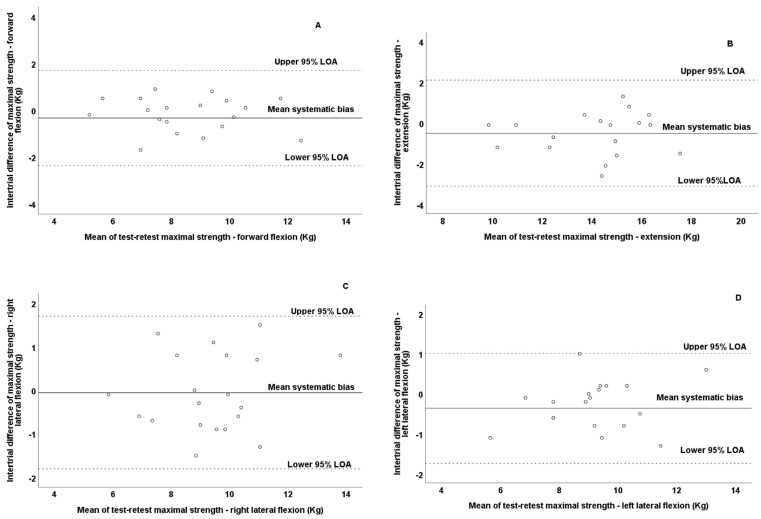
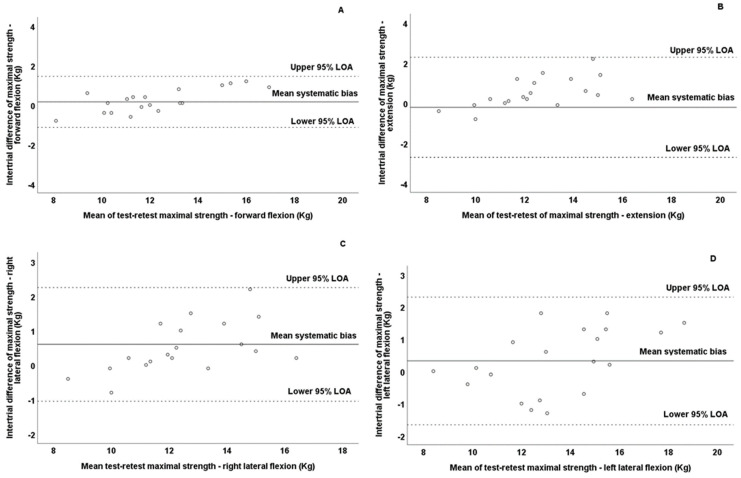
: The cervical spine plays an important role in several daily activities of children and adolescents, and thus, its evaluation using reliable protocols is of crucial importance. This study examined the test-retest reliability of cervical strength protocols using indices of absolute (standard error of measurement-SEM and 95% limits of agreement-LOA) and relative reliability (intraclass correlation coefficient-ICC). : Twenty prepubertal (9.10 ± 0.61 years old) and twenty pubertal boys (13.6 ± 0.6 years old) participated in two assessment sessions separated by 48 h. During both sessions, maximal isometric strength (forward flexion, extension, and right-left lateral flexion) was assessed using a handheld dynamometer, and then, the cervical flexion-to-extension ratio (cervical ratio) was calculated. : According to our data analysis, good absolute and relative reliability was denoted for prepubertal boys in all cervical movements (ICC = 0.81-0.90; SEM% = 5.82-8.62); conversely, pubertal boys denoted high relative and absolute reliability in all directions of movements (ICC = 0.90-0.96; SEM% = 3.8-5.5). The cervical ratio showed moderate reliability in prepubertal (ICC = 0.71; SEM% = 9.11) and pubertal boys (ICC = 0.78; SEM% = 7). : In conclusion, the isometric strength of cervical muscles, using a handheld dynamometer, showed acceptable reliability in prepubertal and pubertal boys; however, prepubertal boys demonstrated slightly lower reliability. Additionally, the assessment of the cervical ratio should be interpreted with caution. However, it would be important to carry out future studies to strengthen the findings of the present study.
颈椎在儿童和青少年的多项日常活动中发挥着重要作用,因此,使用可靠的方案对其进行评估至关重要。本研究使用绝对可靠性指标(测量标准误差-SEM和95%一致性界限-LOA)和相对可靠性指标(组内相关系数-ICC)检验了颈椎力量方案的重测可靠性。20名青春期前男孩(9.10±0.61岁)和20名青春期男孩(13.6±0.6岁)参加了两次评估,两次评估间隔48小时。在两次评估期间,使用手持测力计评估最大等长力量(前屈、后伸和左右侧屈),然后计算颈椎屈伸比(颈椎比值)。根据我们的数据分析,青春期前男孩在所有颈椎运动中均表现出良好的绝对和相对可靠性(ICC = 0.81 - 0.90;SEM% = 5.82 - 8.62);相反,青春期男孩在所有运动方向上均表现出较高的相对和绝对可靠性(ICC = 0.90 - 0.96;SEM% = 3.8 - 5.)。颈椎比值在青春期前男孩(ICC = 0.71;SEM% = 9.11)和青春期男孩(ICC = 0.78;SEM% = 7)中表现出中等可靠性。总之,使用手持测力计测量的颈椎肌肉等长力量在青春期前和青春期男孩中表现出可接受的可靠性;然而,青春期前男孩的可靠性略低。此外,对颈椎比值的评估应谨慎解释。然而,开展未来研究以强化本研究的结果将很重要。