Dei Cas Michele, Mantovani Stefania, Oliviero Barbara, Zulueta Aida, Montavoci Linda, Falleni Monica, Tosi Delfina, Morano Camillo, Penati Sara, Chiocchetti Annalisa, Sinella Riccardo, Barbero Mazzucca Camilla, Donadon Matteo, Soldani Cristiana, Piccolo Gaetano, Barabino Matteo, Bianchi Paolo Pietro, Maestri Marcello, Lleo Ana, Banales Jesus M, Mondelli Mario U, Caretti Anna
Department of Health Sciences, University of Milan, Milan, Italy.
Research Department, Division of Clinical Immunology-Infectious Diseases, Fondazione IRCCS Policlinico San Matteo, Pavia, Italy.
Hepatol Commun. 2025 May 23;9(6). doi: 10.1097/HC9.0000000000000717. eCollection 2025 Jun 1.
Cholangiocarcinoma (CCA) is a globally rare, increasingly incident cancer. Metabolic reprogramming is common in cancer cells, and altered lipid homeostasis favors tumor development and progression. Previous studies have described lipid deregulation in HCC cells, while in CCA, the lipidome profile is still poorly characterized.
We used liquid chromatography-tandem mass spectrometry to examine the lipid level profile of intrahepatic CCA (iCCA) and non-tumor surrounding tissue from patients, as well as in patients' and healthy controls' sera.
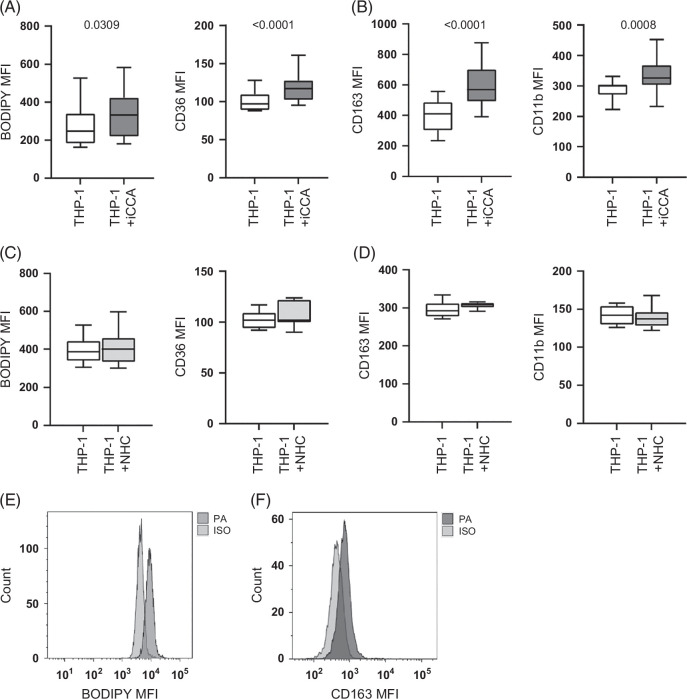
All lipid classes were upregulated in tumor specimens and iCCA-derived sera. Newly synthesized fatty acids (FAs) accumulated in iCCA and were only marginally directed to mitochondrial β-oxidation and scarcely folded in lipid droplets as neutral species. Metabolic flux assay showed that FAs were instead redirected toward plasma membrane formation and remodeling, being incorporated into phospholipids and sphingomyelin. A distinct lipid droplet and macrophage distribution was revealed by immunohistochemistry and Imaging Mass Cytometry. Lipid droplets were fewer in iCCA than in normal tissue and present mainly in the intratumoral fibrous septa and in M2 macrophages. Monocytes modified their lipid content and phenotype in the presence of iCCA cells, and the same effect could be recapitulated by FA supplementation.
Our results reveal a profound alteration in the lipid content of iCCA tissues and demonstrate that FA accumulation prompts iCCA aggressiveness by supporting membrane biogenesis, generating bioactive lipids that boost proliferation, and by modifying macrophage phenotype.
胆管癌(CCA)是一种全球范围内罕见且发病率日益上升的癌症。代谢重编程在癌细胞中很常见,脂质稳态的改变有利于肿瘤的发生和发展。先前的研究描述了肝癌细胞中的脂质失调,而在CCA中,脂质组谱仍未得到充分表征。
我们使用液相色谱 - 串联质谱法检测了患者肝内CCA(iCCA)和非肿瘤周围组织以及患者和健康对照血清中的脂质水平谱。
所有脂质类别在肿瘤标本和iCCA衍生血清中均上调。新合成的脂肪酸(FAs)在iCCA中积累,仅少量导向线粒体β-氧化,几乎没有以中性物质形式折叠在脂滴中。代谢通量分析表明,FAs反而重新导向质膜形成和重塑,被整合到磷脂和鞘磷脂中。免疫组织化学和成像质谱流式细胞术揭示了独特的脂滴和巨噬细胞分布。iCCA中的脂滴比正常组织中的少,主要存在于瘤内纤维间隔和M2巨噬细胞中。单核细胞在iCCA细胞存在下改变其脂质含量和表型,补充FA也可重现相同效果。
我们的结果揭示了iCCA组织脂质含量的深刻改变,并表明FA积累通过支持膜生物发生、产生促进增殖的生物活性脂质以及改变巨噬细胞表型来促进iCCA的侵袭性。