Molina-Lopez Cristina, Hurtado-Navarro Laura, O'Neill Luke A J, Pelegrin Pablo
Molecular Inflammation Group, Biomedical Research Institute of Murcia (IMIB), Edificio LAIB 4ª Planta, Carretera Buenavista S/N, 30120, El Palmar, Murcia, Spain.
CABIMER, Seville, Spain.
Cell Mol Life Sci. 2025 May 23;82(1):209. doi: 10.1007/s00018-025-05699-5.
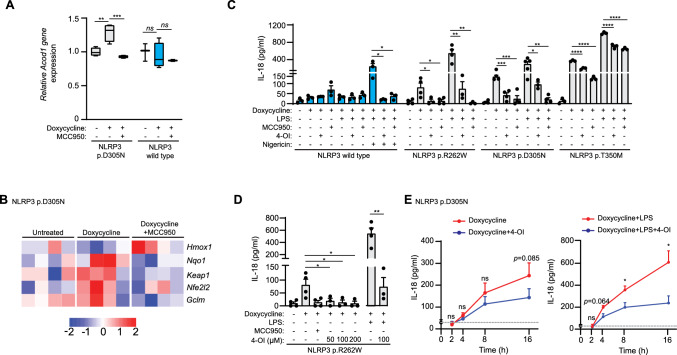
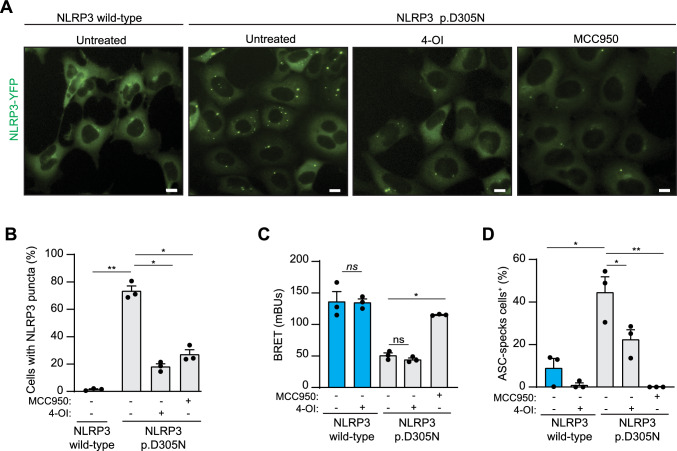
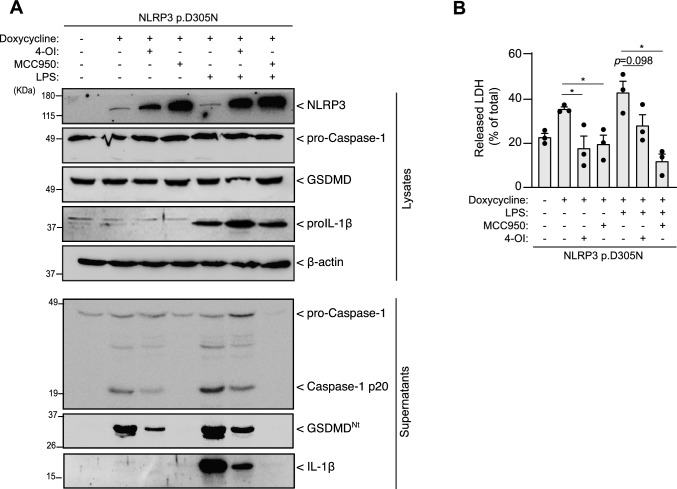
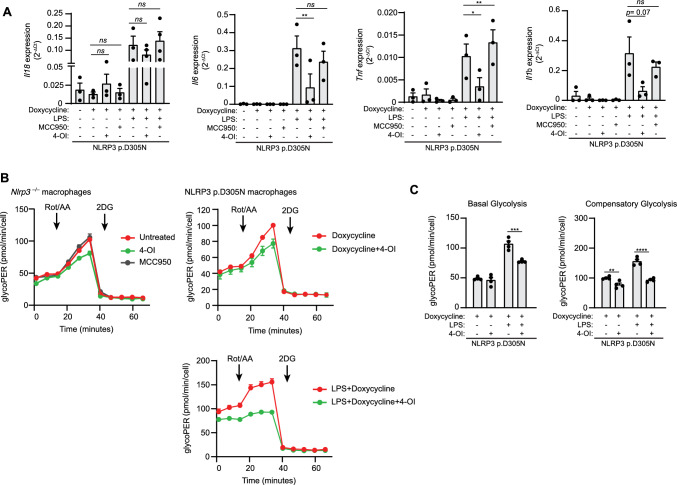
Cryopyrin-associated periodic syndrome (CAPS) is a condition characterized by dominant genetic variants in the NLRP3 gene, which lead to the formation of constitutively active inflammasomes. These inflammasomes play a crucial role in CAPS patients' inflammatory episodes, these being primarily driven by the production of interleukin (IL)-1b. Although treatment with IL-1 blockers is effective for CAPS, some patients develop refractory responses and adverse reactions to these therapies. Consequently, there is a need for novel treatments for CAPS patients. Promising candidates are the derivatives of itaconate, which have been shown to impair NLRP3 inflammasome activation and IL-1β release in blood mononuclear cells from CAPS patients. In this study, we provide insight into the inhibitory mechanisms by which the itaconate derivative 4-octyl itaconate (4-OI) acts on NLRP3 that has different gain-of-function mutations (p.R262W, p.D305N and p.T350M) associated with CAPS. Notably, 4-OI effectively blocks the basal auto-activation of the inflammasome formed by NLRP3 p.R262W, p.D305N and p.T350M variants, which in turn reduces caspase-1 activation, gasdermin D processing, and IL-18 release. Furthermore, after lipopolysaccharide priming of macrophages, 4-OI also decreases IL-1β gene expression and release. Overall, 4-OI impairs CAPS-associated inflammasome function at multiple levels, meaning that therapeutic agents based on itaconate could be a promising therapeutic approach to managing inflammatory episodes in CAPS patients carrying p.R262W, p.D305N or p.T350M variants.
冷吡啉相关周期性综合征(CAPS)是一种由NLRP3基因的显性遗传变异所表征的疾病,这些变异导致组成型活性炎性小体的形成。这些炎性小体在CAPS患者的炎症发作中起关键作用,炎症发作主要由白细胞介素(IL)-1β的产生驱动。尽管用IL-1阻断剂治疗对CAPS有效,但一些患者会出现难治性反应和对这些疗法的不良反应。因此,需要为CAPS患者开发新的治疗方法。有前景的候选药物是衣康酸酯的衍生物,已证明其可损害CAPS患者血液单核细胞中NLRP3炎性小体的激活和IL-1β释放。在本研究中,我们深入了解了衣康酸酯衍生物4-辛基衣康酸酯(4-OI)作用于与CAPS相关的具有不同功能获得性突变(p.R262W、p.D305N和p.T350M)的NLRP3的抑制机制。值得注意的是,4-OI有效阻断了由NLRP3 p.R262W、p.D305N和p.T350M变体形成的炎性小体的基础自激活,这反过来又减少了半胱天冬酶-1的激活、gasdermin D的加工和IL-18的释放。此外,在用脂多糖刺激巨噬细胞后,4-OI还会降低IL-1β基因的表达和释放。总体而言,4-OI在多个水平上损害与CAPS相关的炎性小体功能,这意味着基于衣康酸酯的治疗药物可能是治疗携带p.R262W、p.D305N或p.T350M变体的CAPS患者炎症发作的一种有前景的治疗方法。