• 文献检索
  • 文档翻译
  • 深度研究
  • 学术资讯
  • Suppr Zotero 插件Zotero 插件
  • 邀请有礼
  • 套餐&价格
  • 历史记录
应用&插件
Suppr Zotero 插件Zotero 插件浏览器插件Mac 客户端Windows 客户端微信小程序
定价
高级版会员购买积分包购买API积分包
服务
文献检索文档翻译深度研究API 文档MCP 服务
关于我们
关于 Suppr公司介绍联系我们用户协议隐私条款
关注我们

Suppr 超能文献

核心技术专利:CN118964589B侵权必究
粤ICP备2023148730 号-1Suppr @ 2026

文献检索

告别复杂PubMed语法,用中文像聊天一样搜索,搜遍4000万医学文献。AI智能推荐,让科研检索更轻松。

立即免费搜索

文件翻译

保留排版,准确专业,支持PDF/Word/PPT等文件格式,支持 12+语言互译。

免费翻译文档

深度研究

AI帮你快速写综述,25分钟生成高质量综述,智能提取关键信息,辅助科研写作。

立即免费体验

一种用于促进慢性髓性白血病患者药物依从性的智能药瓶和短信干预措施:txt4 TKI的初步研究

A smart pill bottle and text messaging intervention for promoting medication adherence in patients with chronic myeloid leukemia: a pilot study of txt4 TKI.

作者信息

Wen Kuang-Yi, Palmisiano Neil, Smith Rita, Slamon Rachel, Keiffer Gina, Fidler Christian, Kasner Margaret, Wilde Lindsay

机构信息

Department of Medical Oncology, Thomas Jefferson University, Philadelphia, PA, 19107, USA.

Rutgers Cancer Institute, Rutgers University, New Brunswick, NJ, USA.

出版信息

Support Care Cancer. 2025 May 24;33(6):498. doi: 10.1007/s00520-025-09537-z.

DOI:10.1007/s00520-025-09537-z
PMID:40411655
原文链接:https://pmc.ncbi.nlm.nih.gov/articles/PMC12103477/
Abstract

BACKGROUND

Patients undergoing tyrosine kinase inhibitor (TKI) therapy for chronic myeloid leukemia (CML) often face challenges with adherence, despite the efficacy of the treatment. Theory-guided and evidence-informed interventions addressing psychosocial and adherence barriers are critical for promoting adherence. Using a mixed-method approach, the pilot study developed and evaluated the feasibility and potential impact of an intervention "txt4TKI," to support medication and symptom management among CML patients undergoing TKI therapy.

METHODS

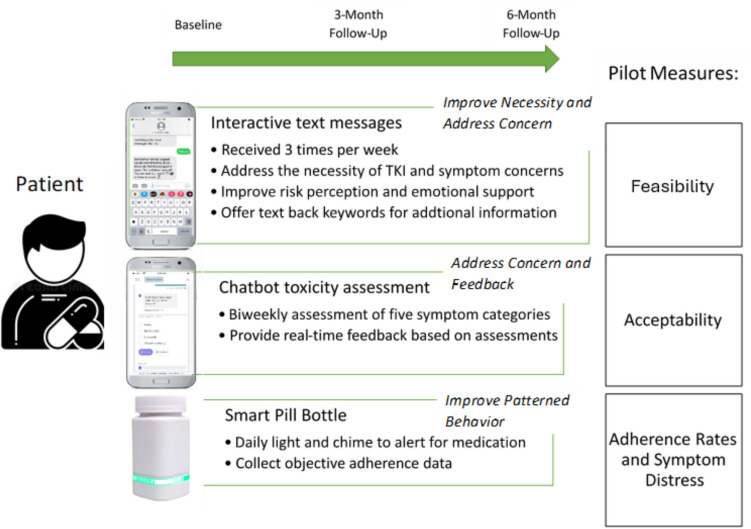
Guided by the Necessity and Concerns framework, the study comprised two phases: Phase 1 involved qualitative patient needs assessment interviews informing intervention design. Phase 2 was a single-arm pilot study conducted for 6 months. The objectives of Phase 2 were to assess the feasibility and acceptability of the txt4 TKI intervention, examining enrollment and retention rates, intervention utilization, patient satisfaction, and changes in TKI medication adherence, psychosocial and symptom factors, from baseline to the 6-month follow-up. The intervention integrates a smart pill bottle activated with light, chimes to remind medication taking and three proactive text messages per week addressing clinical importance of TKI, symptom, lifestyle, and distress management as well as a biweekly toxicity assessment with tailored management feedback. Adherence was also objectively measured by the smart pill bottle and psychosocial survey was repeatedly assessed at 3- and 6-month.

RESULTS

The intervention, developed iteratively and theoretically through patient-centered inputs (n = 10) and evidence-based information during Phase 1, integrates knowledge on CML, TKI therapy, self-care symptom management, emotional support, and healthy lifestyle recommendations. In Phase 2, 20 out of 30 eligible patients (67% consent rate), with a mean age of 55.3, 60% females and 65% Non-White participants, were enrolled. Fifty-five percent have been taking their medication for 1-3 years and 50% were taking Dasatinib. A high satisfaction and engagement rate of 90% with an 85% retention rate were observed. While medication self-efficacy significantly improved from baseline to 6 months, the adherence rate to TKI was slightly decreased over time. Post-intervention interviews indicated that participants found the intervention user-friendly, providing valuable information and emotional support, but adjusting the timing and content of interventions to tailor to different stages of therapy might better support sustained adherence.

CONCLUSIONS

The txt4 TKI intervention using interactive text messaging and a smart pill bottle, feasible, and acceptable, demonstrated an increase in medication self-efficacy, an important aspect of medication adherence behaviors. Further research is needed to explore factors that influence the promotion and maintenance of adherence behaviors.
https://cdn.ncbi.nlm.nih.gov/pmc/blobs/31b0/12103477/1ebf8011a782/520_2025_9537_Fig4_HTML.jpg
https://cdn.ncbi.nlm.nih.gov/pmc/blobs/31b0/12103477/72c1cbcd0114/520_2025_9537_Fig1_HTML.jpg
https://cdn.ncbi.nlm.nih.gov/pmc/blobs/31b0/12103477/925ba343ba40/520_2025_9537_Fig2_HTML.jpg
https://cdn.ncbi.nlm.nih.gov/pmc/blobs/31b0/12103477/070e4fbe2854/520_2025_9537_Fig3_HTML.jpg
https://cdn.ncbi.nlm.nih.gov/pmc/blobs/31b0/12103477/1ebf8011a782/520_2025_9537_Fig4_HTML.jpg
https://cdn.ncbi.nlm.nih.gov/pmc/blobs/31b0/12103477/72c1cbcd0114/520_2025_9537_Fig1_HTML.jpg
https://cdn.ncbi.nlm.nih.gov/pmc/blobs/31b0/12103477/925ba343ba40/520_2025_9537_Fig2_HTML.jpg
https://cdn.ncbi.nlm.nih.gov/pmc/blobs/31b0/12103477/070e4fbe2854/520_2025_9537_Fig3_HTML.jpg
https://cdn.ncbi.nlm.nih.gov/pmc/blobs/31b0/12103477/1ebf8011a782/520_2025_9537_Fig4_HTML.jpg
摘要

背景

尽管酪氨酸激酶抑制剂(TKI)治疗慢性粒细胞白血病(CML)疗效显著,但接受该治疗的患者在坚持治疗方面常常面临挑战。针对心理社会和坚持治疗障碍的理论指导及循证干预措施对于促进坚持治疗至关重要。本试点研究采用混合方法,开发并评估了一种名为“txt4TKI”的干预措施,以支持接受TKI治疗的CML患者进行药物治疗和症状管理。

方法

在必要性和关注点框架的指导下,该研究包括两个阶段:第一阶段涉及定性的患者需求评估访谈,为干预措施设计提供信息。第二阶段是一项为期6个月的单臂试点研究。第二阶段的目标是评估txt4TKI干预措施的可行性和可接受性,检查入组率和留存率、干预措施的使用情况、患者满意度,以及从基线到6个月随访期间TKI药物治疗依从性、心理社会和症状因素的变化。该干预措施整合了一个通过灯光激活的智能药瓶,有提示音提醒服药,每周发送三条主动短信,内容涉及TKI的临床重要性、症状、生活方式和痛苦管理,以及每两周进行一次毒性评估并提供量身定制的管理反馈。还通过智能药瓶客观测量依从性,并在3个月和6个月时反复进行心理社会调查。

结果

在第一阶段,通过以患者为中心的投入(n = 10)和循证信息,对干预措施进行了迭代式和理论性开发,该干预措施整合了关于CML、TKI治疗、自我护理症状管理、情感支持和健康生活方式建议的知识。在第二阶段,30名符合条件的患者中有20名(同意率67%)入组,平均年龄55.3岁,60%为女性,65%为非白人参与者。55%的患者已服药1至3年,50%的患者服用达沙替尼。观察到满意度和参与率高达90%,留存率为85%。虽然从基线到6个月药物自我效能显著提高,但TKI的依从率随时间略有下降。干预后访谈表明,参与者发现该干预措施用户友好,提供了有价值的信息和情感支持,但调整干预措施的时间和内容以适应治疗的不同阶段可能会更好地支持持续的依从性。

结论

使用交互式短信和智能药瓶的txt4TKI干预措施可行且可接受,显示出药物自我效能有所提高,这是药物依从行为的一个重要方面。需要进一步研究以探索影响依从行为促进和维持的因素。

相似文献

1
A smart pill bottle and text messaging intervention for promoting medication adherence in patients with chronic myeloid leukemia: a pilot study of txt4 TKI.一种用于促进慢性髓性白血病患者药物依从性的智能药瓶和短信干预措施:txt4 TKI的初步研究
Support Care Cancer. 2025 May 24;33(6):498. doi: 10.1007/s00520-025-09537-z.
2
Living with chronic myelogenous leukemia in rural communities: Exploring factors related to tyrosine kinase inhibitors adherence with a mixed methods approach.农村社区慢性髓性白血病患者的生活状况:采用混合研究方法探索与酪氨酸激酶抑制剂依从性相关的因素。
J Rural Health. 2025 Mar;41(2):e70028. doi: 10.1111/jrh.70028.
3
Effect of Adherence-enhancing Interventions on Adherence to Tyrosine Kinase Inhibitor Treatment in Chronic Myeloid Leukemia (TAKE-IT): A Quasi-experimental Pre-Post Intervention Multicenter Pilot Study.增强依从性干预措施对慢性髓性白血病酪氨酸激酶抑制剂治疗依从性的影响(TAKE-IT):一项干预前后的多中心类实验性试点研究。
Clin Lymphoma Myeloma Leuk. 2018 Nov;18(11):e449-e461. doi: 10.1016/j.clml.2018.06.026. Epub 2018 Jun 25.
4
Two-Way Clinical Messaging in a CML Specialty Pharmacy Service Model.双向临床信息交流在 CML 专科药房服务模式中的应用。
J Manag Care Spec Pharm. 2019 Nov;25(11):1290-1296. doi: 10.18553/jmcp.2019.25.11.1290.
5
A Community Health Worker-driven and integrated interactive text messaging intervention to promote smoking cessation and lung cancer screening uptake rates among high-risk Asian immigrants: a feasibility pilot RCT study.一项由社区卫生工作者推动的综合交互式短信干预措施,旨在提高高危亚洲移民的戒烟率和肺癌筛查参与率:一项可行性试点随机对照试验研究。
Transl Behav Med. 2025 Jan 16;15(1). doi: 10.1093/tbm/ibaf018.
6
A Remote Intervention Based on mHealth and Community Health Workers for Antiretroviral Therapy Adherence in People With HIV: Pilot Randomized Controlled Trial.一项基于移动健康和社区卫生工作者的远程干预措施对HIV感染者抗逆转录病毒治疗依从性的影响:随机对照试验试点研究
JMIR Form Res. 2025 Apr 2;9:e67997. doi: 10.2196/67997.
7
Effect of a Smart Pill Bottle and Pharmacist Intervention on Medication Adherence in Patients with Multiple Myeloma New to Lenalidomide Therapy.智能药瓶和药师干预对来那度胺治疗初治多发性骨髓瘤患者药物依从性的影响。
J Manag Care Spec Pharm. 2019 Nov;25(11):1244-1254. doi: 10.18553/jmcp.2019.25.11.1244.
8
Text Messaging Adherence Intervention for Adolescents and Young Adults with Chronic Kidney Disease: Pilot Randomized Controlled Trial and Stakeholder Interviews.短信依从性干预在青少年和慢性肾脏病的年轻成年人中的应用:初步随机对照试验和利益相关者访谈。
J Med Internet Res. 2020 Aug 14;22(8):e19861. doi: 10.2196/19861.
9
Adherence and persistence among chronic myeloid leukemia patients during second-line tyrosine kinase inhibitor treatment.慢性髓性白血病患者在二线酪氨酸激酶抑制剂治疗期间的依从性和持续性。
J Manag Care Spec Pharm. 2014 Oct;20(10):1006-15. doi: 10.18553/jmcp.2014.20.10.1006.
10
Chatbot-interfaced and cognitive-affective barrier-driven messages to improve colposcopy adherence after abnormal Pap test results in underserved urban women: A feasibility pilot study.基于聊天机器人界面和认知情感障碍驱动的信息,提高服务不足的城市女性异常巴氏试验结果后的阴道镜检查依从性:一项可行性试点研究。
Transl Behav Med. 2024 Jan 11;14(1):1-12. doi: 10.1093/tbm/ibad064.

本文引用的文献

1
A smartphone program to support adherence to oral chemotherapy in people with cancer: Proof-of-concept trial.智能手机程序辅助癌症患者口服化疗药物依从性:概念验证试验。
Asia Pac J Clin Oncol. 2022 Oct;18(5):e378-e387. doi: 10.1111/ajco.13656. Epub 2022 Jan 30.
2
Monitoring and Improving Adherence to Tyrosine Kinase Inhibitors in Patients with Chronic Myeloid Leukemia: A Systematic Review.慢性髓性白血病患者酪氨酸激酶抑制剂依从性的监测与改善:一项系统综述
Patient Prefer Adherence. 2021 Nov 18;15:2563-2575. doi: 10.2147/PPA.S269355. eCollection 2021.
3
Randomized Pilot Study of an Advanced Smart-Pill Bottle as an Adherence Intervention in Patients With HIV on Antiretroviral Treatment.
随机先导研究:一种高级智能药瓶作为抗逆转录病毒治疗的 HIV 患者服药依从性干预措施
J Acquir Immune Defic Syndr. 2021 Jan 1;86(1):73-80. doi: 10.1097/QAI.0000000000002519.
4
Integrating remote monitoring into heart failure patients' care regimen: A pilot study.将远程监测融入心力衰竭患者的治疗方案中:一项试点研究。
PLoS One. 2020 Nov 19;15(11):e0242210. doi: 10.1371/journal.pone.0242210. eCollection 2020.
5
Improving medication adherence with adjuvant aromatase inhibitor in women with breast cancer: A randomised controlled trial to evaluate the effect of short message service (SMS) reminder.提高乳腺癌患者辅助使用芳香化酶抑制剂的药物依从性:一项评价短信提醒效果的随机对照试验
Breast. 2020 Oct;53:77-84. doi: 10.1016/j.breast.2020.06.012. Epub 2020 Jul 2.
6
Randomized Trial of a Smartphone Mobile App to Improve Symptoms and Adherence to Oral Therapy for Cancer.智能手机移动应用改善癌症患者症状和口服治疗依从性的随机试验
J Natl Compr Canc Netw. 2020 Feb;18(2):133-141. doi: 10.6004/jnccn.2019.7354.
7
A smartphone Chatbot application to optimize monitoring of older patients with cancer.智能手机聊天机器人应用程序,优化对老年癌症患者的监测。
Int J Med Inform. 2019 Aug;128:18-23. doi: 10.1016/j.ijmedinf.2019.05.013. Epub 2019 May 14.
8
Mobile-Based Oral Chemotherapy Adherence-Enhancing Interventions: Scoping Review.基于移动设备的口服化疗依从性增强干预措施:范围综述
JMIR Mhealth Uhealth. 2018 Dec 21;6(12):e11724. doi: 10.2196/11724.
9
Mobile Health Intervention to Increase Oral Cancer Therapy Adherence in Patients With Chronic Myeloid Leukemia (The REMIND System): Clinical Feasibility and Acceptability Assessment.提高慢性髓性白血病患者口腔癌治疗依从性的移动健康干预措施(REMIND系统):临床可行性和可接受性评估
JMIR Mhealth Uhealth. 2017 Dec 6;5(12):e184. doi: 10.2196/mhealth.8349.
10
Is patient empowerment the key to promote adherence? A systematic review of the relationship between self-efficacy, health locus of control and medication adherence.患者赋权是否是促进依从性的关键?自我效能感、健康控制点与药物依从性之间关系的系统评价。
PLoS One. 2017 Oct 17;12(10):e0186458. doi: 10.1371/journal.pone.0186458. eCollection 2017.