Meevassana Jiraroch, Vongsuly Chawisa Wanda, Nakbua Tanchanok, Kamolratanakul Supitcha, Thitiwanichpiwong Pichaya, Bin-Alee Fardeela, Keelawat Somboon, Kitkumthorn Nakarin
Center of Excellence in Burn and Wound Care, Faculty of Medicine, Chulalongkorn University, Bangkok, Thailand.
Department of Clinical Tropical Medicine, Faculty of Tropical Medicine, Mahidol University, Bangkok, Thailand.
PeerJ. 2025 May 20;13:e19485. doi: 10.7717/peerj.19485. eCollection 2025.
Genome-wide hypomethylation, a common epigenetic change that occurs during cancer development, primarily affects repetitive elements, such as Alu repeats. Consequently, Alu repeats can be used as a surrogate marker of genomic hypomethylation.
In this study, we aimed to investigate the correlation between Alu methylation levels and the multistage course of gastric carcinogenesis.
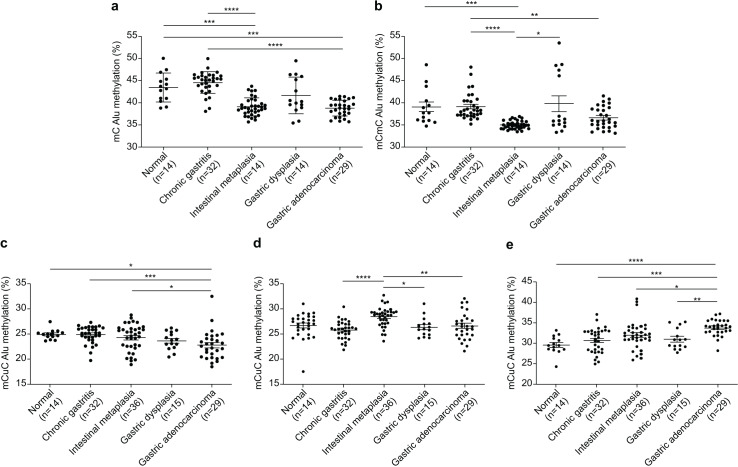
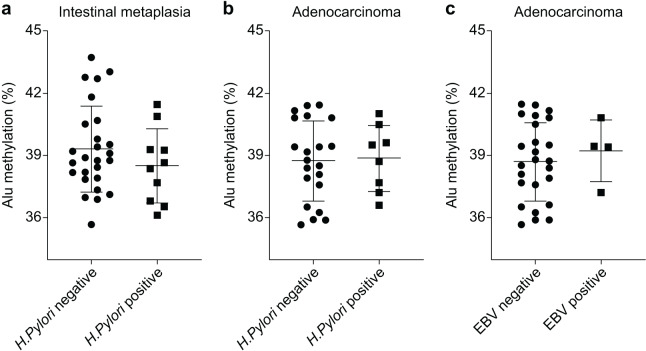
We found that the Alu methylation levels in gastric cancer tissue decreased compared with those in normal gastric tissue, with the change in methylation levels and pattern being most significant between chronic gastritis and intestinal metaplasia. Moreover, Alu methylation levels were not associated with or Epstein-Barr virus infection.
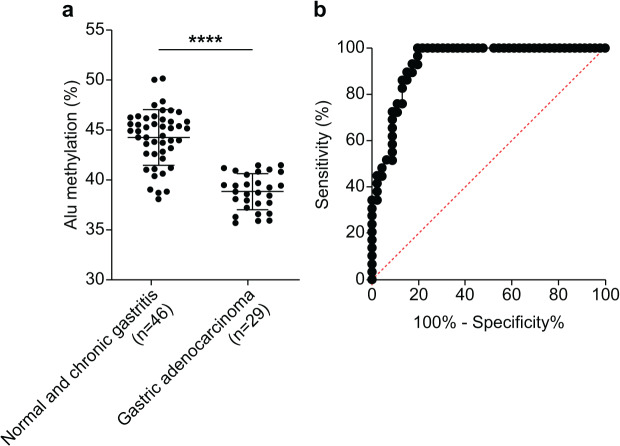
Finally, our sensitivity and specificity analyses suggested that Alu methylation level can be used to distinguish gastric cancer tissue from normal tissue. Thus, Alu methylation level shows promise as biomarker for gastric cancer diagnosis.
全基因组低甲基化是癌症发生过程中常见的表观遗传变化,主要影响重复元件,如Alu重复序列。因此,Alu重复序列可用作基因组低甲基化的替代标志物。
在本研究中,我们旨在探讨Alu甲基化水平与胃癌发生多阶段过程之间的相关性。
我们发现,与正常胃组织相比,胃癌组织中的Alu甲基化水平降低,甲基化水平和模式的变化在慢性胃炎和肠化生之间最为显著。此外,Alu甲基化水平与 或爱泼斯坦-巴尔病毒感染无关。
最后,我们的敏感性和特异性分析表明,Alu甲基化水平可用于区分胃癌组织和正常组织。因此,Alu甲基化水平有望成为胃癌诊断的生物标志物。