Fan Weiyang, Xu Ziyan, Zhong Mengli, Wu Xiao, Chen Pan, Chen Zhen, Su Weiwei, Wu Hao, Li Peibo
Guangdong Provincial Key Laboratory of Plant Stress Biology, State Key Laboratory of Biocontrol, Guangdong Engineering and Technology Research Center for Quality and Efficacy Re-Evaluation of Post Marketed TCM, School of Life Sciences, Sun Yat-sen University, Guangzhou 510275, China.
Cells. 2025 May 8;14(10):678. doi: 10.3390/cells14100678.
Naringenin has demonstrated potential therapeutic effects against cigarette smoke-induced lung injury; however, its underlying mechanisms of regulating matrix metalloproteinase-9 (MMP-9) in alveolar macrophages remain unclear.
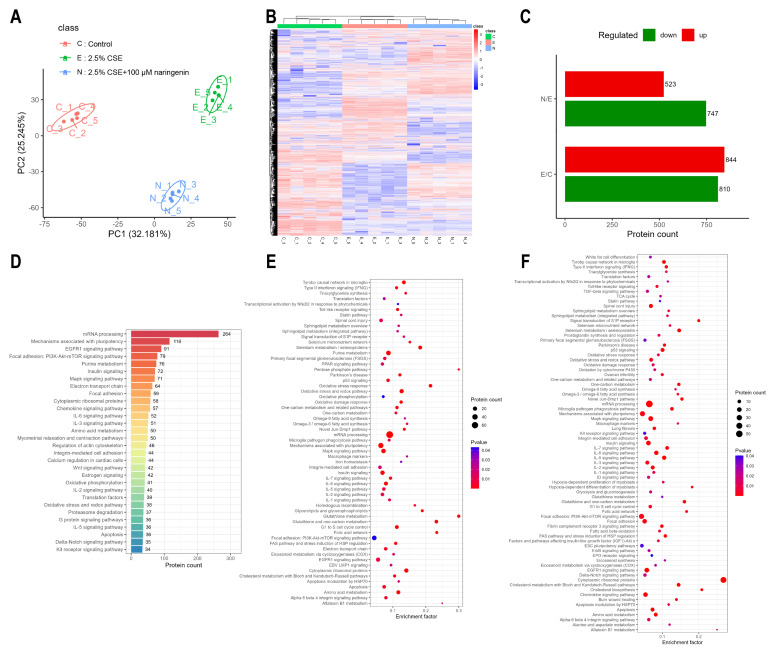
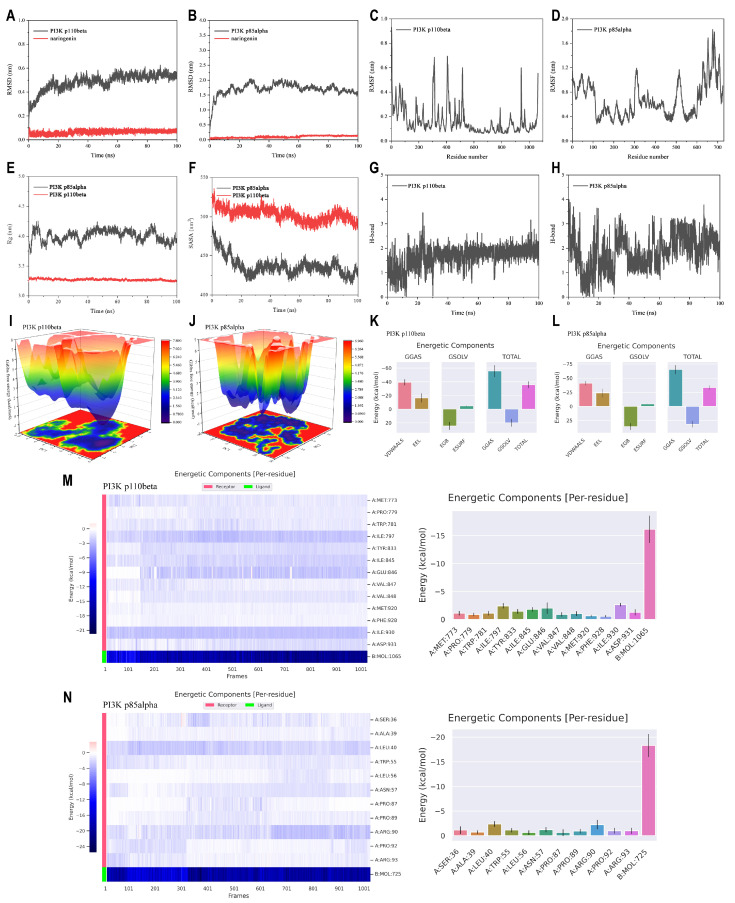
The regulatory mechanisms of naringenin in cigarette smoke extract (CSE)-induced alveolar macrophages were investigated using proteomics, and then, naringenin's targets were further validated by Western blot, molecular docking, molecular dynamics (MD) simulations, cellular thermal shift assay (CETSA), and enzyme activity assay.
The proteomics revealed that the PI3K/AKT signaling pathway might play a crucial role in naringenin's inhibition of MMP-9. Western blot analysis confirmed that naringenin significantly inhibited CSE-upregulated PI3K/AKT signaling pathway and reduced MMP-9 expression in MH-S cells. Notably, the PI3K activator 740Y-P reversed naringenin's effects on MMP-9. Additionally, molecular docking, MD simulations, and CETSA identified PI3K p85alpha as the potential binding site for naringenin, and naringenin markedly inhibited CSE-induced PI3K activity. In in vitro experiments, naringenin inhibiting MMP-9 secretion in alveolar macrophages contributed to alleviating elastin and E-cadherin damage in alveolar epithelial cells. Furthermore, naringenin effectively suppressed CSE-induced MMP-9 secretion in primary mouse alveolar macrophages and human THP-1-differentiated macrophages.
Our findings revealed that naringenin, a potential candidate for treating smoking-induced lung injury, directly targeted PI3K p85alpha, inhibiting PI3K activity and MMP-9 expression in CSE-induced alveolar macrophages via suppressing the PI3K/AKT signaling pathway.
柚皮素已显示出对香烟烟雾诱导的肺损伤具有潜在治疗作用;然而,其在肺泡巨噬细胞中调节基质金属蛋白酶-9(MMP-9)的潜在机制仍不清楚。
采用蛋白质组学研究柚皮素在香烟烟雾提取物(CSE)诱导的肺泡巨噬细胞中的调节机制,然后通过蛋白质印迹、分子对接、分子动力学(MD)模拟、细胞热位移分析(CETSA)和酶活性测定进一步验证柚皮素的靶点。
蛋白质组学显示PI3K/AKT信号通路可能在柚皮素抑制MMP-9中起关键作用。蛋白质印迹分析证实,柚皮素显著抑制CSE上调的PI3K/AKT信号通路,并降低MH-S细胞中MMP-9的表达。值得注意的是,PI3K激活剂740Y-P逆转了柚皮素对MMP-9的作用。此外,分子对接、MD模拟和CETSA确定PI3K p85α为柚皮素的潜在结合位点,柚皮素显著抑制CSE诱导的PI3K活性。在体外实验中,柚皮素抑制肺泡巨噬细胞中MMP-9的分泌有助于减轻肺泡上皮细胞中弹性蛋白和E-钙黏蛋白的损伤。此外,柚皮素有效抑制原代小鼠肺泡巨噬细胞和人THP-1分化巨噬细胞中CSE诱导的MMP-9分泌。
我们的研究结果表明,柚皮素是治疗吸烟诱导肺损伤的潜在候选药物,它直接作用于PI3K p85α,通过抑制PI3K/AKT信号通路抑制CSE诱导的肺泡巨噬细胞中PI3K活性和MMP-9表达。