Vaseekaran Mathini, Wiemer Marcus, Kaese Sven, Görlich Dennis, Hinkelbein Jochen, Jansen Gerrit, Samol Alexander
Department of Cardiology and Critical Care Medicine, Johannes Wesling University Hospital, 32429 Minden, Germany.
Department of Anesthesiology, Intensive Care Medicine and Emergency Medicine, Johannes Wesling Hospital, University Hospital Ruhr-University Bochum, 32429 Minden, Germany.
Bioengineering (Basel). 2025 May 5;12(5):492. doi: 10.3390/bioengineering12050492.
Monitoring pulse rate is fundamental to cardiovascular health management and early detection of rhythm disturbances. While oscillometric blood pressure measurement is well established and validated in clinical practice, its use for pulse rate monitoring, particularly via wrist-worn devices, remains largely unexplored.
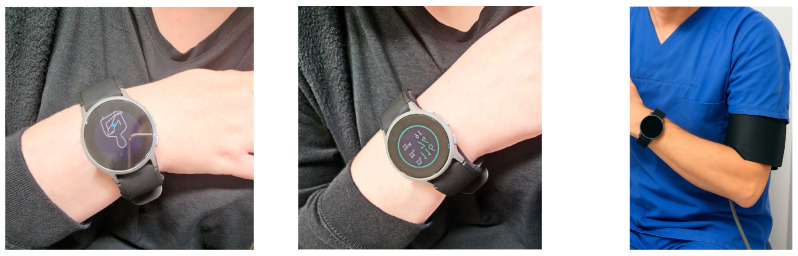
This study investigates whether a smartwatch that performs oscillometric blood pressure measurements at the wrist can also deliver reliable pulse rate readings using the same method.
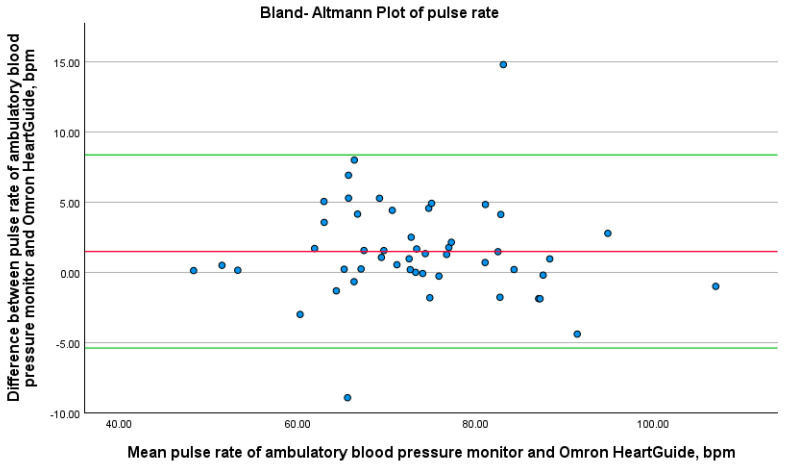
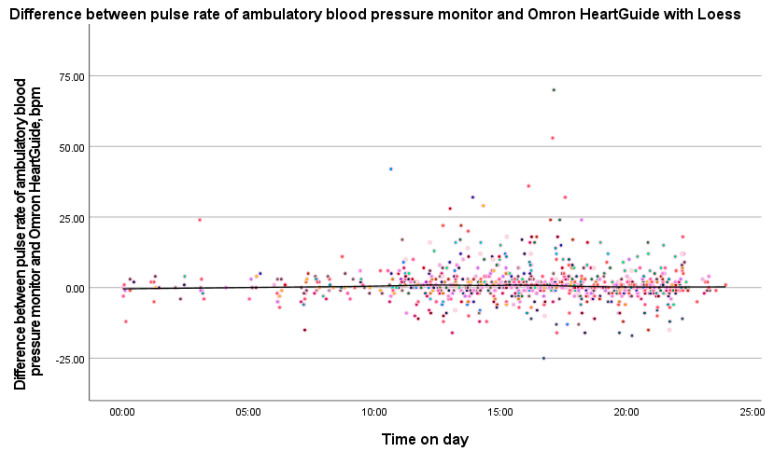
This study compared pulse rates recorded by the Omron HeartGuide smartwatch and conventional ambulatory blood pressure monitors in 50 patients over 24 h. Measurements were taken consecutively, and data were analyzed using intraclass correlation coefficients (ICCs) and Bland-Altman plots.
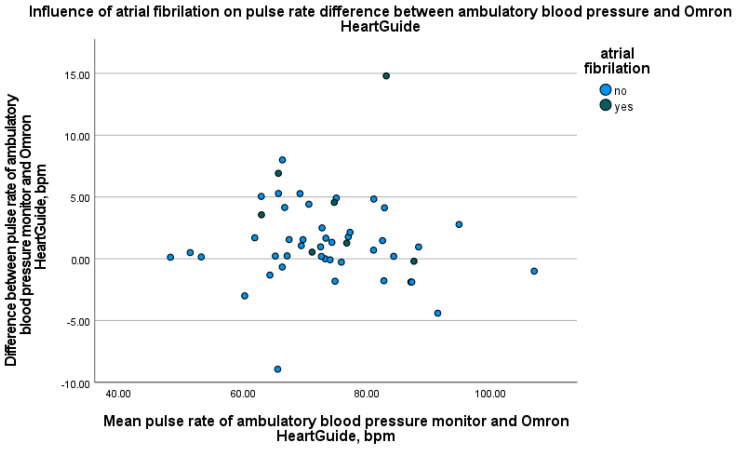
The study showed a high ICC of 0.971, indicating excellent agreement between devices. The average pulse rate difference was 1.5 bpm, with the Omron HeartGuide reporting slightly lower rates, especially in patients with atrial fibrillation.
This study demonstrates that oscillometric pulse-rate monitoring at the wrist can achieve a high degree of accuracy, comparable to conventional upper-arm devices. Given that oscillometric smartwatches like the Omron HeartGuide are already used for blood pressure monitoring, the findings suggest that they may also be suitable for pulse rate measurement, potentially enhancing their role in telemetric healthcare, but further research is needed, particularly in patients with arrhythmias.
监测脉搏率是心血管健康管理和心律失常早期检测的基础。虽然示波法血压测量在临床实践中已得到充分确立和验证,但其用于脉搏率监测,尤其是通过腕戴设备进行监测,在很大程度上仍未得到探索。
本研究调查一款在手腕处进行示波法血压测量的智能手表是否也能使用相同方法提供可靠的脉搏率读数。
本研究比较了欧姆龙HeartGuide智能手表和传统动态血压监测仪在50名患者24小时内记录的脉搏率。连续进行测量,并使用组内相关系数(ICC)和布兰德-奥特曼图对数据进行分析。
研究显示ICC高达0.971,表明设备之间具有极好的一致性。平均脉搏率差异为1.5次/分钟,欧姆龙HeartGuide报告的脉搏率略低,尤其是在房颤患者中。
本研究表明,手腕处的示波法脉搏率监测可达到高度准确性,与传统上臂设备相当。鉴于像欧姆龙HeartGuide这样的示波法智能手表已用于血压监测,研究结果表明它们可能也适用于脉搏率测量,这可能会增强它们在远程医疗保健中的作用,但仍需要进一步研究,尤其是在心律失常患者中。