Syryło Tomasz, Ząbkowski Tomasz, Kamiński Tomasz Waldemar, Skiba Ryszard, Krzepkowski Hubert Andrzej
Department of General, Oncological and Functional Urology, Military Institute of Medicine-National Research Institute, 04-141 Warsaw, Poland.
VERSITI Blood Research Institute, 8727 W Watertown Plank Road, Wauwatosa, WI 53226, USA.
J Clin Med. 2025 May 15;14(10):3444. doi: 10.3390/jcm14103444.
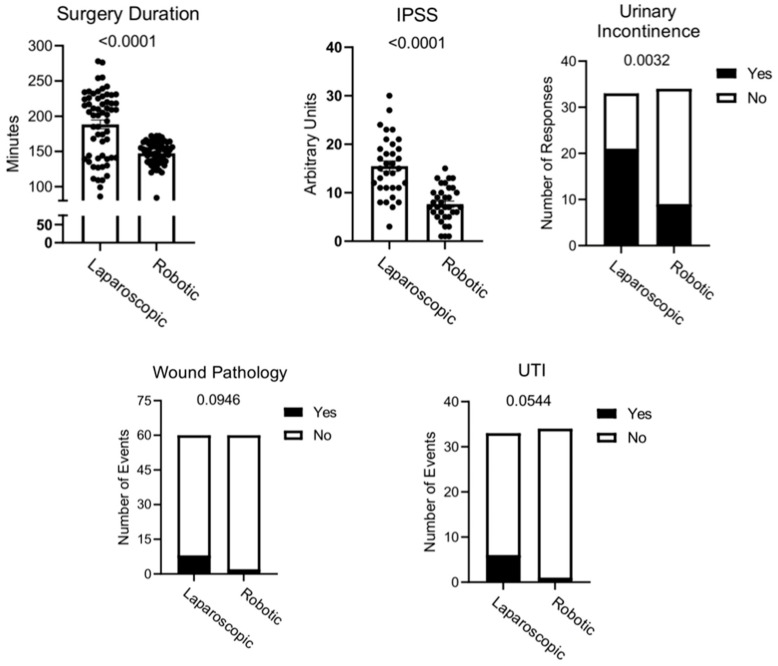
: Radical prostatectomy is a standard treatment for localized prostate cancer. We aimed to compare perioperative outcomes and functional results between laparoscopic radical prostatectomy (LRP) and robot-assisted radical prostatectomy (RARP). : A retrospective analysis was conducted on 120 patients who underwent LRP (n = 60) or RARP (n = 60). Perioperative parameters, including operative time, hospitalization duration, blood transfusion rate, wound healing complications, urinary catheterization duration, urinary tract infections (UTIs), and urinary incontinence, were assessed. Statistical analyses included Student's t-, Mann-Whitney U, and χ tests. : RARP was associated with significantly shorter operative time, compared with LRP (147.25 vs. 188.30 min, < 0.0001). No significant differences were observed in hospitalization duration, transfusion rates, or overall complication rates. However, impaired wound healing was less frequent in the RARP group, with a 10% lower incidence, compared with the LRP group ( = 0.0946). Similarly, UTIs occurred less often in the RARP group (six vs. one cases; = 0.0544). Urinary incontinence was significantly less frequent following RARP, with its incidence being more than twice as low, compared with the LRP group ( = 0.0032). Additionally, the RARP group had significantly lower International Prostate Symptom Scores, with a mean difference of 7.83 points, indicating improved urinary function. No significant differences were found in sexual function (IIEF-5 scores). : RARP offers advantages over LRP, including reduced operative time, lower rates of wound healing complications, decreased incidence of urinary incontinence, and improved postoperative urinary function. Further studies with larger cohorts are warranted to confirm these findings and assess long-term functional and oncological outcomes.
根治性前列腺切除术是局限性前列腺癌的标准治疗方法。我们旨在比较腹腔镜根治性前列腺切除术(LRP)和机器人辅助根治性前列腺切除术(RARP)的围手术期结果和功能结果。
对120例行LRP(n = 60)或RARP(n = 60)的患者进行回顾性分析。评估围手术期参数,包括手术时间、住院时间、输血率、伤口愈合并发症、导尿时间、尿路感染(UTI)和尿失禁情况。统计分析包括Student's t检验、Mann-Whitney U检验和χ²检验。
与LRP相比,RARP的手术时间明显更短(147.25分钟对188.30分钟,P < 0.0001)。在住院时间、输血率或总体并发症发生率方面未观察到显著差异。然而,RARP组伤口愈合受损的情况较少见,发生率比LRP组低10%(P = 0.0946)。同样,RARP组UTI的发生频率较低(6例对1例;P = 0.0544)。RARP术后尿失禁的发生频率明显较低,其发生率比LRP组低两倍多(P = 0.0032)。此外, RARP组的国际前列腺症状评分显著更低,平均差异为7.83分,表明泌尿功能得到改善。在性功能方面(IIEF-5评分)未发现显著差异。
RARP比LRP具有优势,包括手术时间缩短、伤口愈合并发症发生率降低、尿失禁发生率降低以及术后泌尿功能改善。需要进行更大样本量的进一步研究以证实这些发现并评估长期功能和肿瘤学结果。