Tagui Yurika, Takeda Shingo, Waida Hiroyo, Kitahara Shoichi, Kimura Tomoki, Kanda Shinji, Oka Yoshitaka, Hayashi Yu, Umatani Chie
Graduate School of Science, The University of Tokyo, Tokyo, Japan.
Department of Applied Physics, The University of Tokyo, Tokyo, Japan.
Elife. 2025 May 29;13:RP100996. doi: 10.7554/eLife.100996.
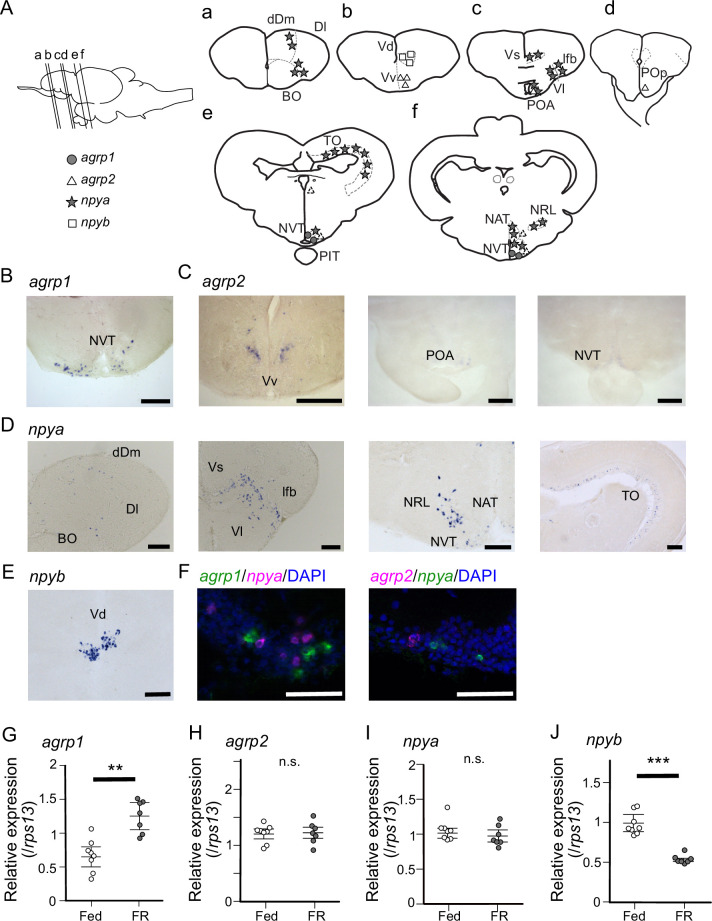
Feeding and reproduction are known to be closely correlated with each other, and the seasonal breeders show breeding season-dependent feeding behavior. However, most model animals do not have definite breeding seasonality, and the mechanisms for such feeding behavior remain unclear. Here, we focused on female medaka (); they show breeding season-dependent feeding behavior, and their condition of breeding season can be experimentally controlled by day-length. We first demonstrated that, among previously reported feeding-related peptides (neuropeptides involved in feeding), agouti-related peptide 1 () and neuropeptide y b () show higher brain expression under the breeding condition than under the non-breeding one. Combined with analysis of knockout medaka, we obtained results to suggest that long day-induced sexually mature condition, especially ovarian estrogenic signals, increase the expressions of in the brain, which results in increased food intake to promote reproduction. Our findings advance the understanding of neural mechanisms of feeding behavior for reproductive success.
已知摄食与繁殖密切相关,季节性繁殖动物表现出与繁殖季节相关的摄食行为。然而,大多数模式动物没有明确的繁殖季节性,这种摄食行为的机制仍不清楚。在这里,我们聚焦于雌性青鳉;它们表现出与繁殖季节相关的摄食行为,并且它们繁殖季节的状况可以通过光周期进行实验控制。我们首先证明,在先前报道的与摄食相关的肽(参与摄食的神经肽)中,刺鼠相关肽1(AgRP1)和神经肽Yb(Npyb)在繁殖条件下的大脑表达高于非繁殖条件。结合对AgRP1基因敲除青鳉的分析,我们得到的结果表明,长日照诱导的性成熟状态,尤其是卵巢雌激素信号,会增加大脑中AgRP1和Npyb的表达,从而导致食物摄入量增加以促进繁殖。我们的研究结果推进了对为实现繁殖成功而进行的摄食行为神经机制的理解。