Zhang Shu Ya, Sun Shan Shan, Liu Lu Yi, Sivaranjan Thusyakaanth, Nie Pin, Xie Hai Xia
State Key Laboratory of Breeding Biotechnology and Sustainable Aquaculture, Institute of Hydrobiology, Chinese Academy of Sciences, Wuhan, China.
College of Advanced Agricultural Sciences, University of Chinese Academy of Sciences, Beijing, China.
Appl Environ Microbiol. 2025 Jun 18;91(6):e0226424. doi: 10.1128/aem.02264-24. Epub 2025 May 29.
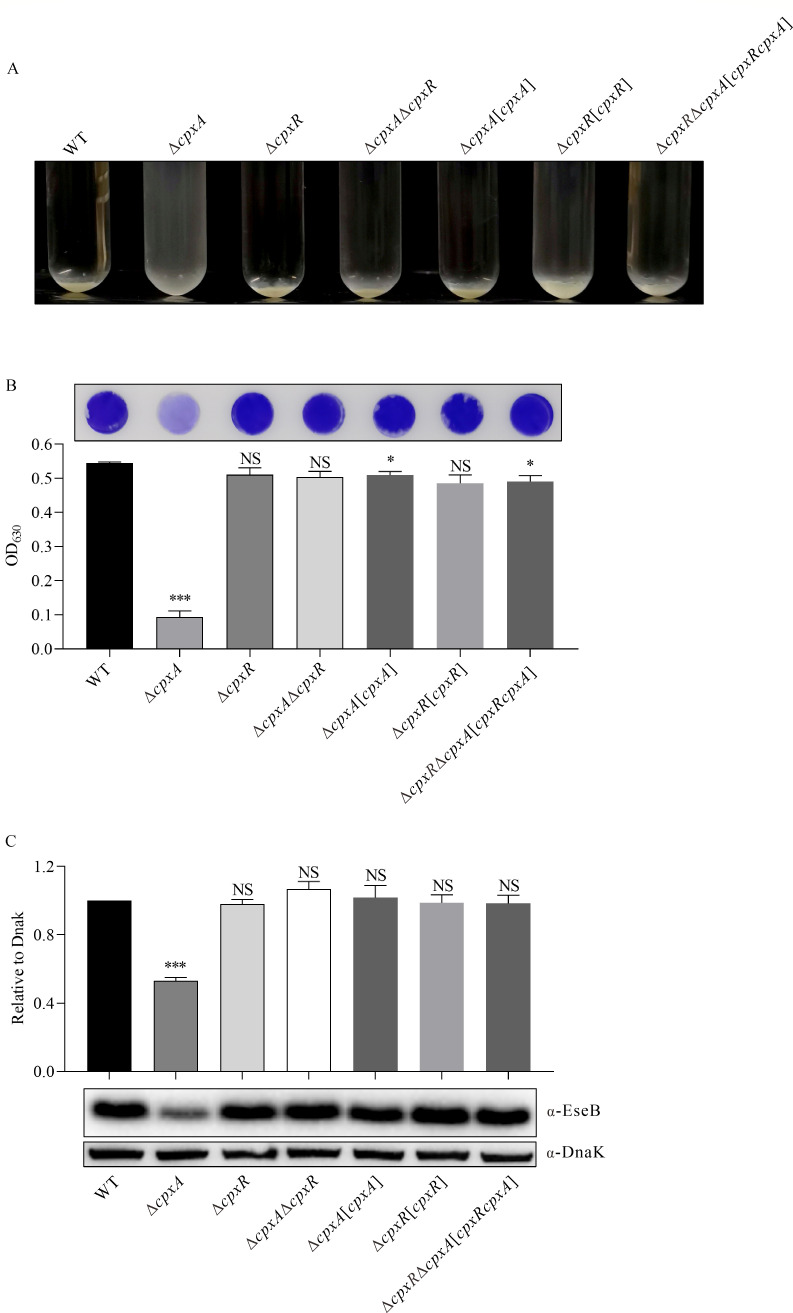
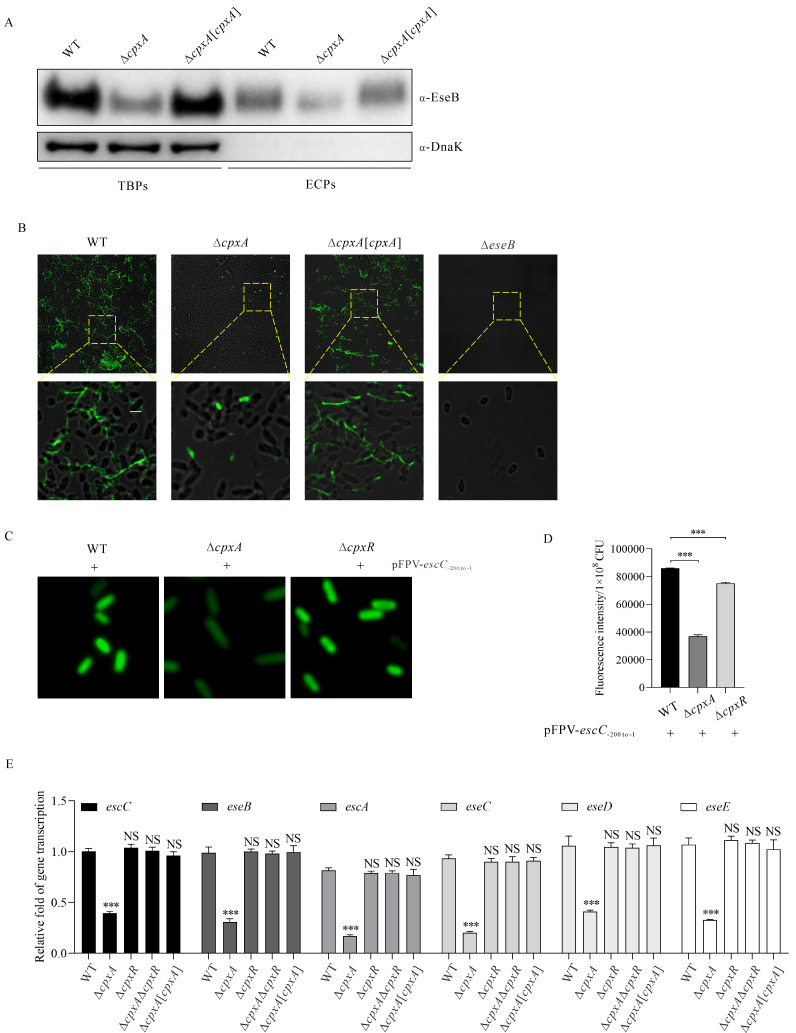
The type III secretion system (T3SS) translocon protein EseB (needle tip protein) forms filamentous appendages on the surface of to facilitate autoaggregation and biofilm formation. By contrast, another T3SS translocon protein EseC inhibits biofilm formation by sequestering EseC's chaperone EseE, which also functions as a positive regulator of the operon, in which EseB is encoded. The two-component system (TCS) EsrAB and the regulator EsrC tightly and positively regulate the T3SS in . The TCS CpxAR provides an adaptive response to external environmental changes. In this study, we have shown that disruption of the histidine kinase CpxA (sensor) instead of CpxR (response regulator) significantly reduces biofilm formation in . CpxR is negatively regulated by CpxA, and significant amounts of CpxR accumulate in in the absence of CpxA. CpxR, together with EsrB and EsrC, directly binds the promoter of the operon to promote CpxR transcription and expression. The elevated phosphorylated CpxR (CpxR-) binds to the promoter of the operon to repress transcription and expression, while EseE, EsrB, and EsrC bind directly to the same promoter to promote EseB transcription and expression. is an enteric pathogen that senses microbiota-derived indole in the gut lumen. EseB filament-mediated biofilm formation in is inversely proportional to exogenous indole. Together, CpxR inhibits while EsrB, EsrC, and EseE stimulate transcription and expression of the operon, thereby coordinately controlling EseB filament-mediated biofilm formation in in response to environmental stimuli.IMPORTANCE is primarily an enteric pathogen of fish and can form a biofilm to resist the lethal effects of host or antimicrobial agents. The assembly of filamentous appendages on the bacterial surface, mediated by the type III secretion system (T3SS) needle tip protein EseB, promotes bacterial-bacterial interactions and biofilm formation when is cultured in Dulbecco's modified Eagle's medium (DMEM). In this study, we have shown that the histidine kinase CpxA regulates biofilm formation in by negatively regulating its response regulator CpxR. Binding to the promoter of the operon, CpxR negatively regulates, whereas EsrB, EsrC, and EseE positively regulate the operon, of which EseB is encoded, coordinately regulating biofilm formation in .
III型分泌系统(T3SS)转运体蛋白EseB(针尖蛋白)在细菌表面形成丝状附属物,以促进自身聚集和生物膜形成。相比之下,另一种T3SS转运体蛋白EseC通过隔离EseC的伴侣蛋白EseE来抑制生物膜形成,EseE也是编码EseB的操纵子的正调控因子。双组分系统(TCS)EsrAB和调控因子EsrC紧密且正向调控细菌中的T3SS。TCS CpxAR对外界环境变化提供适应性反应。在本研究中,我们发现组氨酸激酶CpxA(传感器)而非CpxR(反应调节因子)的破坏会显著降低细菌中的生物膜形成。CpxR受CpxA负调控,在缺乏CpxA时,大量CpxR在细菌中积累。CpxR与EsrB和EsrC一起直接结合操纵子的启动子以促进CpxR的转录和表达。磷酸化的CpxR(CpxR-P)水平升高时会结合操纵子的启动子以抑制转录和表达,而EseE、EsrB和EsrC直接结合同一启动子以促进EseB的转录和表达。该细菌是一种肠道病原体,可感知肠腔中微生物群衍生的吲哚。该细菌中EseB丝介导的生物膜形成与外源性吲哚成反比。总之,CpxR起抑制作用,而EsrB、EsrC和EseE刺激操纵子的转录和表达,从而响应环境刺激协同控制该细菌中EseB丝介导的生物膜形成。重要性该细菌主要是鱼类的肠道病原体,可形成生物膜以抵抗宿主或抗菌剂的致死作用。当该细菌在杜氏改良 Eagle培养基(DMEM)中培养时,由III型分泌系统(T3SS)针尖蛋白EseB介导的细菌表面丝状附属物的组装促进细菌间相互作用和生物膜形成。在本研究中,我们发现组氨酸激酶CpxA通过负调控其反应调节因子CpxR来调节该细菌中的生物膜形成。CpxR结合操纵子的启动子起负调控作用,而EsrB、EsrC和EseE对编码EseB的操纵子起正调控作用,协同调节该细菌中的生物膜形成。