Blaskovich Mark A T, Cooper Matthew A
Centre for Superbug Solutions, Institute for Molecular Bioscience, The University of Queensland, Brisbane, 4072, Australia.
ARC Centre for Environmental and Agricultural Solutions to Antimicrobial Resistance, Institute for Molecular Bioscience, The University of Queensland, Brisbane, 4072, Australia.
NPJ Antimicrob Resist. 2025 May 30;3(1):47. doi: 10.1038/s44259-025-00096-1.
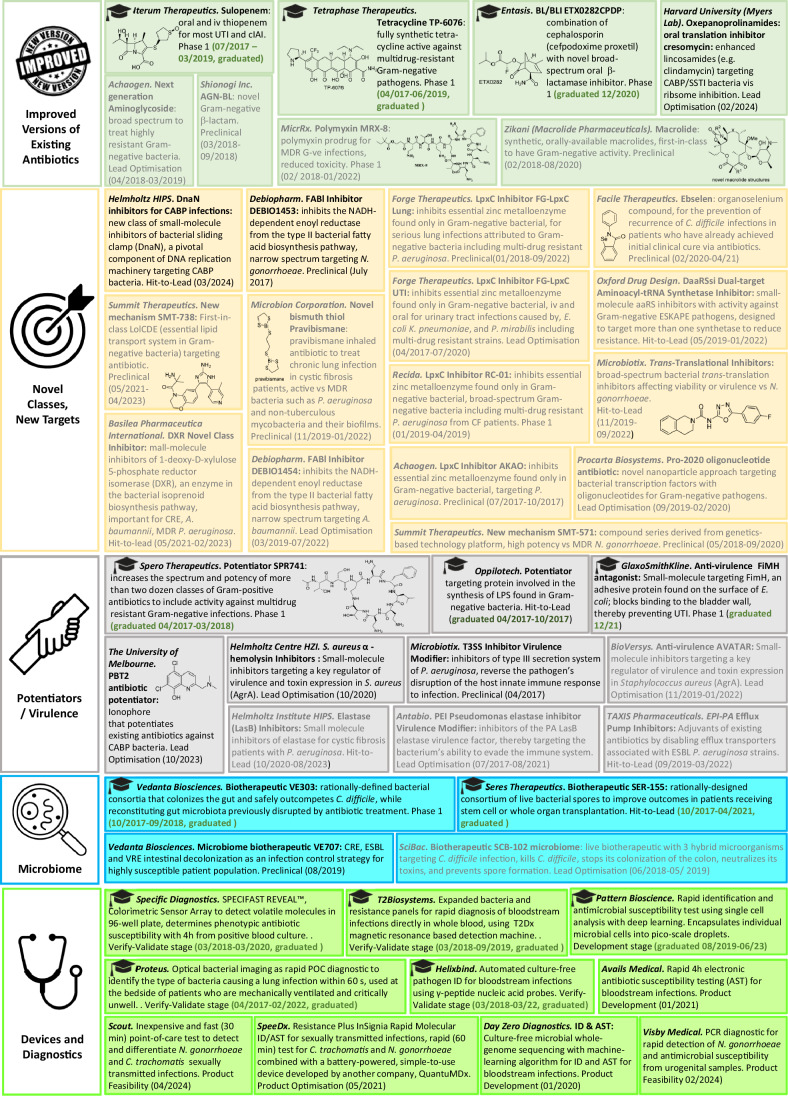
After decades of neglect and a decline in antibiotic research and development, we are now finally witnessing the advent of new funding programs dedicated to new therapies. In addition to traditional new chemical entities that directly kill or arrest the growth of bacteria, alternative approaches are being identified and advanced towards proof-of-concept trials in the clinic. We briefly review the current pipeline of conventional new antibiotics and highlight in more depth promising alternatives, including potentiators of antibiotic action, bacteriophage, lysins and microbiome modulation. More innovative approaches, such as adaptive and innate immune modulators, CRISPR-Cas and diagnostic guided 'theranostics' are discussed and contrasted. Such exploratory therapies may require the development of alternative regulatory and clinical development pathways, but represent a potential circuit breaker from the current 'arms race' between bacteria and traditional antibiotics.
在经历了数十年的忽视以及抗生素研发的衰退之后,我们如今终于见证了致力于新疗法的新资助项目的出现。除了直接杀死或抑制细菌生长的传统新化学实体之外,正在确定替代方法并推进至临床概念验证试验。我们简要回顾了传统新抗生素的当前研发进程,并更深入地突出了有前景的替代方案,包括抗生素作用增强剂、噬菌体、溶菌酶和微生物群调节。还讨论并对比了更具创新性的方法,如适应性和先天性免疫调节剂、CRISPR-Cas以及诊断导向的“治疗诊断学”。此类探索性疗法可能需要开发替代的监管和临床开发途径,但代表了打破当前细菌与传统抗生素之间“军备竞赛”的潜在突破口。