Song Xiaoqian, Zhang Zhonghua, Huang Haiyan, Guan Xin, Jin Lu, Shi Yu, Wang Wenjie, Tang Zhonghua
College of Chemistry, Chemical Engineering and Resource Utilization, Northeast Forestry University, Harbin, 150040, China.
Key Laboratory of Forest Plant Ecology, Ministry of Education, Northeast Forestry University, Harbin, 150040, China.
Sci Rep. 2025 Jun 1;15(1):19185. doi: 10.1038/s41598-025-04113-1.
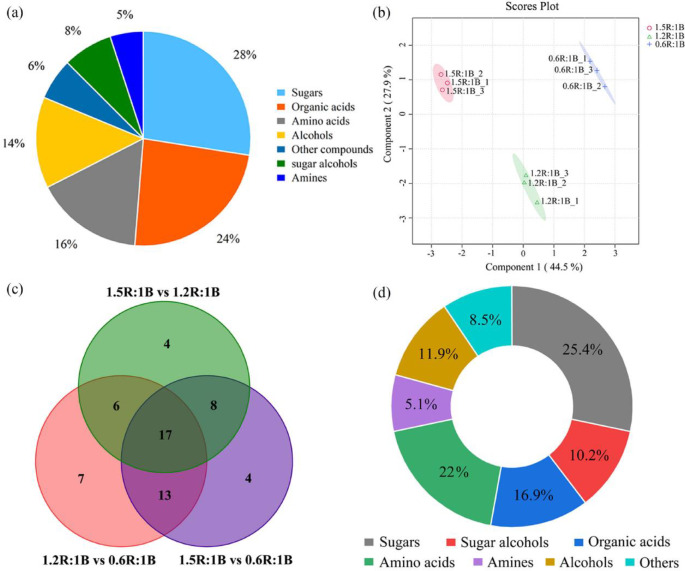
Light is crucial for understory sapling regeneration, and understanding leaf functional traits (LFT) is key to saplings' adaptation to different light conditions. Currently, how LFT vary with light quality heterogeneity is not well understood. This study aims to assess canopy-induced light heterogeneity and the adaptive strategies of larch saplings to it. The study classified the light environments of larch saplings into three types based on red-to-blue light ratios: 0.6R:1B, 1.2R:1B, and 1.5R:1B. As canopy openness (CO) increases and leaf area index decreases, the proportion of red light in the understory gradually rises. Saplings under the highest CO with a 1.5R:1B had lower leaf area but higher leaf dry matter, starch, carbon, and potassium contents. Metabolite analysis revealed that, under 1.5R:1B light conditions, the upregulation of sucrose synthase (SS) and sucrose-phosphate synthase (SPS) enzyme activities accelerated the consumption of maltose in leaves, led to the accumulation of ribitol and d-glucitol, and increased the levels of organic acids, thereby promoting the accumulation of flavonoids. These findings suggest that 0.6R:1B favors a resource acquisition strategy (rapid growth), while 1.5R:1B leans towards a resource conservation strategy (slow growth). This study provides a new perspective on the effects of light conditions on understory vegetation regeneration.
光照对于林下幼树更新至关重要,了解叶片功能性状(LFT)是幼树适应不同光照条件的关键。目前,人们对LFT如何随光质异质性变化还了解不足。本研究旨在评估树冠引起的光照异质性以及落叶松幼树对其的适应策略。该研究根据红蓝光比例将落叶松幼树的光照环境分为三种类型:0.6R:1B、1.2R:1B和1.5R:1B。随着树冠开阔度(CO)增加和叶面积指数降低,林下红光比例逐渐上升。在CO最高且为1.5R:1B条件下的幼树叶片面积较小,但叶片干物质、淀粉、碳和钾含量较高。代谢物分析表明,在1.5R:1B光照条件下,蔗糖合酶(SS)和蔗糖磷酸合酶(SPS)酶活性上调加速了叶片中麦芽糖的消耗,导致核糖醇和d - 葡萄糖醇积累,并增加了有机酸水平,从而促进了黄酮类化合物的积累。这些发现表明,0.6R:1B有利于资源获取策略(快速生长),而1.5R:1B倾向于资源保守策略(缓慢生长)。本研究为光照条件对林下植被更新的影响提供了新视角。