Righi Ilaria, Fenizia Claudio, Trabattoni Daria, Nosotti Mario, Grisorio Giacomo, Vanetti Claudia, di Tella Sonia, Mocellin Cristina, Fantini Norma, Prati Daniele, Morlacchi Letizia Corinna, Rossetti Valeria, Blasi Francesco, Clerici Mario, Rosso Lorenzo Paolo
Thoracic Surgery and Lung Transplant Unit, Fondazione Istituto di Ricovero e Cura a Carattere Scientifico (IRCCS) Ca' Granda Ospedale Maggiore Policlinico, Milan, Italy.
Department of Pathophysiology and Transplantation, University of Milan, Milan, Italy.
Front Immunol. 2025 May 16;16:1583460. doi: 10.3389/fimmu.2025.1583460. eCollection 2025.
Extracorporeal photopheresis (ECP) is a viable treatment that slows the progression of chronic lung allograft dysfunction. Despite its immunoregulatory potential, data on extracorporeal photopheresis as an induction therapy remain rather limited.
We conducted a pilot randomized controlled study on ECP as induction therapy in cystic fibrosis patients undergoing primary lung transplantation. Primary endpoints included safety, assessed based on the incidence of adverse events, treatment-related toxicity, and procedure-related complication rates; and feasibility, evaluated through the completion rate of scheduled ECP sessions, patient tolerability, and treatment discontinuation rates. Secondary endpoint consisted of an exploratory assessment of efficacy, using a composite measure that included three key components: freedom from biopsy-proven acute rejection within the first 12 months, absence of chronic lung allograft dysfunction at 36 months, and optimal graft function, defined as a predicted forced expiratory volume in the first second ≥ 90% at 36 months. Finally, exploratory endpoints included cell phenotypic and functional analyses, secreted immune protein profiling, and gene expression analysis for mechanistic insights. Patients were randomly assigned to receive either standard immunosuppressive therapy alone or standard therapy plus six sessions of extracorporeal photopheresis, with a follow-up period of 36 months.
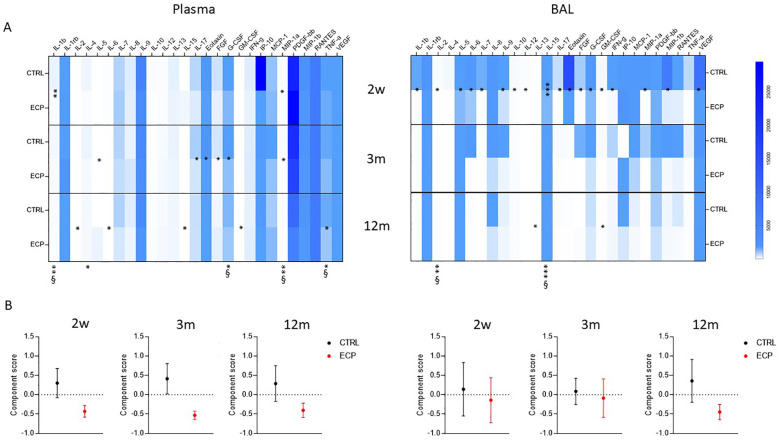
Among 36 cystic fibrosis patients who underwent lung transplantation between 2018 and 2021 and met the eligibility criteria, 21 were randomized (9 to the study group and 12 to the control group). No patients in the treatment group experienced adverse events. The enrollment rate was 61%, and the treatment discontinuation rate was 22%. The clinical composite endpoint was achieved by 28.6% of patients in the treatment group and 16.7% in the control group. Exploratory endpoint analyses revealed significant decreases in pro-inflammatory cytokines, degranulating CD8 T lymphocytes, and NK cells in the treatment group. Moreover, significant increases in Treg lymphocytes, IL-10-producing NK cells, and anti-inflammatory cytokines appeared to be associated with improved pulmonary function in the treatment group.
Induction therapy with extracorporeal photopheresis is safe and feasible in lung transplantation for cystic fibrosis. Some clinical benefits appear to persist for the first 36 months of follow-up. Interestingly, a correlation between immunological modulation induced by extracorporeal photopheresis and pulmonary function was observed.
https://clinicaltrials.gov/study/NCT03500575?cond=NCT03500575&rank=1, identifier NCT03500575.
体外光化学疗法(ECP)是一种可行的治疗方法,可减缓慢性肺移植功能障碍的进展。尽管其具有免疫调节潜力,但关于体外光化学疗法作为诱导疗法的数据仍然相当有限。
我们对接受初次肺移植的囊性纤维化患者进行了一项关于ECP作为诱导疗法的前瞻性随机对照研究。主要终点包括安全性,根据不良事件发生率、治疗相关毒性和手术相关并发症发生率进行评估;以及可行性,通过预定的ECP疗程完成率、患者耐受性和治疗中断率进行评估。次要终点包括对疗效的探索性评估,使用一种综合测量方法,该方法包括三个关键组成部分:在最初12个月内无活检证实的急性排斥反应、36个月时无慢性肺移植功能障碍以及最佳移植功能,定义为36个月时第一秒用力呼气量预测值≥90%。最后,探索性终点包括细胞表型和功能分析、分泌免疫蛋白谱分析以及基因表达分析,以获得机制性见解。患者被随机分配接受单独的标准免疫抑制治疗或标准治疗加六次体外光化学疗法,随访期为36个月。
在2018年至2021年间接受肺移植且符合入选标准的36例囊性纤维化患者中,21例被随机分组(9例进入研究组,12例进入对照组)。治疗组中没有患者发生不良事件。入组率为61%,治疗中断率为22%。治疗组28.6%的患者和对照组16.7%的患者达到了临床综合终点。探索性终点分析显示,治疗组中促炎细胞因子、脱颗粒CD8 T淋巴细胞和NK细胞显著减少。此外,调节性T淋巴细胞、产生IL-10的NK细胞和抗炎细胞因子的显著增加似乎与治疗组肺功能改善有关。
体外光化学疗法诱导治疗在囊性纤维化肺移植中是安全可行的。在随访的前36个月中,一些临床益处似乎持续存在。有趣的是,观察到体外光化学疗法诱导的免疫调节与肺功能之间存在相关性。
https://clinicaltrials.gov/study/NCT03500575?cond=NCT03500575&rank=1,标识符NCT03500575。