Omotayo Abiodun Olusola, Omotoso Abeeb Babatunde, Asong John Awungnjia
Food Security and Focused Area Research Group, Faculty of Natural and Agricultural Sciences, North-West University, Mafikeng, South Africa.
Faculty of Plant and Environmental Sciences, Oyo State College of Agriculture and Technology, Igboora, P.M.B. 10, Nigeria.
Sci Rep. 2025 Jun 3;15(1):19404. doi: 10.1038/s41598-025-03853-4.
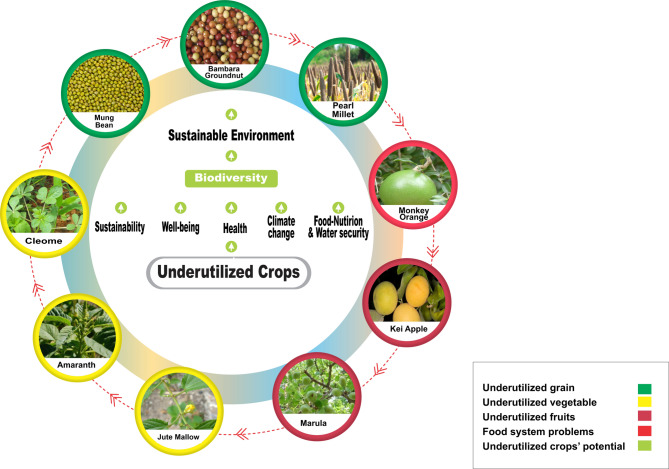
This study aims to integrate underutilized crops (UCs) into the food system to address climate change impacts, and food -water insecurity. UCs have immense potential to mitigate food shortages, yet their role remains largely unexplored in mainstream agricultural and food security strategies. A multidisciplinary approach using social psychology, resource-based theory (RBT), and a new ecological paradigm was used to investigate factors influencing UCs adoption and their potential contribution to water and food insecurity in South Africa. The water poverty index (WPI) and household food insecurity access score (HFIAS) were used to determine the water and food insecurity status of rural households. The study found that UCs cultivation was driven by awareness, access to extension advisory services, and climate information. The findings indicate that adopting UCs significantly improves water and food insecurity in South Africa. Consequently, households that integrated UCs into their farming systems experienced higher WPI scores, reflecting improved water availability and conservation, as UCs require less water than conventional crops. Likewise, lower HFIAS values suggest that UCs enhance food insecurity by diversifying diets, stabilizing food access, and reducing seasonal hunger. Statistically, households in Limpopo, Mpumalanga, and North-West provinces who adopted UCs saw 25.18 (21%), 31.03 (26%), and 28.77 (24%) rise in WPI and HFIAS compared to those who did not embrace UCs, respectively. These results highlight the potential of UCs as climate-resilient crops that mitigate water scarcity and food insecurity, making them a viable strategy for enhancing rural livelihoods amid climate change. Therefore, prioritizing UCs cultivation could build more resilient agricultural systems, address water scarcity and improve food security.
本研究旨在将未充分利用的作物(UCs)纳入粮食系统,以应对气候变化影响以及粮食和水资源不安全问题。UCs在缓解粮食短缺方面具有巨大潜力,但其在主流农业和粮食安全战略中的作用在很大程度上仍未得到探索。本研究采用社会心理学、基于资源的理论(RBT)和新生态范式的多学科方法,调查了影响UCs采用的因素及其对南非水资源和粮食不安全的潜在贡献。用水贫困指数(WPI)和家庭粮食不安全获取得分(HFIAS)来确定农村家庭的水资源和粮食不安全状况。研究发现,UCs的种植受到意识、获得推广咨询服务以及气候信息的驱动。研究结果表明,采用UCs能显著改善南非的水资源和粮食不安全状况。因此,将UCs纳入其耕作系统的家庭的WPI得分更高,这反映出水资源可用性和保护得到改善,因为UCs比传统作物需水量更少。同样,较低的HFIAS值表明,UCs通过使饮食多样化、稳定粮食获取和减少季节性饥饿来缓解粮食不安全状况。从统计数据来看,与未采用UCs的家庭相比,林波波省、姆普马兰加省和西北省采用UCs的家庭的WPI和HFIAS分别提高了25.18(21%)、31.03(26%)和28.77(24%)。这些结果凸显了UCs作为适应气候变化作物的潜力,它们能缓解水资源短缺和粮食不安全状况,使其成为在气候变化背景下改善农村生计的可行战略。因此,优先发展UCs种植可以建立更具韧性的农业系统,解决水资源短缺问题并改善粮食安全。