Mandil Obada, Alrmali Abdusalam, Kalani Khushboo, Ray Bidisha, Ghataliya Parth, Alhazmi Shahad, Levine Robert A, Saleh Muhammad H A, Wang Hom-Lay
Department of Periodontics and Oral Medicine, School of Dentistry, University of Michigan, Ann Arbor, MI, USA.
Department of Periodontics, School of Dental Medicine, Case Western Reserve University, Cleveland, OH, USA.
Clin Oral Investig. 2025 Jun 5;29(6):333. doi: 10.1007/s00784-025-06405-2.
This study aimed to evaluate the long-term effectiveness of single-visit full-mouth non-surgical therapy in managing patients with progressive periodontitis during supportive periodontal therapy (SPT), with tooth loss due to periodontitis (TLP) as the primary outcome. Secondary objectives included assessing changes in probing depth (PD) and identifying risk factors associated with TLP.
A retrospective analysis was conducted using patient records from the University of Michigan School of Dentistry. Included were 283 patients (mean age: 53.2 years) with periodontal breakdown during SPT (PiKS) who underwent single-visit full-mouth ultrasonic instrumentation. The primary outcome was TLP over a mean follow-up of 19.4 years. Secondary outcomes included changes in PD (≥ 5 mm and ≥ 6 mm) and identification of risk factors for tooth loss. Statistical analyses used multilevel binary logistic regression with generalized estimating equations (GEE) and linear regression models.
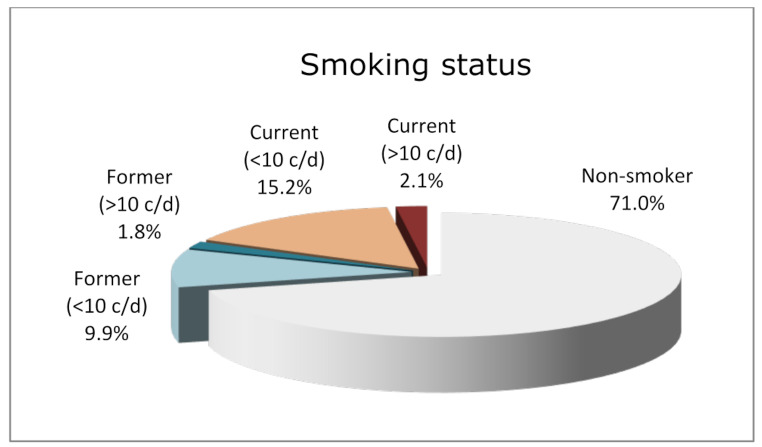
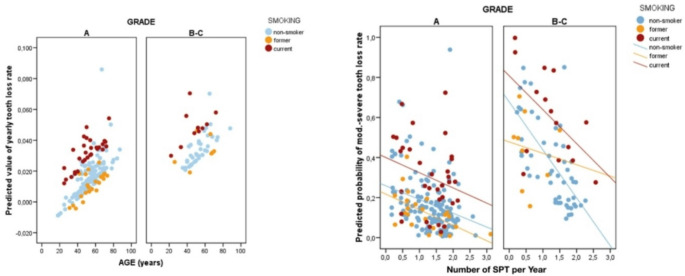
Among 283 patients (mean age: 53.2 years), the mean TLP was 0.9 teeth per patient over a mean follow-up of 19.4 years. Factors significantly associated with TLP included diabetes (OR = 2.41; p = 0.013), current smoking (OR = 2.13; p = 0.025), higher periodontitis Grades B and C (OR = 3.31; p = 0.001), and Stages III-IV (OR = 8.67; p = 0.001). Baseline pocket depths (PD) ≥ 5 mm (OR = 1.13; p = 0.002) and ≥ 6 mm (OR = 1.29; p = 0.001) were also associated with higher TLP. Each additional annual SPT visit reduced the TLP risk by half (OR = 0.50; p = 0.003). PD ≥ 5 mm showed minimal increase change (0.16; p = 0.02), while depths ≥ 6 mm actually decreased (-0.10; p = 0.01).
Single-visit full-mouth non-surgical therapy is effective for long-term management of PiKS, with low tooth loss rates. Diabetes, smoking, advanced periodontitis stage/grade, and deeper baseline pockets are key predictors of TLP. Frequent SPT visits significantly mitigate tooth loss risk.
During (SPT) appointments, prevalent practice involves the full-mouth instrumentation of persistent periodontal pockets to disrupt microbial populations and consequently reduce the inflammatory response responsible for disease progression. This study investigates the efficacy of single-visit full-mouth instrumentation as a potential alternative to standard practices in controlling periodontal disease during SPT, which have potential benefits for patients, including reduced treatment time, improved adherence to maintenance therapy, and comprehensive management of periodontal disease. By minimizing the number of visits, this approach may enhance patient compliance while reducing the risk of reinfection from untreated sites between sessions, ultimately contributing to better long-term periodontal stability. Factors such as deeper baseline probing depths and crucial risk elements for TLP-including diabetes, smoking, and advanced stages (III-IV) and grades (B and C) of periodontitis, can play a role in TLP. Additionally, this study provides valuable insights into the customization of more intensive interventions for patients at higher risk. Our findings highlight the importance of frequent SPT visits, with each additional annual visit halving the risk of TLP. The observed reduction in PD of ≥ 6 mm following treatment indicates the significant potential of comprehensive debridement for enhancing long-term periodontal stability. This evidence supports the implementation of tailored, intensive SPT schedules, particularly for patients identified as having higher risks, thereby contributing to improved clinical outcomes in periodontal disease management.
本研究旨在评估单次全口非手术治疗在支持性牙周治疗(SPT)期间对进展期牙周炎患者的长期疗效,以牙周炎导致的牙齿丧失(TLP)作为主要结局。次要目标包括评估探诊深度(PD)的变化以及确定与TLP相关的危险因素。
使用密歇根大学牙科学院的患者记录进行回顾性分析。纳入283例在SPT期间出现牙周破坏(PiKS)且接受单次全口超声洁治的患者(平均年龄:53.2岁)。主要结局是在平均19.4年的随访期内的TLP。次要结局包括PD(≥5mm和≥6mm)的变化以及牙齿丧失危险因素的识别。统计分析采用广义估计方程(GEE)的多水平二元逻辑回归和线性回归模型。
在283例患者(平均年龄:53.2岁)中,平均随访19.4年期间,每位患者的平均TLP为0.9颗牙。与TLP显著相关的因素包括糖尿病(OR = 2.41;p = 0.013)、当前吸烟(OR = 2.13;p = 0.025)、牙周炎B级和C级较高(OR = 3.31;p = 0.001)以及III-IV期(OR = 8.67;p = 0.001)。基线袋深度(PD)≥5mm(OR = 1.13;p = 0.002)和≥6mm(OR = 1.29;p = 0.001)也与较高的TLP相关。每年额外进行一次SPT就诊可使TLP风险降低一半(OR = 0.50;p = 0.003)。PD≥5mm显示出最小的增加变化(0.16;p = 0.02),而深度≥6mm实际上有所下降(-0.10;p = 0.01)。
单次全口非手术治疗对PiKS的长期管理有效,牙齿丧失率低。糖尿病、吸烟、晚期牙周炎阶段/分级以及更深的基线袋深度是TLP的关键预测因素。频繁进行SPT就诊可显著降低牙齿丧失风险。
在(SPT)就诊期间,普遍的做法是对持续性牙周袋进行全口洁治,以破坏微生物群落,从而减少导致疾病进展的炎症反应。本研究调查了单次全口洁治作为SPT期间控制牙周疾病的标准做法的潜在替代方法的疗效,这对患者可能有潜在益处,包括减少治疗时间、提高对维持治疗的依从性以及牙周疾病的综合管理。通过尽量减少就诊次数,这种方法可能提高患者的依从性,同时降低各疗程之间未治疗部位再次感染的风险,最终有助于实现更好的长期牙周稳定性。诸如更深的基线探诊深度以及TLP的关键危险因素,包括糖尿病