Huang Ao, Guo De-Zhen, Su Zhi-Xi, Zhong Yun-Shi, Liu Liang, Xiong Zhi-Guo, He Dong-Li, Yan Bin, Li Quan-Lin, Feng Zhen, Wang Wen-Quan, Lu Pin-Xiang, He Meng-Jiang, Qi Zhi-Peng, Guo Qi, Cheng Jian-Wen, Zhang Shi-Yu, Guo Wei, Li Qing, Lin Guo-Yong, Sun Hui-Chuan, Qiu Shuang-Jian, He Qi-Ye, Fan Jia, Goel Ajay, Liu Rui, Jin Gang, Yang Xin-Rong, Zhou Jian
Department of Hepatobiliary Surgery and Liver Transplantation, Liver Cancer Institute, Zhongshan Hospital, and Key Laboratory of Carcinogenesis and Cancer Invasion of Ministry of Education, Fudan University, Shanghai, 200032, China.
Singlera Genomics (Shanghai) Ltd., Shanghai, 201203, China.
Mol Cancer. 2025 Jun 5;24(1):163. doi: 10.1186/s12943-025-02367-x.
Gastrointestinal (GI) cancers are among the most prevalent and lethal malignancies worldwide. Early, non-invasive detection is essential for timely intervention and improved survival. To address this clinical need, we developed GutSeer, a blood-based assay combining DNA methylation and fragmentomics for multi-GI cancer detection.
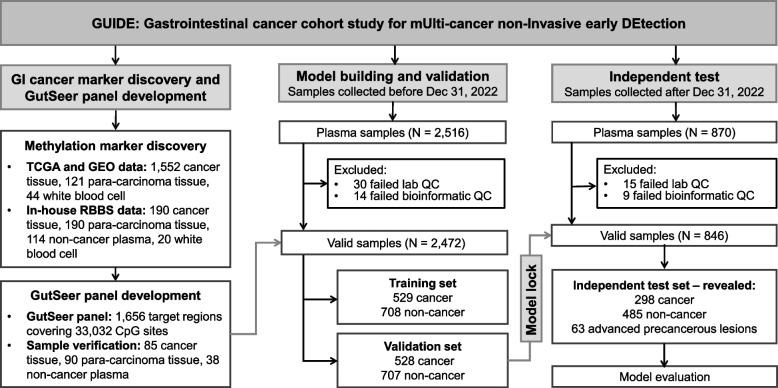
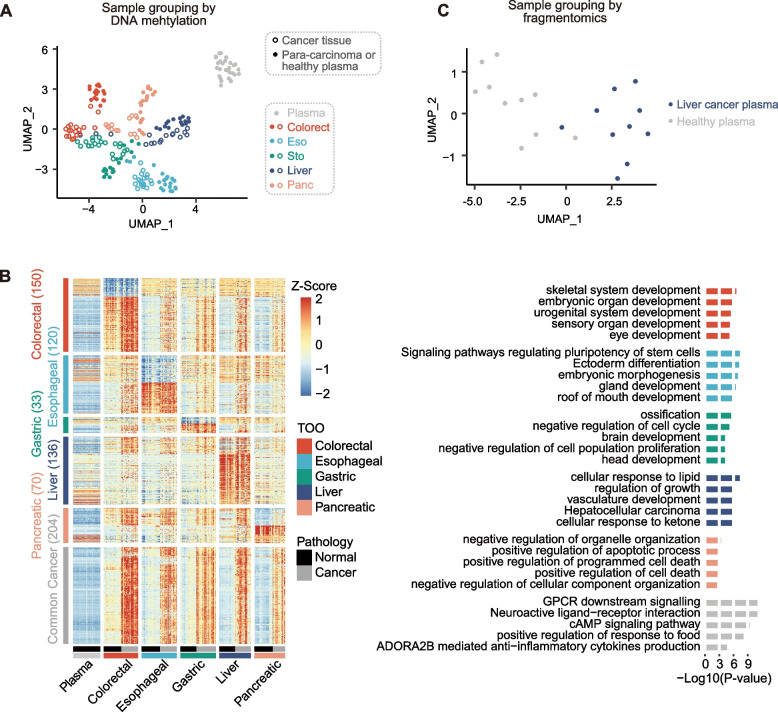
Genome-wide methylome profiling identified 1,656 markers specific to five major GI cancers and their tissue origins. Based on these findings, we designed GutSeer, a targeted bisulfite sequencing panel, which was trained and validated using plasma samples from 1,057 cancer patients and 1,415 non-cancer controls. The locked model was blindly tested in an independent cohort of 846 participants, encompassing both inpatient and outpatient settings across five hospitals.
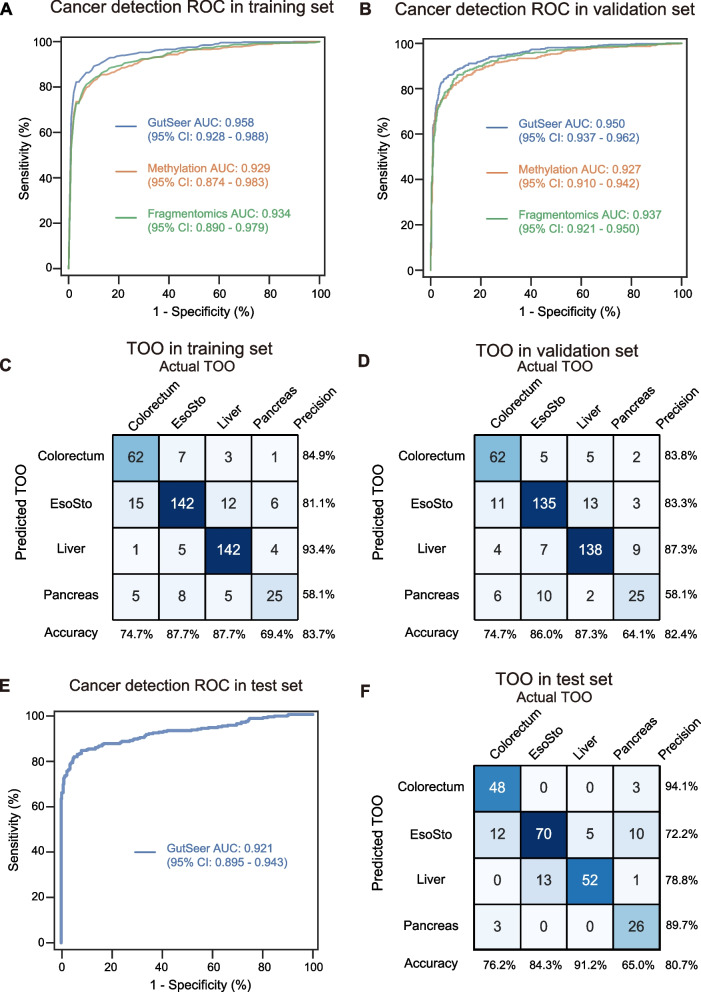
In the validation cohort, GutSeer achieved an area under the curve (AUC) of 0.950 [95% Confidence Interval (CI): 0.937-0.962] for cancer detection, with 82.8% sensitivity (95% CI: 79.5-86.0) and 95.8% specificity (95% CI: 94.3-97.2). It detected 92.2% of colorectal, 75.5% of esophageal, 65.3% of gastric, 92.9% of liver, and 88.6% of pancreatic cancers. The independent test cohort included 198 early-stage cancers (stage I/II, 66.4%) and 63 advanced precancerous lesions. GutSeer maintained robust performance, with 81.5% sensitivity (95% CI: 77.1-85.9) for GI cancers and 94.4% specificity (95% CI: 92.4-96.5). It also demonstrated the ability to detect advanced precancerous lesions in the colorectum, esophagus, and stomach as a single, non-invasive blood test.
By integrating DNA methylation and fragmentomics into a compact panel, GutSeer outperformed genome-wide sequencing in both accuracy and clinical applicability. Its high sensitivity for early-stage GI cancers and practicality as a non-invasive assay highlights its potential to revolutionize early cancer detection and improve patient outcomes.
ClinicalTrials.gov identifier: NCT05431621.
胃肠道(GI)癌症是全球最常见且致命的恶性肿瘤之一。早期的非侵入性检测对于及时干预和提高生存率至关重要。为满足这一临床需求,我们开发了GutSeer,一种基于血液的检测方法,结合了DNA甲基化和片段组学用于多种胃肠道癌症的检测。
全基因组甲基化谱分析确定了1656个特定于五种主要胃肠道癌症及其组织起源的标志物。基于这些发现,我们设计了GutSeer,一个靶向亚硫酸氢盐测序面板,使用来自1057名癌症患者和1415名非癌症对照的血浆样本进行训练和验证。锁定模型在一个由846名参与者组成的独立队列中进行盲测,涵盖了五家医院的住院和门诊患者。
在验证队列中,GutSeer在癌症检测方面的曲线下面积(AUC)为0.950 [95%置信区间(CI):0.937 - 0.962],灵敏度为82.8%(95% CI:79.5 - 86.0),特异性为95.8%(95% CI:94.3 - 97.2)。它检测出92.2%的结直肠癌、75.5%的食管癌、65.3%的胃癌、92.9%的肝癌和88.6%的胰腺癌。独立测试队列包括198例早期癌症(I/II期,66.4%)和63例高级别癌前病变。GutSeer保持了稳健的性能,对胃肠道癌症的灵敏度为81.5%(95% CI:77.1 - 85.9),特异性为94.4%(95% CI:92.4 - 96.5)。它还证明了作为一种单一的非侵入性血液检测能够检测结直肠、食管和胃中的高级别癌前病变。
通过将DNA甲基化和片段组学整合到一个紧凑的面板中,GutSeer在准确性和临床适用性方面均优于全基因组测序。其对早期胃肠道癌症的高灵敏度以及作为非侵入性检测方法的实用性突出了其在革新早期癌症检测和改善患者预后方面的潜力。
ClinicalTrials.gov标识符:NCT05431621。