Li Zhi-Li, Yang Hong-Yu, Lv Xiao-Xiao, Zhang Ya-Kun, Zhu Xin-Yu, Zhang Yu-Rou, Guo Li
Department of Radiology, The Second Affiliated Hospital of Kunming Medical University, 374 Dianmian Avenue, Wuhua District, Kunming, Yunnan, 650101, China.
Department of Radiology, Children's Hospital, Affiliated to Zhejiang University School of Medicine, Hangzhou, Zhejiang, 310003, P.R. China.
BMC Med Imaging. 2025 Jun 5;25(1):206. doi: 10.1186/s12880-025-01697-y.
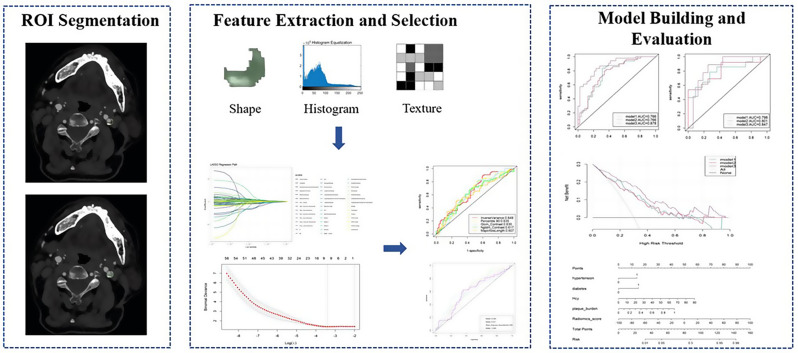
The study explores the value of a model constructed by integrating CTA-based carotid plaque radiomic features, clinical risk factors, and plaque imaging characteristics for prognosticating the risk of ischemic stroke.
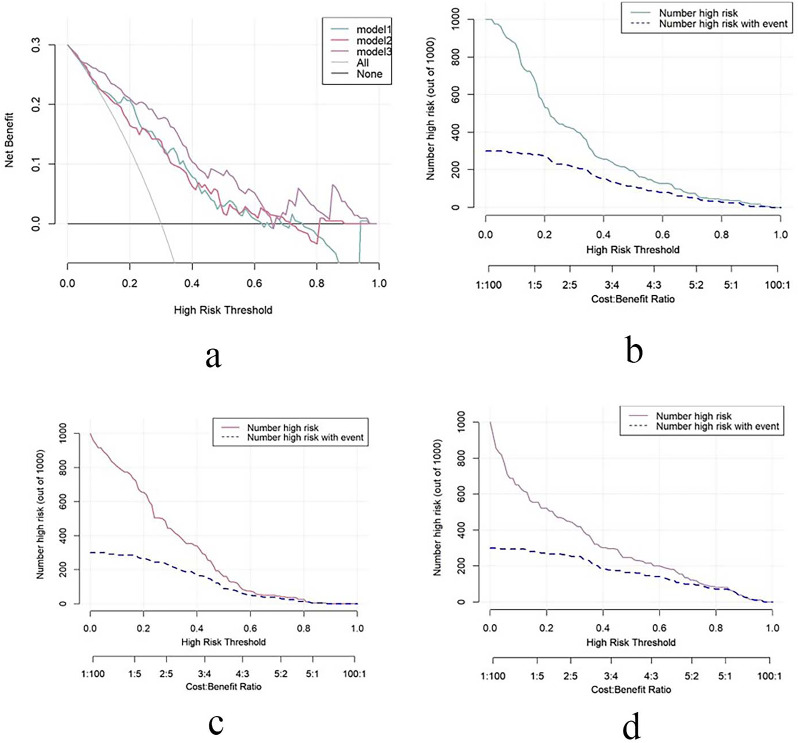
Data from 123 patients with carotid atherosclerosis were analyzed and divided into stroke and asymptomatic groups based on DWI findings. Clinical information was collected, and plaque imaging characteristics were assessed to construct a traditional model. Radiomic features of carotid plaques were extracted using 3D-Slicer software to build a radiomics model. Logistic regression was applied in the training set to establish the traditional model, the radiomics model, and a combined model, which were then tested in the validation set. The prognostic ability of the three models for ischemic stroke was evaluated using ROC curves, while calibration curves, decision curve analysis, and clinical impact curves were used to assess the clinical utility of the models. Differences in AUC values between models were compared using the DeLong test.
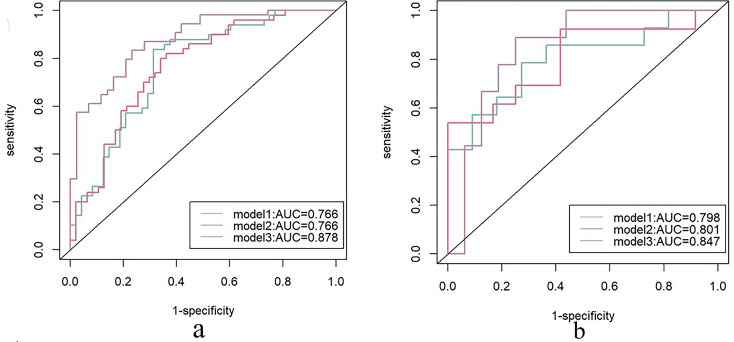
Hypertension, diabetes, elevated homocysteine (Hcy) concentrations, and plaque burden are independent risk factors for ischemic stroke and were used to establish the traditional model. Through Lasso regression, nine optimal features were selected to construct the radiomics model. ROC curve analysis showed that the AUC values of the three Logistic regression models were 0.766, 0.766, and 0.878 in the training set, and 0.798, 0.801, and 0.847 in the validation set. Calibration curves and decision curve analysis showed that the radiomics model and the combined model had higher accuracy and better fit in prognosticating the risk of ischemic stroke.
The radiomics model is slightly better than the traditional model in evaluating the risk of ischemic stroke, while the combined model has the best prognostic performance.
本研究探讨通过整合基于CTA的颈动脉斑块影像组学特征、临床危险因素和斑块影像特征构建的模型对缺血性卒中风险进行预后评估的价值。
分析123例颈动脉粥样硬化患者的数据,并根据DWI结果分为卒中组和无症状组。收集临床信息,评估斑块影像特征以构建传统模型。使用3D-Slicer软件提取颈动脉斑块的影像组学特征以构建影像组学模型。在训练集中应用逻辑回归建立传统模型、影像组学模型和联合模型,然后在验证集中进行测试。使用ROC曲线评估三种模型对缺血性卒中的预后能力,同时使用校准曲线、决策曲线分析和临床影响曲线评估模型的临床实用性。使用DeLong检验比较模型之间AUC值的差异。
高血压、糖尿病、同型半胱氨酸(Hcy)浓度升高和斑块负荷是缺血性卒中的独立危险因素,并用于建立传统模型。通过Lasso回归,选择九个最佳特征构建影像组学模型。ROC曲线分析显示,三个逻辑回归模型在训练集中的AUC值分别为0.766、0.766和0.878,在验证集中分别为0.798、0.801和0.847。校准曲线和决策曲线分析表明,影像组学模型和联合模型在预测缺血性卒中风险方面具有更高的准确性和更好的拟合度。
影像组学模型在评估缺血性卒中风险方面略优于传统模型,而联合模型具有最佳的预后性能。