Dorosti Sara, Shekaari Hemayat, Bagheri Mohammad, Ghaffari Fariba, Mokhtarpour Masumeh
Department of Physical Chemistry, Faculty of Chemistry, University of Tabriz, Tabriz, Iran.
BMC Chem. 2025 Jun 5;19(1):160. doi: 10.1186/s13065-025-01491-5.
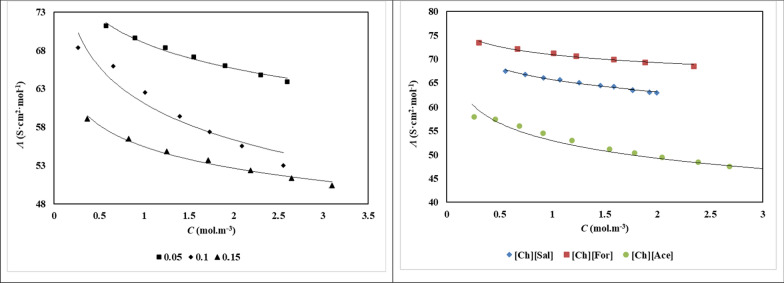
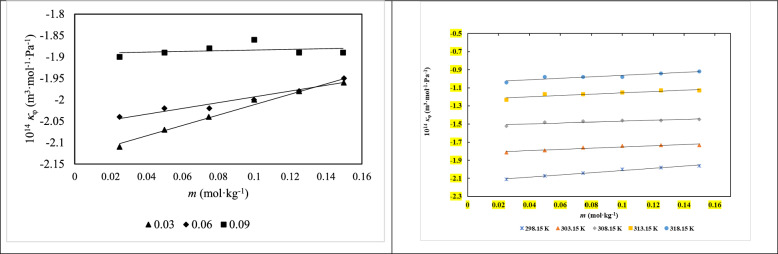
In order to better understand how choline-based ionic liquids can improve the process of converting sugar to bioethanol, our study examined how d-fructose interacted with aqueous solutions of choline salicylate ([Ch][Sal]), choline formate ([Ch][For]), and choline acetate ([Ch][Ace]). A series of measurements including density, speed of sound, viscosity, and electrical conductivity were performed across varying temperatures and concentrations to assess the physicochemical performance of d-fructose in the studied solutions. The obtained properties including apparent molar volume (V), apparent molar isentropic compressibility (κ), viscosity B-coefficients, and molar conductivity (Λ) were analyzed to gain insights into the nature of intermolecular interactions. The calculated standard partial molar volume (V) of d-fructose indicated enhanced interactions between d-fructose and the ionic liquids. Hepler's constant values pointed to a structure-making tendency of d-fructose, particularly in aqueous [Ch][Sal] solutions. To further probe these interactions, DFT-COSMO calculation was employed, revealing that [Ch][Sal] exhibits preferentially the most energetically favorable interactions. Additionally, values of apparent specific volume (ASV) and apparent specific isentropic compressibility (ASIC) suggested that the ILs have a negligible influence on the inherent physical characteristics of d-fructose. As the temprature increased, the hydration number of d-fructose decreased, which can be due to the weakening of hydrogen bonding with water. These results highlight [Ch][Sal] ionic liquid as a promising medium for potentially promoting sugar-to-bioethanol conversion.
为了更好地理解胆碱基离子液体如何改善糖转化为生物乙醇的过程,我们的研究考察了d-果糖与水杨酸胆碱([Ch][Sal])、甲酸胆碱([Ch][For])和乙酸胆碱([Ch][Ace])水溶液之间的相互作用。在不同温度和浓度下进行了一系列测量,包括密度、声速、粘度和电导率,以评估d-果糖在所研究溶液中的物理化学性能。对获得的性质,包括表观摩尔体积(V)、表观摩尔等熵压缩系数(κ)、粘度B系数和摩尔电导率(Λ)进行了分析,以深入了解分子间相互作用的本质。计算得到的d-果糖的标准偏摩尔体积(V)表明d-果糖与离子液体之间的相互作用增强。赫普勒常数的值表明d-果糖具有结构形成倾向,特别是在[Ch][Sal]水溶液中。为了进一步探究这些相互作用,采用了DFT-COSMO计算,结果表明[Ch][Sal]表现出最有利的能量相互作用。此外,表观摩尔比容(ASV)和表观摩尔比等熵压缩系数(ASIC)的值表明离子液体对d-果糖的固有物理特性影响可忽略不计。随着温度升高,d-果糖的水合数减少,这可能是由于与水的氢键减弱所致。这些结果突出了[Ch][Sal]离子液体作为潜在促进糖向生物乙醇转化的有前景的介质。