Huang Lulu, Xiao Yun, Han Xiaoyu, Yu Yang, Zheng Chao, Fang Xiangdong, Li Qing, Liu Fanglan, Xia Chunhua, Zhang Yongjie, He Jiake
Department of Pharmacy, The 2nd affiliated hospital, Jiangxi Medical College, Nanchang University, Nanchang, Jiangxi, China.
Clinical Pharmacology Institute, School of Pharmacy, Jiangxi Medical College, Nanchang University, Nanchang, Jiangxi, China.
Front Pharmacol. 2025 May 22;16:1565713. doi: 10.3389/fphar.2025.1565713. eCollection 2025.
The objective of the study was to investigate whether bupropion (BUP) or its circulation metabolites could decrease plasma level of asymmetric dimethylarginine (ADMA) and ameliorate renal injury by modulation of Ddah1, Oatp4c1, Oct2, and Mate1 in rats with adenine-induced chronic renal injury.
The study initially determined the effect of BUP and its metabolites on cell viability and apoptosis in HK2 cells in the presence and absence of ADMA. Secondly, the study explored whether long-term administration of BUP could reduce the plasma level of ADMA and mitigate renal damage. Thirdly, the expression and activity of Oct2, Ddah1, Mate1 and Oatp4c1 was determined by Western blot and UPLC-MS/MS.
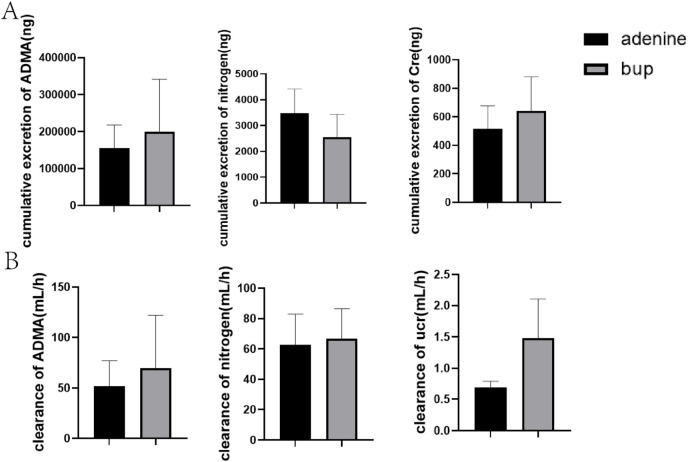
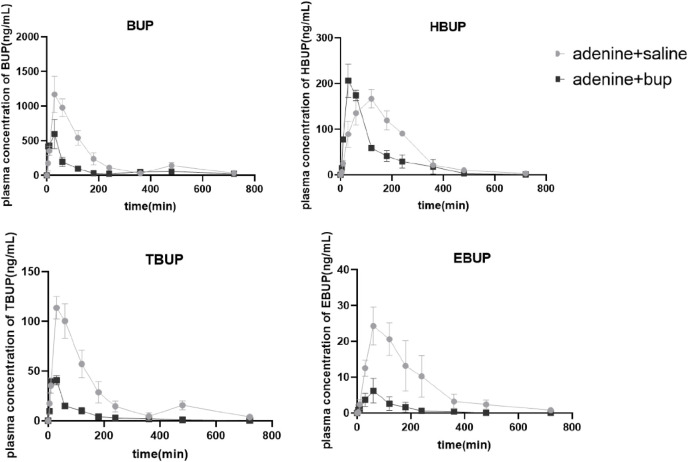
With 0.5 μmol/L ADMA, hydroxybupropion (HBUP, 100 nmol/L), threo-hydrobupropion (TBUP, 10 nmol/L and 1 μmol/L) reduced N-Acetyl-β-D-glucosidase (NAG) level. At 5 μmol/L ADMA, BUP (1 nmol/L-1 μmol/L), HBUP (1-100 nmol/L), and BUP cocktail enhanced survival. At 50 μmol/L ADMA, HBUP (10 nmol/L and 1 μmol/L), TBUP/erythro-hydrobupropion (EBUP) (10-100 nmol/L), and BUP cocktail stimulated survival. EBUP (1 and 100 nmol/L) lowered LDH. BUP (100 nmol/L) and TBUP (1 μmol/L) decreased NAG. TBUP (10 nmol/L, 1 μmol/L) and EBUP (100 nmol/L) inhibited apoptosis. In adenine-induced chronic renal injury rats, long-term administration of BUP significantly decreased the serum concentration of ADMA and creatinine by 12.78% and 38.85%, respectively, ameliorated interstitial lesions and fibrosis and upregulated Ddah1, Oatp4c1, Oct2, Mate1. BUP increased metformin renal clearance without affecting digoxin disposition.
Bupropion moderately decreases plasma levels of ADMA and ameliorates renal injury by modulation of Ddah1, Oatp4c1, Oct2, and Mate1.
本研究旨在探讨安非他酮(BUP)及其循环代谢产物是否能降低不对称二甲基精氨酸(ADMA)的血浆水平,并通过调节腺嘌呤诱导的慢性肾损伤大鼠的Ddah1、Oatp4c1、Oct2和Mate1来改善肾损伤。
本研究首先确定了BUP及其代谢产物在有无ADMA存在的情况下对HK2细胞活力和凋亡的影响。其次,研究了长期给予BUP是否能降低ADMA的血浆水平并减轻肾损伤。第三,通过蛋白质免疫印迹法和超高效液相色谱-串联质谱法测定Oct2、Ddah1、Mate1和Oatp4c1的表达和活性。
在0.5 μmol/L ADMA存在的情况下,羟基安非他酮(HBUP,100 nmol/L)、苏式-羟基安非他酮(TBUP,10 nmol/L和1 μmol/L)降低了N-乙酰-β-D-葡萄糖苷酶(NAG)水平。在5 μmol/L ADMA存在的情况下,BUP(1 nmol/L - 1 μmol/L)、HBUP(1 - 100 nmol/L)和BUP混合物提高了细胞存活率。在50 μmol/L ADMA存在的情况下,HBUP(10 nmol/L和1 μmol/L)、TBUP/赤式-羟基安非他酮(EBUP)(10 - 100 nmol/L)和BUP混合物刺激细胞存活。EBUP(1和100 nmol/L)降低了乳酸脱氢酶(LDH)水平。BUP(100 nmol/L)和TBUP(1 μmol/L)降低了NAG水平。TBUP(10 nmol/L,1 μmol/L)和EBUP(100 nmol/L)抑制了细胞凋亡。在腺嘌呤诱导的慢性肾损伤大鼠中时,长期给予BUP可使ADMA和肌酐的血清浓度分别显著降低12.78%和38.85%,改善间质病变和纤维化,并上调Ddah1、Oatp4c1、Oct2、Mate1。BUP增加了二甲双胍的肾清除率,而不影响地高辛的处置。
安非他酮可适度降低ADMA的血浆水平,并通过调节Ddah1、Oatp4c1、Oct2和Mate1来改善肾损伤。