Yang Huiwen, Yang Linlin, Liu Yingxin, Wang Linlin
Shandong First Medical University, Shandong Academy of Medical Sciences, Jinan, Shandong, People's Republic of China.
Department of Radiation Oncology, Shandong Cancer Hospital and Institute, Shandong First Medical University and Shandong Academy of Medical Sciences, Jinan, Shandong, People's Republic of China.
Biologics. 2025 May 31;19:365-377. doi: 10.2147/BTT.S500470. eCollection 2025.
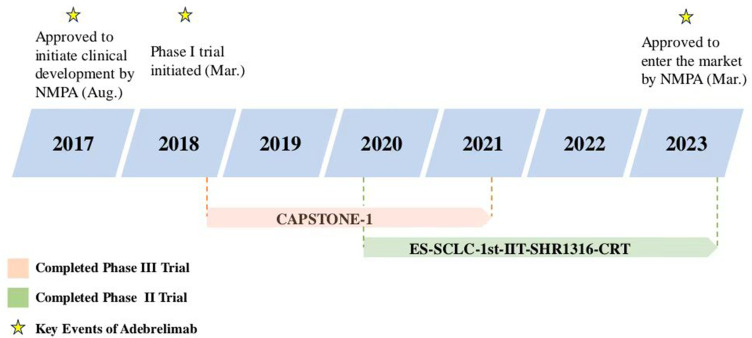
Adebrelimab is a fully humanized monoclonal antibody against programmed cell death-ligand 1 (PD-L1) that has been approved in combination with chemotherapy as the first-line treatment for extensive-stage small cell lung cancer (ES-SCLC). This approval was driven by the landmark CAPSTONE-1 trial, where adebrelimab demonstrated superior survival outcomes: median overall survival (mOS) improved from 12.8 to 15.3 months (HR=0.72, p=0.0017) and 3-year survival rates doubled (21.1% vs 10.5%) compared to chemotherapy alone. Based on this systemic treatment, addition of sequential thoracic radiotherapy achieved unprecedented mOS of 22.9 months in a Phase II trial. In limited-stage small cell lung cancer (LS-SCLC), the initial results of adebrelimab combined with concurrent chemoradiotherapy are promising. Whether in first-line or later-line treatment, there are numerous ongoing clinical trials to explore the potential of the novel adebrelimab-based regimen, and the results are highly anticipated. Despite ongoing efforts to identify biomarkers that may guide treatment decisions, no validated prognostic or predictive biomarkers are currently available for SCLC. This review summarizes the present role of adebrelimab in SCLC and outlines novel strategies aimed to further improve survival outcome.
阿得贝利单抗是一种针对程序性细胞死亡配体1(PD-L1)的全人源化单克隆抗体,已被批准与化疗联合用于广泛期小细胞肺癌(ES-SCLC)的一线治疗。这一批准是由具有里程碑意义的CAPSTONE-1试验推动的,在该试验中,阿得贝利单抗显示出卓越的生存结果:中位总生存期(mOS)从12.8个月提高到15.3个月(HR=0.72,p=0.0017),3年生存率翻倍(21.1%对10.5%),与单纯化疗相比。基于这种全身治疗,在一项II期试验中,序贯胸部放疗使mOS达到了前所未有的22.9个月。在局限期小细胞肺癌(LS-SCLC)中,阿得贝利单抗联合同步放化疗的初步结果很有前景。无论是一线还是后线治疗,都有许多正在进行的临床试验来探索基于阿得贝利单抗的新方案的潜力,结果备受期待。尽管一直在努力寻找可能指导治疗决策的生物标志物,但目前小细胞肺癌尚无经过验证的预后或预测生物标志物。本综述总结了阿得贝利单抗在小细胞肺癌中的当前作用,并概述了旨在进一步改善生存结果的新策略。