Pozzi Alessandro, Arcuri Lorenzo, Carosi Paolo, Laureti Andrea, Londono Jimmy, Wang Hom-Lay
Department of Clinical Science and Translational Medicine, University of Rome Tor Vergata, Rome, Italy.
Department of Periodontics & Oral Medicine, University of Michigan School of Dentistry, Ann Arbor, Michigan, USA.
Clin Implant Dent Relat Res. 2025 Jun;27(3):e70059. doi: 10.1111/cid.70059.
The application of digital impressions for complete-arch implant supported fixed dental prostheses (FDP) remains controversial, and data from a systematic review with meta-analysis comparing intraoral scanning (IOS) and stereophotogrammetry (SPG) remain limited.
To evaluate and compare the accuracy of currently available digital technologies, specifically IOS and SPG, in capturing complete-arch implant impressions.
An electronic and manual search was conducted on May 4, 2024, across PubMed, Embase, and Cochrane CENTRAL databases following PRISMA guidelines. The search targeted studies (excluding case reports) that assessed the in vivo, in vitro, or ex vivo accuracy of IOS and SPG for complete-arch implant impressions. Two investigators screened eligible studies using the QUADAS-2 tool. Accuracy was the primary outcome, including linear, angular, surface deviations, and inter-implant distance. Three meta-analyses were performed on angular deviations, trueness, and surface deviations, trueness, and precision using a random-effect model.
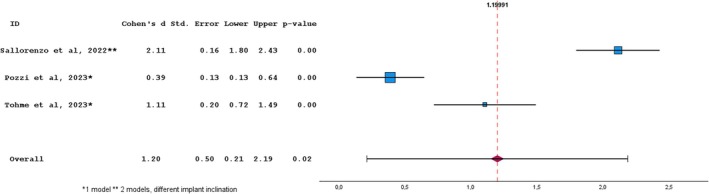
Thirteen studies (3 in vivo and 10 in vitro) met inclusion criteria, displaying methodological heterogeneity (8 analyzing surface, 3 linear, 8 angular, and 3 interimplant distance deviations). The studies evaluated seven IOS (Aoralscan 3, Carestream 3600, iTero Element 2, iTero Element 5D, Primescan, Trios 3, and Trios 4) and two SPG devices (PIC and ICam4D). The number of implants ranged from 4 to 8. SPG reported higher accuracy than IOS in 10 of 13 studies. One in vitro study found IOS to have higher trueness but lower precision, another in vitro study found higher accuracy with IOS, and one in vivo study showed comparable trueness. Meta-analyses of in vitro studies revealed significant differences favoring SPG in surface deviation trueness and precision, and angular deviation trueness (p < 0.05), with reported effects of 3.426, 4.893, and 1.199. SPG showed surface trueness and precision, and angular trueness mean ranges 5.18-48.74 and 0.10-5.46 μm, and 0.24°-0.80°, while IOS ranges 14.8-67.72 and 3.90-37.07 μm, and 0.28°-1.74°.
Within study limitations, SPG showed to be a more reliable technology than IOS for complete-arch digital implant impression, exhibiting significantly greater trueness and precision. IOS reported an angular deviation exceeding the 1° threshold required for a passive fit. Further clinical trials are required for conclusive evidence. Until then, a rigid prototype try-in is still recommended.
CRD42024490844.
全牙弓种植体支持的固定义齿(FDP)数字印模的应用仍存在争议,一项比较口内扫描(IOS)和立体摄影测量(SPG)的系统评价及荟萃分析的数据仍然有限。
评估和比较当前可用的数字技术,特别是IOS和SPG,在获取全牙弓种植体印模方面的准确性。
2024年5月4日,按照PRISMA指南,在PubMed、Embase和Cochrane CENTRAL数据库中进行了电子和手动检索。检索目标为评估IOS和SPG在体内、体外或离体条件下获取全牙弓种植体印模准确性的研究(不包括病例报告)。两名研究人员使用QUADAS-2工具筛选符合条件的研究。准确性是主要结果,包括线性、角度、表面偏差和种植体间距离。使用随机效应模型对角度偏差、真实性和表面偏差、真实性和精密度进行了三项荟萃分析。
13项研究(3项体内研究和10项体外研究)符合纳入标准,显示出方法学上的异质性(8项分析表面、3项线性、8项角度和3项种植体间距离偏差)。这些研究评估了7种IOS(Aoralscan 3、Carestream 3600、iTero Element 2、iTero Element 5D、Primescan、Trios 3和Trios 4)和2种SPG设备(PIC和ICam4D)。种植体数量从4个到8个不等。在13项研究中的10项中,SPG的准确性高于IOS。一项体外研究发现IOS的真实性较高但精密度较低,另一项体外研究发现IOS的准确性较高,还有一项体内研究显示真实性相当。体外研究的荟萃分析显示,在表面偏差真实性和精密度以及角度偏差真实性方面,有利于SPG的显著差异(p<0.05),报告的效应分别为3.426、4.893和1.199。SPG显示表面真实性和精密度以及角度真实性的平均范围为5.18 - 48.74和0.10 - 5.46μm,以及0.24° - 0.80°,而IOS的范围为14.8 - 67.72和3.90 - 37.07μm,以及0.28° - 1.74°。
在研究局限性内,对于全牙弓数字种植体印模,SPG显示出比IOS更可靠的技术,表现出显著更高的真实性和精密度。IOS报告的角度偏差超过了被动就位所需的1°阈值。需要进一步的临床试验来获得确凿证据。在此之前,仍建议进行刚性原型试戴。
CRD42024490844。