Zhi Shihan, Gu Wei, Zhou Nan, Liang Lei, Wang Meng, Gao Rui, Yoong Si Qi, Wang Wenru
School of Nursing, Health Science Center, Xi'an Jiaotong University, No.76 Yanta West Road, Xi'an, 710061, Shaanxi, China.
School of Nursing, Shaanxi University of Chinese Medicine, Century Avenue, Chenyangzhai, Qindu District, Xianyang, 712046, Shaanxi, China.
BMC Pregnancy Childbirth. 2025 Jun 7;25(1):662. doi: 10.1186/s12884-025-07757-z.
Pregnancy poses a significant stressor for married couples. Alterations in marital dynamics may affect the marital adjustment of both parties, particularly in the third trimester of pregnancy. Self-esteem serves as a protective factor for marital adjustment; however, the extent to which dyadic coping strategies, which are jointly enacted by both partners, contribute to this process remains unexplored. Therefore, the objective of this study was to examine the effect of self-esteem on marital adjustment among couples in the third trimester of pregnancy, while exploring the potential mediating role of dyadic coping in this association.
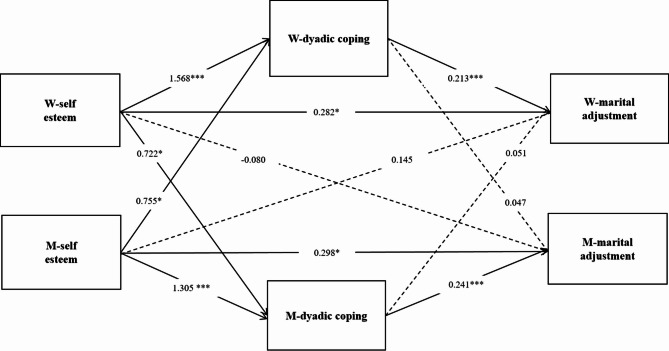
A total of 228 pregnant women and their spouses (n = 456) participated in the study, completing the Rosenberg Self-Esteem Scale, the Dyadic Coping Inventory, and the Revised Dyadic Adjustment Scale independently. The actor-partner interdependence mediation model was used to examine the associations between these three variables within the dyad.
Regarding the intra-individual aspect, a direct effect of self-esteem on marital adjustment (β = 0.282, P = 0.027 for women and β = 0.298, P = 0.014 for men) and an indirect effect of self-esteem on marital adjustment through dyadic coping (β = 0.334, 95% CI = 0.183, 0.526 for women and β = 0.315, 95% CI = 0.165, 0.510 for men) were found. As for the inter-individual aspect, an indirect effect was found, with actors' self-esteem being associated with partners' marital adjustment through partners' dyadic coping (β = 0.174, 95% CI = 0.043, 0.350 for women and β = 0.161, 95% CI = 0.048, 0.327 for men).
These findings highlight the importance of assessing the dyadic coping strategies of couples during late pregnancy to regulate the effect of self-esteem on marital adjustment and targeting them in the couple-based psychological support offered to couples to improve their dyadic coping and, consequently, their marital adjustment.
怀孕对已婚夫妇来说是一个重大压力源。婚姻动态的改变可能会影响双方的婚姻调适,尤其是在怀孕晚期。自尊是婚姻调适的一个保护因素;然而,夫妻双方共同采用的二元应对策略在这一过程中的作用程度仍未得到探索。因此,本研究的目的是探讨自尊对怀孕晚期夫妻婚姻调适的影响,同时探究二元应对在这种关联中的潜在中介作用。
共有228名孕妇及其配偶(n = 456)参与了本研究,他们分别独立完成了罗森伯格自尊量表、二元应对量表和修订后的二元调适量表。采用actor-partner相互依赖中介模型来检验二元组中这三个变量之间的关联。
在个体内部方面,发现自尊对婚姻调适有直接效应(女性β = 0.282,P = 0.027;男性β = 0.298,P = 0.014),自尊通过二元应对对婚姻调适有间接效应(女性β = 0.334,95%CI = 0.183,0.526;男性β = 0.315,95%CI = 0.165,0.510)。在个体之间方面,发现有间接效应,即行为者的自尊通过伴侣的二元应对与伴侣的婚姻调适相关(女性β = 0.174,95%CI = 0.043,0.350;男性β = 0.161,95%CI = 0.048,0.327)。
这些发现凸显了评估怀孕后期夫妻二元应对策略的重要性,以调节自尊对婚姻调适的影响,并在为夫妻提供的基于夫妻关系的心理支持中针对这些策略,以改善他们的二元应对,从而改善他们的婚姻调适。