Han Yoo Min, Choi Ji Min, Rhee Tae-Min, Choi Su-Yeon, Lee Heesun
Division of Gastroenterology, Department of Internal Medicine, Seoul National University Hospital Healthcare System Gangnam Centre, Seoul, Republic of Korea.
Division of Cardiology, Department of Internal Medicine, Seoul National University Hospital Healthcare System Gangnam Centre, Seoul, Republic of Korea.
Clin Hypertens. 2025 Jun 1;31:e22. doi: 10.5646/ch.2025.31.e22. eCollection 2025.
Renin-angiotensin system (RAS) inhibitors have shown potential chemopreventive effects against colorectal cancer (CRC). However, little is known about the impact of RAS inhibitors on the risk of colorectal precancerous lesions.
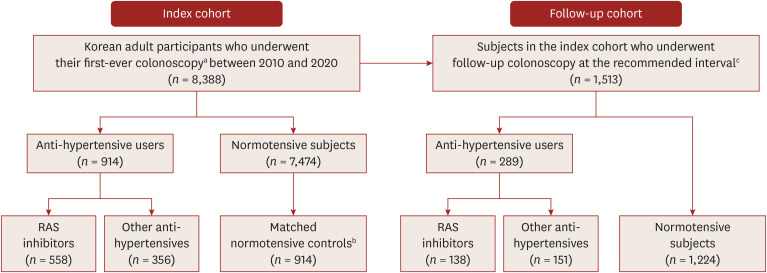
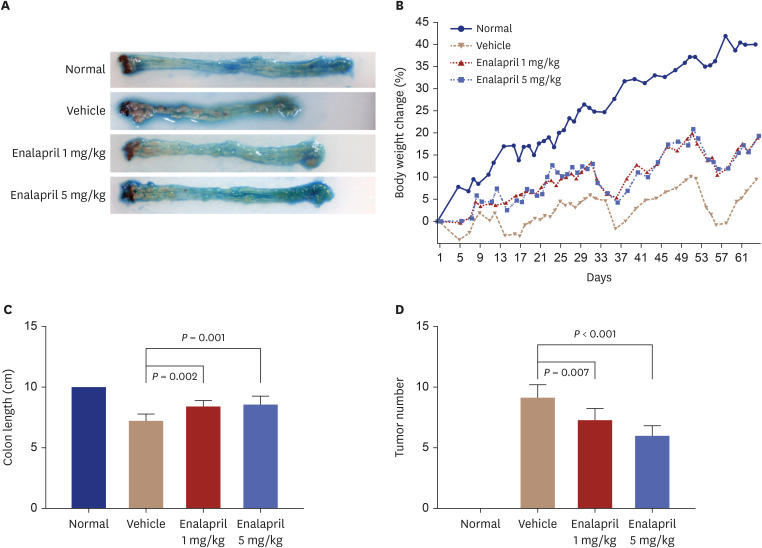
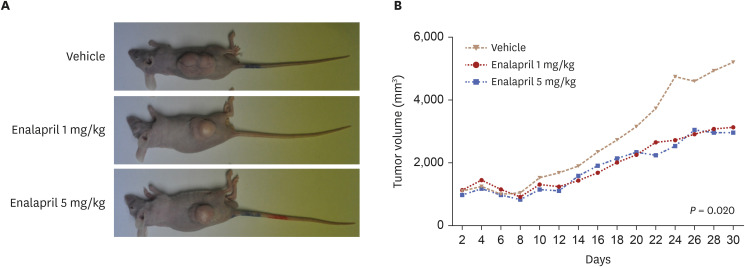
Preclinically, we established mouse models of colitis-associated colon cancer and xenografts: vehicle, 1 mg/kg, 5 mg/kg enalapril groups. Body weight, colon length, and colorectal tumor size were evaluated on the euthanization day. Clinically, we retrospectively recruited 8,388 asymptomatic adults undergoing their first-ever colonoscopy for health check-ups (index cohort). From the index cohort, we selected individuals undergoing follow-up colonoscopy (follow-up cohort). The study outcome was incidental and recurrent colorectal neoplasms, including CRC. We evaluated the prevalence and risk of colorectal neoplasms associated with RAS inhibitor use of ≥ 1 year.
In the experimental study, enalapril administration significantly attenuated weight loss and colon shortening, reduced tumor numbers in colitis-associated colon cancer models, and decreased tumor volume in the xenografts. In the index cohort, while the initial analysis showed a positive association with the RAS inhibitor use (unadjusted odds ratio [OR], 1.22), this shifted toward an inverse trend after adjusting for confounders (adjusted OR, 0.91). During follow-up (median, 41.0 months), incidental and recurrent colorectal neoplasms were less common in the RAS inhibitor group (32.6%) than in the other anti-hypertensives group (39.1%) ( < 0.001), despite similar intervals between the index and follow-up endoscopies. In the follow-up cohort, hypertension itself was a risk factor for colorectal neoplasm development (adjusted hazard ratio [HR], 1.70; 95% confidence interval [CI], 1.00-2.53; = 0.049), whereas RAS inhibitor use was significantly associated with a 27% lower risk (adjusted HR, 0.73; 95% CI, 0.59-0.95; = 0.035).
Long-term, regular use of RAS inhibitors independently reduces the risk of colorectal neoplasms, irrespective of dosage or drug type. Given their potential chemopreventive effects on colorectal neoplasms, RAS inhibitors may serve as a preventive strategy starting from the precancerous stage.
肾素-血管紧张素系统(RAS)抑制剂已显示出对结直肠癌(CRC)的潜在化学预防作用。然而,关于RAS抑制剂对结直肠前体病变风险的影响知之甚少。
临床前,我们建立了结肠炎相关结肠癌和异种移植的小鼠模型:赋形剂组、1mg/kg依那普利组、5mg/kg依那普利组。在安乐死日评估体重、结肠长度和结直肠肿瘤大小。临床上,我们回顾性招募了8388名首次因健康检查接受结肠镜检查的无症状成年人(索引队列)。从索引队列中,我们选择接受随访结肠镜检查的个体(随访队列)。研究结果是偶发性和复发性结直肠肿瘤,包括CRC。我们评估了使用RAS抑制剂≥1年与结直肠肿瘤的患病率和风险。
在实验研究中,依那普利给药显著减轻体重减轻和结肠缩短,减少结肠炎相关结肠癌模型中的肿瘤数量,并减小异种移植中的肿瘤体积。在索引队列中,虽然初步分析显示与使用RAS抑制剂呈正相关(未调整优势比[OR],1.22),但在调整混杂因素后这一趋势转向相反方向(调整后OR,0.91)。在随访期间(中位时间,41.0个月),RAS抑制剂组的偶发性和复发性结直肠肿瘤(32.6%)比其他抗高血压药物组(39.1%)少见(<0.001),尽管索引和随访内镜检查之间的间隔相似。在随访队列中,高血压本身是结直肠肿瘤发生的危险因素(调整后风险比[HR],1.70;95%置信区间[CI],1.00-2.53;P=0.049),而使用RAS抑制剂与风险显著降低27%相关(调整后HR,0.73;95%CI,0.59-0.95;P=0.035)。
长期、规律使用RAS抑制剂可独立降低结直肠肿瘤的风险,与剂量或药物类型无关。鉴于其对结直肠肿瘤的潜在化学预防作用,RAS抑制剂可作为从癌前阶段开始的预防策略。