Stępiński Mateusz J, Banaszewski Jacek
Department of Laryngology with Maxillofacial Surgery Subdepartment, Multidisciplinary Regional Hospital, Gorzow Wielkopolski, Poland.
Department of Otolaryngology and Laryngological Oncology, Poznan University of Medical Sciences, Poznan, Poland.
Ann Med Surg (Lond). 2025 May 12;87(6):3082-3096. doi: 10.1097/MS9.0000000000003223. eCollection 2025 Jun.
Intranasal adhesions (synechiae) are common complications of nasal surgery. This study aimed to analyze the factors influencing the development of synechiae, with particular emphasis on the use of nasal septal splints. We also propose a solution to reduce the incidence of this complication in the future.
This retrospective analysis of patients ( = 243) who underwent septoplasty and septoconchoplasty between 2017 and 2022.
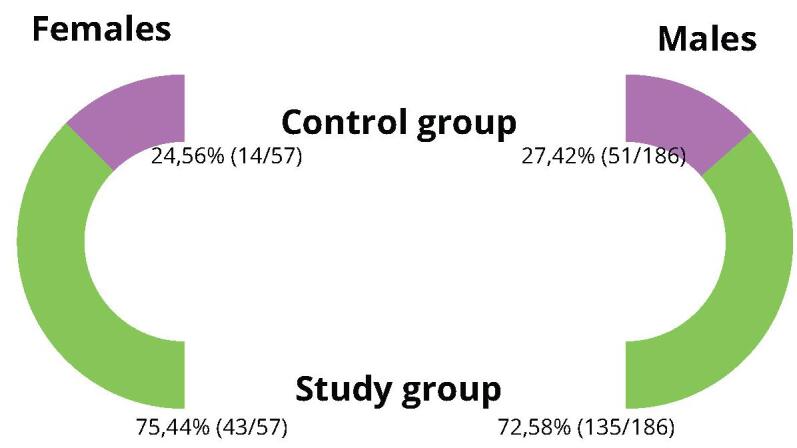
Iatrogenic intranasal synechiae occurred in 26.75% (65/243) of patients. Among patients who received nasal septal splints, synechiae occurred in 13.1%. Synechiae complicated 46.9% of the surgeries in the group without separators ( < 0.001). There was no statistically significant relationship between increased risk of synechiae and concomitant conchoplasty (26% vs. 27.7%, = 0.817). Patients with seton gauze dressings experienced synechiae significantly more often than those with nasal tampons or other gauze dressings ( < 0.001).
The use of nasal septal separators and tampons significantly reduces the risk of iatrogenic intranasal synechiae following septoplasty or septoconchoplasty, regardless of the degree of nasal septum deviation. Conversely, the use of seton gauze dressings is associated with a higher risk of developing synechiae.
鼻内粘连是鼻部手术常见的并发症。本研究旨在分析影响粘连形成的因素,尤其着重于鼻中隔夹板的使用。我们还提出了一种未来降低该并发症发生率的解决方案。
对2017年至2022年间接受鼻中隔成形术和鼻中隔鼻甲成形术的患者(n = 243)进行回顾性分析。
医源性鼻内粘连发生在26.75%(65/243)的患者中。在接受鼻中隔夹板的患者中,粘连发生率为13.1%。在没有分离器的组中,46.9%的手术出现粘连(P < 0.001)。粘连风险增加与同期鼻甲成形术之间无统计学显著关系(26%对27.7%,P = 0.817)。使用丝线纱布敷料的患者比使用鼻腔填塞物或其他纱布敷料的患者粘连发生率明显更高(P < 0.001)。
无论鼻中隔偏曲程度如何,使用鼻中隔分离器和填塞物可显著降低鼻中隔成形术或鼻中隔鼻甲成形术后医源性鼻内粘连的风险。相反,使用丝线纱布敷料与粘连发生风险较高相关。