Nguyen Khanh P, Gruber Joshua B, Mertzel Megan L, Madison Cecelia, Thompson Reid, Gundle Kenneth, Damrauer Scott, Sanfilippo Kristen M
Research & Development, Portland Veterans Administration Health Care System, Portland, Oregon, USA.
Department of Vascular Surgery, Oregon Health and Science University, Portland, Oregon, USA.
Res Pract Thromb Haemost. 2025 May 17;9(4):102855. doi: 10.1016/j.rpth.2025.102855. eCollection 2025 May.
Patients who undergo below-knee surgical amputation (BKA) are at risk of postoperative venous thromboembolism (VTE). Limited prior studies quantified the rate of VTE post-BKA or the association of VTE with survival in this population.
We aimed to assess the incidence of post-BKA VTE and the association with all-cause mortality in a cohort of United States veterans.
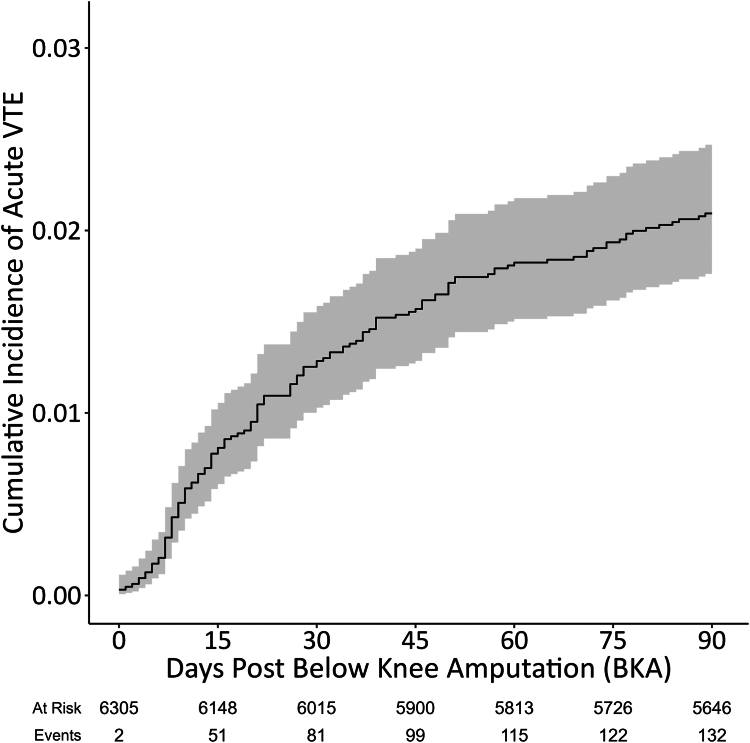
This was a retrospective cohort study of veterans who underwent surgical BKA between October 2016 and January 2023. We identified VTE within 90 days post-BKA using a previously validated algorithm combining International Classification of Diseases codes with a new anticoagulant prescription, placement of an inferior vena cava filter, or death within 30 days. A time-dependent Cox proportional hazard model tested the association between VTE and death while adjusting for potential confounders. A sensitivity analysis removed individuals categorized as having an acute VTE based on the International Classification of Diseases for VTE plus death within 30 days.
A total of 6305 patients underwent a first-time surgical BKA. Of these, 132 experienced a VTE within 90 days post-BKA. Younger age was associated with a reduced risk of post-BKA VTE. After adjusting for confounders, VTE within 90 days of BKA was associated with a 3-fold increase in mortality (adjusted hazard ratio, 3.17, 95% CI, 2.12-4.17).
Patients who had a VTE within 90 days of BKA had a higher mortality than those without VTE post-BKA. Future studies are warranted to confirm these findings and investigate strategies to prevent post-BKA VTE.
接受膝下手术截肢(BKA)的患者有术后静脉血栓栓塞(VTE)的风险。既往有限的研究对BKA术后VTE的发生率或该人群中VTE与生存率的关联进行了量化。
我们旨在评估美国退伍军人队列中BKA术后VTE的发生率及其与全因死亡率的关联。
这是一项对2016年10月至2023年1月期间接受手术BKA的退伍军人进行的回顾性队列研究。我们使用一种先前验证的算法,结合国际疾病分类代码与新的抗凝处方、下腔静脉滤器置入或30天内死亡情况,在BKA术后90天内识别VTE。一个时间依赖性Cox比例风险模型在调整潜在混杂因素的同时测试了VTE与死亡之间的关联。一项敏感性分析排除了根据国际疾病分类中VTE分类以及30天内死亡而被归类为患有急性VTE的个体。
共有6305例患者接受了首次手术BKA。其中,132例在BKA术后90天内发生了VTE。年龄较小与BKA术后VTE风险降低相关。在调整混杂因素后,BKA术后90天内的VTE与死亡率增加3倍相关(调整后风险比,3.17,95%CI,2.12 - 4.17)。
BKA术后90天内发生VTE的患者比未发生VTE的患者死亡率更高。未来有必要进行研究以证实这些发现并调查预防BKA术后VTE的策略。