Panzacchi Simona, Tibaldi Eva, De Angelis Luana, Falcioni Laura, Giovannini Rita, Gnudi Federica, Iuliani Martina, Manservigi Marco, Manservisi Fabiana, Manzoli Isabella, Menghetti Ilaria, Montella Rita, Noferini Roberta, Sgargi Daria, Strollo Valentina, Truzzi Francesca, Antoniou Michael N, Chen Jia, Dinelli Giovanni, Lorenzetti Stefano, Mantovani Alberto, Mesnage Robin, Perry Melissa J, Vornoli Andrea, Landrigan Philip J, Belpoggi Fiorella, Mandrioli Daniele
Cesare Maltoni Cancer Research Center, Ramazzini Institute, Via Saliceto, 3, Bentivoglio, Bologna, 40010, Italy.
Department of Agricultural and Food Sciences, Alma Mater Studiorum-University of Bologna, Bologna, Italy.
Environ Health. 2025 Jun 10;24(1):36. doi: 10.1186/s12940-025-01187-2.
Glyphosate-based herbicides (GBHs) are the world's most widely used weed control agents. Public health concerns have increased since the International Agency for Research on Cancer (IARC) classified glyphosate as a probable human carcinogen in 2015. To further investigate the health effects of glyphosate and GBHs, the Ramazzini Institute launched the Global Glyphosate Study (GGS), which is designed to test a wide range of toxicological outcomes. Reported here are the results of the carcinogenicity arm of the GGS.
Glyphosate and two GBHs, Roundup Bioflow used in the European Union (EU) and RangerPro used in the U.S., were administered to male and female Sprague-Dawley (SD) rats, beginning at gestational day 6 (via maternal exposure) through 104 weeks of age. Glyphosate was administered through drinking water at three doses: the EU acceptable daily intake (ADI) of 0.5 mg/kg body weight/day, 5 mg/kg body weight/day and the EU no-observed adverse effect level (NOAEL) of 50 mg/kg body weight/day. The two GBH formulations were administered at the same glyphosate-equivalent doses.
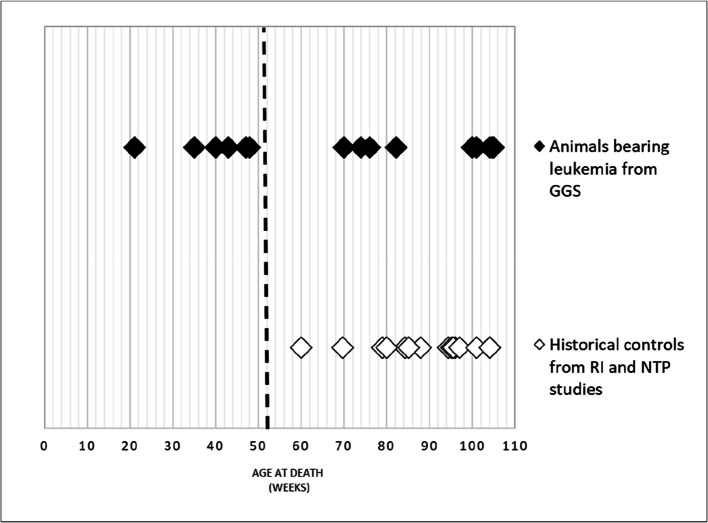
In all 3 treatment groups, statistically significant dose-related increased trends or increased incidences of benign and malignant tumors at multiple anatomic sites were observed compared to historical and concurrent controls. These tumors arose in haemolymphoreticular tissues (leukemia), skin, liver, thyroid, nervous system, ovary, mammary gland, adrenal glands, kidney, urinary bladder, bone, endocrine pancreas, uterus and spleen (hemangiosarcoma). Increased incidences occurred in both sexes. Most of these involved tumors that are rare in SD rats (background incidence < 1%) with 40% of leukemias deaths in the treated groups occurring before 52 weeks of age and increased early deaths were also observed for other solid tumors.
Glyphosate and GBHs at exposure levels corresponding to the EU ADI and the EU NOAEL caused dose-related increases in incidence of multiple benign and malignant tumors in SD rats of both sexes. Early-life onset and mortality were observed for multiple tumors. These results provide robust evidence supporting IARC's conclusion that there is "sufficient evidence of carcinogenicity [of glyphosate] in experimental animals". Furthermore, our data are consistent with epidemiological evidence on the carcinogenicity of glyphosate and GBHs.
草甘膦基除草剂(GBHs)是全球使用最广泛的杂草控制剂。自国际癌症研究机构(IARC)在2015年将草甘膦归类为可能的人类致癌物以来,公众对其健康影响的担忧与日俱增。为了进一步研究草甘膦和GBHs对健康的影响,拉马齐尼研究所发起了全球草甘膦研究(GGS),旨在测试广泛的毒理学结果。本文报告了GGS致癌性研究部分的结果。
将草甘膦以及两种GBHs(欧盟使用的Roundup Bioflow和美国使用的RangerPro)给予雄性和雌性斯普拉格-道利(SD)大鼠,从妊娠第6天开始(通过母体接触)直至104周龄。草甘膦通过饮用水以三种剂量给药:欧盟每日允许摄入量(ADI)0.5毫克/千克体重/天、5毫克/千克体重/天以及欧盟未观察到有害作用水平(NOAEL)50毫克/千克体重/天。两种GBH制剂以与草甘膦等效的相同剂量给药。
与历史对照组和同期对照组相比,在所有3个治疗组中,均观察到多个解剖部位的良性和恶性肿瘤发生率出现具有统计学意义的剂量相关增加趋势或增加。这些肿瘤出现在血液淋巴组织(白血病)、皮肤、肝脏、甲状腺、神经系统、卵巢、乳腺、肾上腺、肾脏、膀胱(血管肉瘤)、骨骼、内分泌胰腺、子宫和脾脏。两性的发生率均有所增加。其中大多数涉及在SD大鼠中罕见的肿瘤(背景发生率<1%),治疗组中40%的白血病死亡发生在52周龄之前,并且其他实体瘤的早期死亡也有所增加。
与欧盟ADI和欧盟NOAEL相对应的暴露水平的草甘膦和GBHs导致两性SD大鼠中多种良性和恶性肿瘤的发生率出现剂量相关增加。观察到多种肿瘤的早期发病和死亡情况。这些结果提供了有力证据,支持IARC的结论,即“有充分证据表明[草甘膦]在实验动物中具有致癌性”。此外,我们的数据与关于草甘膦和GBHs致癌性的流行病学证据一致。